
For Directors of Procurement, VP/Directors of Supply Chain, and Senior Packaging Engineers managing national consumer brands, custom packaging tooling represents a hidden, multi-million-dollar asset portfolio.
When launching or scaling high-volume product lines across mass retail and club channels—such as Walmart, Target, Costco, Sam’s Club, Home Depot, Sephora, Ulta, AutoZone, Petco, and PetSmart—a brand frequently invests tens of thousands to hundreds of thousands of dollars into physical tooling packages:
- Precision flatbed and rotary steel rule cutting dies
- Dynamic upper and lower stripping fixtures
- Dedicated dynamic blanking grids
- Milled steel and Pertinax counterplates
- Multi-level CNC brass embossing and foil stamping dies
- Blister card heat-seal nests and sealing trays
Despite this massive capital outlay, packaging tooling remains one of the most frequently mismanaged, legally ambiguous, and operationally vulnerable asset categories in enterprise supply chains.
The Un-Audited Converter Trap
- ×Amortized in Unit Price: Converter claims legal title; locks brand out of CAD files and physical dies upon re-sourcing.
- ×Unmonitored Blade Wear: Ragged edges, score stiffness variance, and carton dust cause catastrophic line jams at CPOs.
- ×Proprietary Platen Chases: Non-standard dieboard dimensions demand 4-to-6-week re-tooling delays during transfers.
- ×Customs Impoundment: Tooling moved cross-border without IMMEX Pedimento risks severe tax penalties and confiscation.
Enterprise Audited Ecosystem (PM Model)
- ✓100% Capitalized Brand Title: Invoiced as distinct CapEx with unrestricted 24-hr native CAD (.ARD/.DXF) escrow.
- ✓Serialized Asset Tagging: Laser-engraved QR/RFID plates tracking lifetime impression strikes and maintenance logs.
- ✓Bobst Centerline Standard: Universal 1060mm/1450mm chases enabling 15-minute machine hot-swapping between plants.
- ✓Fast-Track IMMEX Clearance: Fully registered temporary import regime with 100% Mexican IVA exemption and 0% USMCA tariffs.
When an enterprise brand attempts to dual-source production, transfer high-volume folding cartons to a nearshore converter, or activate a secondary supplier during a surge or disaster recovery event, systemic tooling governance failures abruptly surface:
- “Hostage Tooling” & Proprietary Lock-In: Converters claim custom cutting dies or CAD dieline geometries are proprietary property, refusing to release physical dies or digital master vector files without exorbitant exit fees.
- Missing Stripping and Blanking Components: The brand pays for what it assumes is a “complete tooling package,” only to discover the incumbent supplier only fabricated a manual cutting dieboard, leaving dynamic high-speed stripping and blanking tooling missing or incompatible with standard converting equipment.
- Severe Unmonitored Mechanical Wear: Dies run past their certified blade-strike lifecycle produce cartons with microscopic burrs, crushed flutes, and variable score stiffness—causing catastrophic jams on high-speed automated cartoning lines (120 to 400+ cartons per minute) at downstream contract packagers (CPOs).
- Cross-Border Customs Non-Compliance: Dies moved between U.S. and Mexican contract manufacturing facilities without proper IMMEX fixed-asset pedimento documentation risk severe customs fines, confiscation, or double taxation.
With over 45 years of specialized packaging engineering, precision die-making expertise, and large-format converting operations, dual-border operations headquartered in San Diego, CA, and advanced manufacturing campuses in Baja California (Tijuana and Mexicali), PM Packaging operates on complete commercial transparency, standardized machine footprints, and rigorous tooling asset governance.
1. The Anatomy of a High-Volume Tooling Suite: What Does a “Complete Tooling Package” Contain?
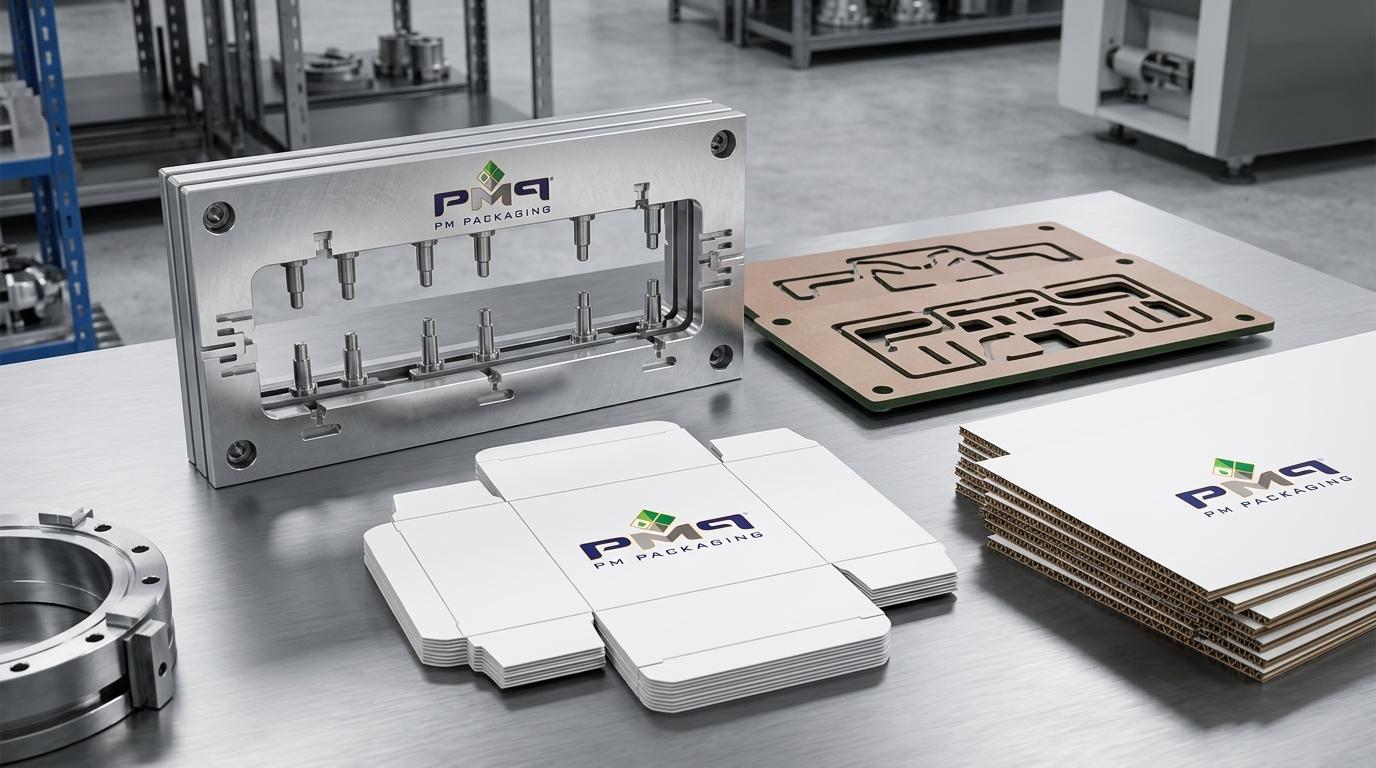
A widespread misconception among non-technical procurement professionals is that a “die” is simply a single piece of wood with embedded steel blades. In modern high-speed converting (running at 6,000 to 10,000 sheets per hour on automated flatbed systems like Bobst or Iberica), cutting a printed sheet into finished blanks requires a fully synchronized multi-station tooling suite.
1. Cutting & Creasing Die
Station 1: DieHigh-density 18mm Finnish birch or dimensionally stable composite base laser-slotted with razor-honed steel rules and elastomeric ejection rubber profiles.
2. Crease Counterplate
Station 2: MatrixPrecision CNC-milled synthetic resin (Pertinax) or 1mm–2mm hardened tool steel plate engraved with microscopic creasing channels.
3. Dynamic Stripping Tool
Station 3: StrippingUpper aluminum frame with mechanical steel pins and claws paired with a lower universal pin grid or dedicated laser baseplate.
4. Dynamic Blanking Tool
Station 4: BlankingUpper aluminum pusher grid and lower high-precision steel cassette matching the exact carton nesting layout.
Component 1: Steel Rule Cutting and Creasing Dieboard
The core dieboard consists of a high-density, multi-ply laser-cut hardwood base (typically 5/8" to 3/4" premium Finnish birch or dimensionally stable composite) into which steel rules are driven:
- Cutting Rules: Hardened steel blades with razor-honed bevels (center bevel for thin paperboard; long bevel or side bevel for thick single-face laminate E/F microflute) that sever board under 300 to 500+ tons of platen pressure.
- Creasing Rules: Rounded, non-cutting steel blades that compress paperboard fibers against the counterplate to establish precise score lines and fold hinges.
- Perforating & Zipper Rules: Intermittent cutting/creasing blades used for retail opening features, tear strips, and tamper-evident security tabs.
- Ejection Rubbering: High-performance elastomeric profiles (open-cell cellular rubber, closed-cell neoprene, and specialized micro-cellular polyurethane) bonded adjacent to cutting rules to push paperboard off blades instantly after impression.
Component 2: Counterplates (Pertinax vs. Milled Steel)
Creasing accuracy depends on the matching counter-matrix beneath the dieboard:
- Phenolic (Pertinax) Counterplates: Precision CNC-milled synthetic resin plates (0.015" to 0.035" thickness) containing microscopic channels aligned with every crease rule. Ideal for short to mid-range production runs (50,000 to 250,000 impressions).
- Milled Steel Counterplates: Hardened 1mm to 2mm steel plates with CNC-engraved crease channels. Mandatory for high-volume enterprise programs (500,000 to 5,000,000+ impressions) where phenolic matrices would wear down, resulting in loss of score definition and carton squaring failure on automated packing lines.
Component 3: Dynamic Stripping Tooling (Upper & Lower)
To maintain press speeds exceeding 7,000 sheets per hour, converters cannot manually strip internal scrap using hand mallets. Upper custom wood or aluminum frames fitted with mechanical steel pins work in tandem with lower pin grids to eject scrap downward onto waste conveyors.
Component 4: Dynamic Blanking & Unit-Separation Tooling
Blanking separates individual carton blanks from master sheets without leaving rough “nicks”. Converters lacking blanking tooling must “breaker-blank” or hand-separate cartons, damaging board edges and introducing carton-to-carton dimensional variance.
Component 5: Specialty Embellishment Tooling
For premium retail packaging (cosmetics, OTC health, consumer electronics, craft spirits), tooling suites include CNC-machined hardened brass multi-level 3D embossing dies with cast epoxy male counters, hot foil stamping brass dies with thermal expansion compensation, and photopolymer spot coating sleeves.
Technical Tooling Asset Matrix
| Tooling Component | Substrate Material | Cost (USD) | Lifecycle (Strikes) | Maintenance Cycle | Failure Mode if Unmaintained |
|---|---|---|---|---|---|
| Laser Steel Rule Dieboard | 18mm Finnish Birch / Hardened Rule | $1,500 – $4,500 | 250k – 1.0M | Re-knife worn rules & replace rubber every 250k | Ragged edges, carton dust, line jams |
| Phenolic Counterplate (Pertinax) | High-Density Laminated Resin | $300 – $800 | 100k – 250k | Replace when channel walls erode 0.003" | Variable crease stiffness; skewed cartons |
| Milled Steel Counterplate | Hardened Tool Steel (55–60 HRC) | $2,500 – $6,000 | 1.0M – 5.0M+ | Ultrasonic clean & channel mic check every 500k | Score fracture; board cracking along fold |
| Dynamic Stripping Tool (Upper/Lower) | Laser Wood / Aluminum / Steel Pins | $1,200 – $2,800 | 500k – 1.5M | Inspect pin alignment & replace bent claws every 150k | Scrap hangs on blanks; press jamming |
| Dynamic Blanking Grid | Custom CNC Aluminum & Steel | $2,000 – $5,000 | 1.0M – 3.0M | Realize frame tension & inspect pushers every 300k | Crushed blank corners; bundle shingling |
| CNC Multi-Level Brass Embossing Die | Precision Machined Solid Brass | $1,500 – $4,500 | 1.0M – 3.0M | Clean resin buildup; replace epoxy counter every 250k | Dull embossing depth; misregistration |
| Blister Sealing Nests / Trays | CNC Aluminum (6061-T6) / Silicone | $1,800 – $4,000 | 500k – 2.0M | Clean heat platen residue & re-level silicone every 100k | Incomplete seal; retail blister pop-offs |
2. Contractual Ownership, Capitalization, and Legal Protections (The MSA & PO Framework)
The root cause of 90% of packaging supplier disputes during contract transitions is ambiguous contractual language regarding tooling ownership and intellectual property.
Tooling Capitalization: OpEx vs. CapEx Comparison
Evaluating Financial Architecture & Legal Title Protection
Hidden Converter Lock-In
- • Converter absorbs upfront tooling cost and adds +$8.50 per thousand cartons to unit price.
- • In many jurisdictions, tooling paid via unit pricing remains the physical property of the converter.
- × Incumbent refuses to release dies or CAD files without paying huge “buyout fees.”
- × 4-to-8-week delay while new supplier reverse-engineers structural dielines.
- Result: Supply chain paralysis and missed retail on-shelf dates.
PM Packaging Requirement
- • Tooling invoiced as dedicated, itemized CapEx line item on PO-1 (Dieboard, Blanker, Counterplate, CAD).
- • 100% undisputed legal title vests exclusively in the Brand upon payment of tooling invoice.
- ✓ Brand can transfer physical tooling or export CAD escrow files instantly.
- ✓ Zero transition downtime; instant nearshore activation and backup machine routing.
- Result: Complete tooling portability and zero business interruption.
The 5 Golden Clauses for Packaging Tooling in Master Services Agreements (MSAs)
| Clause Name | Procurement Protection & Operational Obligation |
|---|---|
| 1. Unconditional Title & Ownership | Legal title to all tooling, dies, plates, counterplates, stripping fixtures, and blankers vests 100% in Buyer upon payment of the dedicated tooling invoice. |
| 2. Immediate Physical Surrender SLA | Converter agrees to surrender and prepare all Buyer-owned tooling for freight pickup within forty-eight (48) hours of written notice, without liens or fees. |
| 3. CAD & Digital Escrow Obligation | Converter must deliver native vector CAD dieline files (.ard, .cf2, .dxf) and multi-up imposition layout schematics within 24 hours of customer request. |
| 4. Safe Custody, Storage & Insurance | Converter shall store tooling in climate-controlled environments, maintain fire/casualty insurance at full replacement value, and mark dies with Buyer asset tags. |
| 5. Maintenance & Lifecycle Logging | Converter is contractually obligated to maintain strike counters, execute certified re-knifing, and replace ejection rubber at converter’s sole expense. |
Sample Master Services Agreement (MSA) Legal Clauses
Section 8.1 - Tooling, Die, and Intellectual Property Ownership: All tooling, steel rule cutting dies, milled counterplates, stripping units, dynamic blankers, embossing dies, printing plates, and associated manufacturing fixtures purchased by Buyer or fabricated by Supplier for the production of Buyer’s packaging (collectively, “Tooling”) shall immediately become and remain the sole and exclusive personal property of Buyer upon payment of Supplier’s initial tooling invoice. Supplier holds all Tooling solely as a bailee at will.
Section 8.2 - Structural Design and CAD Escrow: All structural dielines, 1-up CAD geometries, multi-up imposition schemes, nestings, and machine-readable data files (including native .ARD, .CF2, and .DXF formats) created for Buyer’s packaging are “works made for hire” owned exclusively by Buyer. Supplier shall maintain an unencrypted digital archive of all CAD files and deliver complete digital packages to Buyer within twenty-four (24) hours of receipt of a written request.
Section 8.3 - Right of Physical Repossession: Upon written demand by Buyer for any reason, Supplier shall immediately make all Tooling available for packaging, crating, and physical pickup by Buyer or its designated freight carrier at Supplier’s loading dock within forty-eight (48) business hours. Supplier expressly waives any right to assert a common law or statutory artisan’s lien, possessory lien, or offset against Buyer-owned Tooling.
3. Physical Tooling Audits: Inspecting Tooling Condition, Storage, and Maintenance on the Factory Floor
A paper contract guarantees ownership, but an on-site physical audit verifies whether the tooling is capable of producing enterprise-grade packaging that runs smoothly on high-speed lines. Packaging engineers and procurement directors must evaluate three physical domains: Asset Identification, Storage Environment, and Mechanical Tooling Wear.
Asset Tagging & Registry
Metal asset tag or laser engraving on birch base with SKU #, die serial #, revision code, and strike counter log.
Vault Climate Control
HVAC humidity regulation (45%–55% RH) and vertical suspension rack storage preventing birch core warping and rule pullout.
Blade & Rubber Metrology
Micrometer blade height inspection, rubber durometer elasticity testing, and crease matrix channel wear verification.
Tooling Storage Environment Audit Standards
| Environmental Parameter | Unacceptable / High-Risk Facility | World-Class Packaging Facility (PM Model) |
|---|---|---|
| Storage Racking Architecture | Flat horizontal piles on floor pallets (causes blade bending) | Vertical suspension rolling rack system with foam spacers |
| Vault Humidity Control | Uncontrolled factory ambient humidity (>65% causes warping) | Automated HVAC maintaining 45% – 55% Relative Humidity |
| Rule Protection Covers | Exposed blades subject to accidental impact | Rigid protective edge-guards on all active dieboards |
| Asset Tracking System | Handwritten grease pencil markings on wood | Laser-engraved tags + Barcode / QR Registry in ERP |
| Preventive Maintenance Frequency | Reactive (repaired only after on-press breakdown) | Scheduled re-ruling every 250k impressions |
Tooling Wear Diagnostic & Failure Analysis
| Visual Symptom | Mechanical Tooling Defect | Impact on Cartoning Line | Corrective Maintenance |
|---|---|---|---|
| “Angel Hairs” & Carton Dust | Dull, rounded cutting rule; excessive platen tonnage | Paperboard dust clogs cartoner optical sensors; suction slip | Re-knife entire cutting perimeter with new steel |
| Variable Opening Force (Stiff Scores) | Worn phenolic counterplate; creasing channel rounded | Cartons fail to square in hopper; jams at 200cpm | Replace Pertinax counter; upgrade to milled steel |
| Board Cracking along Fold Line | Crease rule too high; incorrect rule radius | Carton flaps snap off during automated 90° tuck folding | Reduce crease rule height; calibrate channel width |
| Tearing along Manufacturer’s Tab | Degraded ejection rubber; compressed dead foam | Sheet sticks in die; micro-tears cause glue tab skew | Strip and re-rubber die with micro-cellular profile |
| Flute Crushing (SFL Microflute) | Center-bevel blade used on E/F flute corrugate | SFL box loses 25% BCT top-to-bottom compression strength | Retrofit long-bevel blades; install flute-support rubber |
4. Tooling Portability and Machine Standardization: Ensuring Frictionless Multi-Vendor & Nearshore Transfers
When an enterprise procurement team decides to reallocate packaging volume—whether transitioning from an offshore Asian converter to a nearshore North American facility or activating dual-sourcing across regional plants—the primary obstacle is machine chasing incompatibility.
Bobst Centerline® 1 & 2 Standardization
In high-volume converting, industry-standard flatbed die-cutters utilize standardized sheet formats and chasing systems:
When dies are built using the Bobst Centerline standard, the dieboard, counterplate, stripping frame, and blanker incorporate precision-milled reference notches along the exact X/Y axes—enabling instant hot-swapping between machines in under 15 minutes.
Tooling Transfer Protocol: Step-by-Step Checklist
1Phase 1: Pre-Transfer Digital Audit
- Request native ArtiosCAD (.ARD) 1-up dielines and multi-up sheet layout CF2/DXF files from incumbent.
- Compare digital CAD geometry against current approved packaging dieline revisions.
- Verify total impression strikes from incumbent converter’s maintenance press logs.
2Phase 2: Physical Tooling Receipt & Metrology Inspection
- Unbox and inventory all components: Dieboard, Counterplate, Upper/Lower Stripping Frames, Blanking Grid.
- Measure birch dieboard planarity and moisture content using digital pinless hygrometers.
- Inspect blade sharpness, nick profiles, and rubber durometer under 20x magnification.
- Check Bobst Centerline alignment notches for wear or structural distortion.
3Phase 3: Pilot Qualification Run & First Article Inspection (FAI)
- Mount tooling into standardized Bobst flatbed die-cutter and calibrate platen tonnage.
- Run 500-sheet pilot converting batch across target substrate (18pt SBS, 24pt CCNB, or E-Flute SFL).
- Perform First Article Inspection (FAI): Measure score line stiffness (Taber test), opening force, 90° squareness, and glue tab alignment.
- Ship sample blanks to downstream Contract Packager (CPO) to verify zero jamming on automated cartoning lines.
5. Cross-Border Customs & Tax Compliance for Nearshore Tooling (US-Mexico / IMMEX)
As enterprise brands transition high-volume packaging from Asia to nearshore US-Mexico manufacturing corridors, packaging tooling must frequently cross international borders.
Cross-Border Tooling Movements under the IMMEX Regime
Brand purchases tooling (CapEx line item); title remains with Brand. San Diego CAD Design Center validates dieline and outputs digital master.
Tooling enters Mexico under AF / V1 Pedimento. 100% EXEMPT from 16% Mexican IVA under IMMEX certification; 0% tariffs under USMCA.
Tooling physically tagged with SAT Annex 24 barcodes. Runs high-volume production; finished cartons ground-shipped to U.S. DCs in 1 to 3 days.
Key Cross-Border Compliance Rules for Procurement Teams:
- Commercial Invoice Requirements: Must state “Customer-Owned Tooling for Temporary Importation under IMMEX Program,” HTS Code
8480.60(Molds/Dies for Paperboard) or8207.30(Dies for Stamping), serial number, and declared asset value. - SAT Annex 24 Inventory Registration: All foreign-owned tooling must be registered in the converter’s Annex 24 system and marked with permanent fixed-asset barcodes linking the die to its import pedimento.
- Frictionless Repatriation: Because tooling is legally registered as temporary foreign capital, the brand owner can repatriate dies back to the U.S. at any time without triggering export duties or tax penalties.
6. Shared Tooling Programs vs. Dedicated Tooling: The qikCombo™ Innovation
While dedicated steel rule tooling suites are mandatory for high-volume custom folding cartons (100k to millions of units), certain retail packaging formats allow enterprise procurement teams to eliminate upfront tooling costs entirely through shared production runs.
Custom Cartons & SFL Boxes
- • Volume Profile: 100k – 5M+ Units / Custom Dieline / High-Speed Line
- • Tooling Investment: $3,500 – $12,000 (Dieboard, Steel Counter, Stripping, Blanker)
- • Unit Economics: Lowest possible carton unit cost ($0.08 – $0.22/unit)
- • Best For: National retail rollouts (Walmart, Target, Costco) with high velocity
Blister Cards & Inserts
- • Volume Profile: 5,000 – 100,000 Units / Multi-SKU Portfolios (5 to 20 SKUs)
- • Tooling Investment: $0 UPFRONT TOOLING EXPENSE
- • Turnaround Speed: 10 Business Days from PDF proof to delivery
- • Best For: Fast-turn OTC wellness, hardware, cosmetic carding, and line extensions
Decision Matrix: Dedicated Tooling vs. Shared qikCombo™ vs. Digital Finishing
| Parameter | Dedicated Steel Rule Suite | Shared qikCombo™ Run | Digital CNC / Laser |
|---|---|---|---|
| Target Order Volume | 50,000 to 10,000,000+ Units | 5,000 to 100,000 Units | 500 to 5,000 Units |
| Upfront Tooling Cost | $2,500 – $10,000+ per SKU | $0 (Zero Tooling Fee) | $0 (Zero Tooling Fee) |
| Speed (Sheets/Hr) | 6,000 – 10,000 sheets/hr | 6,000 – 9,000 sheets/hr | 50 – 300 sheets/hr |
| Unit Packaging Cost | Lowest Baseline (100%) | Low to Moderate (110% - 125%) | Very High (250% - 450%) |
| Packaging Styles | Cartons, SFL Microflute, PDQs | Blister Cards, Trap Cards, Inserts | Carton Mockups & Prototypes |
| Automated Cartoner Match | 100% High-Speed Certified | Manual / Semi-Auto Heat Seal | Hand Assembly Only |
| Turnaround Time | 2–3 Weeks (First Run) / Fast Reorders | 10 Business Days | 3 – 5 Days |
7. The Enterprise Packaging Tooling Audit Scorecard
Procurement directors, supply chain managers, and packaging engineers can execute this 10-point quantitative scorecard during quarterly business reviews (QBRs) or supplier qualification audits.
Enterprise Packaging Tooling Audit Scorecard (50 Points Total)
| Ref | Audit Criteria | Verification Standard (Target = 5 Points) | Score |
|---|---|---|---|
| 01 | Contractual Title & PO Status | Tooling invoiced as dedicated CapEx; 100% legal title in Brand’s name with zero amortized lock-in. | [ ] / 5 |
| 02 | Native CAD File Escrow | Unencrypted ArtiosCAD (.ARD) and CF2/DXF vector files archived and delivered to Buyer within 24 hours. | [ ] / 5 |
| 03 | Physical Asset Tagging | Metal asset tag or laser engraving with Brand name, part #, die serial #, and revision code on all die components. | [ ] / 5 |
| 04 | Complete Tooling Suite Verified | Package includes Dieboard, Counterplate, Dynamic Upper/Lower Stripping Tools, and Dynamic Blanker (no missing units). | [ ] / 5 |
| 05 | Counterplate Specification | Phenolic Pertinax (runs <250k) or Milled Hardened Steel (runs >500k) matched to volume and substrate caliper. | [ ] / 5 |
| 06 | Storage Climate Control | Tooling stored in humidity-controlled vault (45-55% RH) on vertical rolling suspension racks (zero floor stacking). | [ ] / 5 |
| 07 | Preventive Maintenance Logging | Verified strike counter logs; certified re-ruling and rubber replacement executed every 250k impressions. | [ ] / 5 |
| 08 | Machine Footprint Portability | Tooling built to Bobst Centerline standard (1060mm/1450mm); universal quick-lock compatibility across converters. | [ ] / 5 |
| 09 | Cross-Border Customs Compliance | Fully registered in IMMEX Annex 24 inventory system with valid Temporary Importation Pedimento and zero tax liens. | [ ] / 5 |
| 10 | Repossession / Surrender SLA | MSA guarantees complete physical tooling crating and dock release within 48 hours of written demand. | [ ] / 5 |
| TOTAL AUDIT SCORE (OUT OF 50): | 45–50 (Enterprise-Ready) | 35–44 (Moderate Risk) | <35 (Critical Vulnerability) | ||
8. The PM Packaging Advantage: Transparent Tooling Governance and High-Volume Scale
For more than 45 years, PM Packaging has served as the trusted high-volume packaging manufacturing partner for Fortune 500 consumer brands, national retailers, and high-growth CPG innovators. We eliminate tooling ambiguity through complete commercial transparency, cutting-edge structural engineering, and mirrored dual-border converting capabilities.
100% Unconditional Brand Ownership & Instant CAD Access
Every tooling package is capitalized, asset-tagged, and owned 100% by the client. Native ArtiosCAD dielines, sheet nesting impositions, and print PDFs are shared freely upon request with zero buyout penalties.
Mirrored Dual-Plant Converting Architecture (San Diego / Baja California)
Advanced converting campuses in Tijuana and Mexicali equipped with matched large-format offset presses and standardized Bobst high-speed flatbed die-cutting platens. Tooling packages hot-swap between plants seamlessly.
Full-Spectrum Substrate & Packaging Capabilities
Folding Cartons (12pt to 32pt SBS, CUK/SUS, CCNB, CRB), Single Face Laminate (SFL) Litho-Laminated E/F/B microflute boxes, Blister Cards via qikCombo™ ($0 tooling), and Luxury Rigid Setup Boxes.
Nearshore Logistics & Fast-Track USMCA / IMMEX Clearance
1-to-3-day ground freight delivery to West Coast and Southwest distribution centers (3-5 days nationwide), eliminating transpacific ocean delays, port congestion, and tariff risks.
Certified G7 Master & ISO 9001:2015 Quality Management
Idealliance G7 Master Printer certification guarantees ΔE ≤ 1.5 color consistency across all manufacturing runs. GMI Certified, SQF food safety compliant, and FSC/SFI chain-of-custody certified.
Partner with PM Packaging for Flawless High-Volume Retail Packaging
Whether auditing an existing packaging tooling portfolio, transitioning production to an agile nearshore manufacturing partner, or engineering a high-volume national retail rollout for mass merchants and club stores, PM Packaging provides the technical precision, legal transparency, and manufacturing scale required to protect brand margins and guarantee on-time delivery.
Schedule Your Packaging Tooling Audit
- Physical Die Inspection: Metrology check on blade planarity, rubber elasticity, and counterplate channel tolerances.
- CAD & Dieline Review: Validate ArtiosCAD geometry against high-speed automated cartoning line specifications.
- Nearshore Portability Roadmap: Establish duty-free IMMEX tooling transfer protocols for US-Mexico production.