
For Directors of Procurement, VP/Directors of Supply Chain, Brand Directors, and Senior Packaging Engineers managing enterprise consumer brands, packaging color consistency is far more than an aesthetic preference—it is a critical commercial asset, a direct driver of on-shelf conversion, and an unforgiving operational gatekeeper across mass retail and club store distribution.
When consumer packaged goods (CPG), consumer electronics, OTC healthcare, beauty, food and beverage, or hardware brands scale across national retail networks—including Walmart, Target, Costco, Sam’s Club, Home Depot, Lowe’s, Sephora, Ulta, AutoZone, Petco, and PetSmart—packaging components are frequently manufactured across multiple production facilities, converted on different high-speed offset lithographic presses, and printed on varied paperboard substrates.
The Ungoverned Multi-Plant Converter Trap
- × Subjective visual swatch matching leads to pressroom density drift.
- × Aging physical drawdowns cause uncalibrated spectrophotometer shifts.
- × Transpacific ocean transit (8–12 wks) degrades coatings and causes UV fading.
- × GMI scorecard rejection (<80 pts), retail DC intake stoppages, and fines.
Enterprise Digital Color Governance (PM Packaging)
- ✓ Centralized PantoneLIVE & CxF/X-4 digital spectral asset escrow.
- ✓ Dual-plant nearshore redundant presses calibrated to G7 Colorspace.
- ✓ Closed-loop inline spectrophotometry with calibrated M1 condition.
- ✓ 100% GMI / G7 Compliance | Lot-to-Lot ΔE00 ≤ 1.5 Target | 1–3 Day Transit.
Without an objective, data-driven color governance architecture, multi-plant packaging programs inevitably suffer from severe visual color drift. When two folding cartons of the same SKU sit side by side on a retail shelf under high-CRI LED lighting, subtle color mismatches (ΔE00 > 2.0) create an immediate consumer perception of product tampering, counterfeit goods, expired inventory, or substandard quality.
Furthermore, major retailers strictly enforce quantitative print quality compliance programs. Failing a Graphic Measures International (GMI) print audit at Target or Walmart can trigger catastrophic operational consequences: mandatory lot rework, distribution center intake rejections, delayed national product rollouts, and costly financial chargebacks.
With over 45 years of specialized packaging engineering, large-format converting excellence, and G7 Master Printer certification, operating dual-border headquarters in San Diego, CA, and advanced manufacturing campuses in Baja California (Tijuana and Mexicali), PM Packaging provides high-volume brand owners with a unified, cross-border color governance framework.
1. The Cost of Visual Drift: Why Packaging Color is a Commercial Supply Chain Gatekeeper
To build an executive business case for multi-plant color governance, procurement and supply chain directors must quantify the direct commercial and operational liabilities of uncontrolled print variation.
1. Retail Compliance & Fines
- • Target / Walmart GMI Fines
- • Rework & Re-Inspection POs
- • Retail DC Intake Stoppages
- • Demerits & Loss of Preferred Vendor Status
2. Brand Equity & Trust
- • Perception of Old or Expired Goods
- • Suspicions of Counterfeit Inventory
- • Consumer Shelf Rebuff / Abandonment
- • Destruction of “Billboard Effect”
3. Supply Chain Disruption
- • Rejected Master Cartons & Skids
- • Co-Packer Line Downtime & False Ejects
- • Emergency Air-Freight Reruns
- • Finished Goods Inventory Write-Downs
1.1 The “Billboard Effect” and Consumer Conversion Psychology
In high-volume retail environments, individual folding cartons and litho-laminated structural packs do not sit in isolation; they are merchandised in dense, continuous rows across 4-foot to 12-foot shelf displays. This collective presentation is known in retail packaging engineering as the “Billboard Effect.”
When primary packaging units are printed across different converting facilities or produced in separate production batches with inconsistent ink densities:
- A secondary spot color (e.g., brand teal or warm corporate red) shifts in hue angle or saturation.
- When stacked side-by-side on the store shelf, the boundary between adjacent cartons creates an irregular checkerboard pattern rather than a seamless brand billboard.
- Consumer eye-tracking studies confirm that visual color inconsistency triggers an immediate subconscious reaction: shoppers perceive the lighter or slightly shifted carton as faded, aged, compromised by UV exposure, or counterfeit, leading to direct conversion drop-offs.
1.2 Retailer Chargebacks and Quality Scorecard Penalties
Mass retailers do not leave print consistency to subjective interpretation. Major retail corporations utilize third-party auditing bodies (such as Graphic Measures International / GMI) to enforce rigorous quality metrics on every folding carton, blister card, and retail display entering their supply chain:
GMI Certification Mandates
Suppliers producing packaging for private-label or direct-import programs at retailers like Target, Walmart, Lowe’s, Home Depot, and Walgreens must utilize certified print facilities that score a minimum of 80 out of 100 points on GMI production audits.
Fail Scorecards (<80 points)
Immediately trigger a “Category 3 Defect” or “Critical Failure.” The packaging converter is placed on corrective action probation, and all production lots are held at the printer or distribution center.
Financial Penalties & Missed Reset Windows
Retailers assess non-compliance chargebacks ranging from $5,000 to $25,000 per violation, in addition to charging the brand for third-party re-testing and mandatory on-site sorting. If promotional packaging lots miss their designated reset window, revenue is permanently lost.
1.3 Co-Packer and Multi-Plant Bottlenecks
For enterprise brands utilizing contract packagers (CPOs) across multiple geographical nodes (e.g., California, Texas, Illinois, and Baja California), packaging components from different converting plants are often delivered to a single automated cartoning facility. If Plant A produces cartons with a ΔE00 of 1.2 against the master digital standard, but Plant B produces cartons with a ΔE00 of 3.8, automated optical vision inspection systems on packing lines running at 200 to 400 cartons per minute will flag false positives, shutting down lines and causing costly friction.
2. G7 vs. GMI: Decoding the Technical and Governance Differences
Procurement professionals frequently conflate G7 and GMI, treating them as interchangeable certifications. In reality, they serve fundamentally different functions in packaging manufacturing: G7 is a process calibration methodology, whereas GMI is a quantitative auditing and governance scoring program.
G7 Methodology
- • Focus: Press Calibration & Visual Neutrality (NPDC Gray Balance).
- • Philosophy: Calibrate curves so CMY gray balance matches regardless of press or substrate.
- • Metric: Tonality, midtone gray balance (HR, HD, HC), solid ink CIELAB targets.
- Role: Scientific Foundation for Predictable Multi-Press Reproduction.
GMI Auditing Architecture
- • Focus: Quantitative Quality Assurance & Mass Retail Compliance Auditing.
- • Philosophy: Continually audit production sheets against tight tolerances for a weighted score.
- • Metric: Spot ΔE00, CMYK solid density, dot gain (TVI), trapping, barcode grade, cut-to-print.
- Role: Enforcement Gatekeeper for Retail Brand Standards (Walmart, Target).
2.1 G7 Master Methodology (Idealliance)
G7 is a globally recognized specification defined by Idealliance (Printing United Alliance) that revolutionized commercial printing by shifting calibration from mechanical dot gain (TVI) to colorimetric neutral gray balance.
- Gray Balance Priority: Human vision is exceptionally sensitive to shifts in neutral gray tones. G7 specifies that an exact balance of Cyan (50%), Magenta (40%), and Yellow (40%) must yield a spectrally neutral gray across all densities from highlight to shadow.
- Substrate-Independent Alignment: By aligning NPDC curves and CIELAB target values for primary ink solids, G7 ensures that an offset lithographic press running 24pt SBS paperboard produces the identical visual tone curve and color separation as an 18pt CCNB run or an E-flute litho-laminated sheet.
- G7 Master Printer Tiers: Enterprise procurement teams must verify whether a converter holds G7 Master Qualified, G7 Targeted, or G7 Colorspace certification. G7 Colorspace represents the highest tier, requiring the press to match the entire ISO 12647-2 / GRACoL 2013 color gamut across solids, overprints, and full IT8.7/4 target patches.
2.2 Graphic Measures International (GMI / SGS & Co)
GMI is a specialized third-party packaging quality management system that evaluates, scores, and monitors packaging converters on behalf of global retailers and brand owners:
- Comprehensive Defect Point System: GMI inspects printed sheets across five core categories: Substrate Whiteness (L*a*b*), Solid Ink Densities & ΔE, Dot Gain (Tone Value Increase), Registration / Cut-to-Print Alignment, and Barcode Scannability (ANSI / ISO grading).
- Weighted Defect Scoring: Defects are classified into Minor (1 pt), Major (2 pts), and Critical (4 pts). A production run score is calculated out of 100 points: 90–100 (High Performance), 80–89 (Acceptable / Monitored), and <80 (Failing Grade / Immediate Quarantine).
G7 vs. GMI Comprehensive Comparison Matrix
| Audit Dimension | G7 Master Methodology (Idealliance) | Graphic Measures International (GMI) |
|---|---|---|
| Core Objective | Press calibration based on visual gray balance & NPDC | Production quality control & retail compliance auditing |
| Primary Metric | Neutral Print Density Curves (NPDC) & Gray Balance | Weighted 100-point scorecard across color, cut, and print |
| Target Color Space | CIELAB (L*a*b*) aligned with GRACoL / ISO 12647-2 | Retailer-specified Pantone / CxF digital standards |
| Measurement Device | Spectrophotometer (M1 condition required for GRACoL 2013) | Calibrated 45°/0° Spectrophotometer (M1/M0 specified) |
| Barcode Verification | Not evaluated in G7 core spec | Mandatory ANSI / ISO 15416 Grade A or B verification |
| Structural Alignment | Focuses strictly on prepress-to-print curve alignment | Audits die-to-print cut registration (≤ ±0.5 mm) |
| Retail Mandate | Widely required baseline across top-tier converters | Mandated by Target, Walmart, Lowe’s, Walgreens, Home Depot |
| Certification Cycle | Annual physical recertification by certified G7 Expert | Annual facility audit + mandatory continuous run uploads |
3. The Physics of Color Measurement: Spectrophotometry, Delta E, and Measurement Conditions
Procurement contracts that specify packaging color simply as “match approved master swatch” or “ΔE < 3.0” are commercially defective. Without defining the exact mathematical Delta E formula, spectrophotometer geometry, illuminant/observer standard, and ISO measurement condition, color specifications are legally unenforceable and technically meaningless.
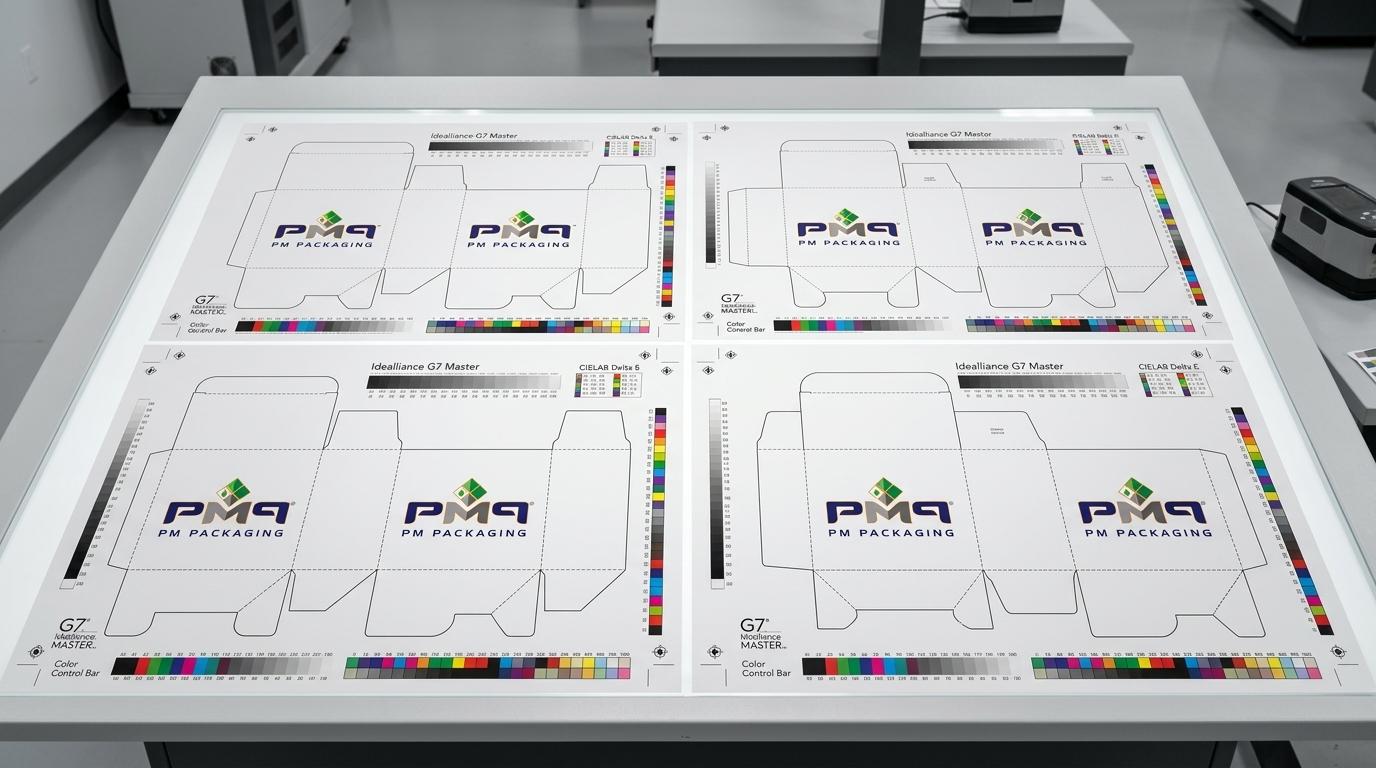
3.1 Why Enterprise Procurement Must Mandate ΔE00 (CIEDE2000)
The original 1976 ΔE*ab formula calculated color difference as a simple Euclidean distance in three-dimensional L*a*b* space. However, the human eye does not perceive color differences uniformly:
- The human eye is vastly more sensitive to minute hue shifts in neutral grays and skin tones than in highly saturated oranges or neon greens.
- A ΔE*ab of 2.0 in a saturated yellow might be completely invisible to a retail shopper, whereas a ΔE*ab of 2.0 in a neutral slate gray or corporate brand navy appears as an unmistakable, glaring defect.
- CIEDE2000 (ΔE00) compensates for these non-uniformities by incorporating specific weighting functions for lightness (SL), chroma (SC), and hue (SH), alongside a critical rotation term (RT) to correct for chromatic distortions in the blue region (hue angles near 275°).
- Procurement Requirement: All Master Services Agreements (MSAs) and Technical Quality Agreements (TQAs) must explicitly stipulate ΔE00 (CIEDE2000) under D50 Illuminant and 2° Standard Observer.
Delta E (ΔE00) Human Perception & Quality Tiers
Laboratory match; undetectable by human eye.
Detectable only by trained color technicians.
Acceptable high-volume production tolerance.
Visible color difference on shelf; risk of rejection.
Severe mismatch; mandatory lot quarantine.
3.2 Spectrophotometer Geometries & ISO 13655 Measurement Modes
45°/0° Optical Geometry (e.g., X-Rite eXact 2, Techkon SpectroDens)
Illuminates the sample at 45 degrees and measures reflected light at 0 degrees (normal to surface). This geometry matches human visual perception under standard retail lighting by incorporating surface gloss and texture. Mandatory for folding cartons, SFL microflutes, and blister cards.
ISO 13655 Mode M1 (D50 Daylighting with UV Control - The Enterprise Standard)
Illumination strictly calibrated to D50 daylighting specifications including defined UV spectral distribution. Essential when measuring substrates containing Optical Brightening Agents (OBAs) like virgin SBS paperboards, eliminating measurement disputes.
Procurement Color Specification Benchmark Matrix
| Color Category | Target Metric | Tight Tolerance (ΔE00) | Commercial Standard | Reject Threshold | Measurement Condition |
|---|---|---|---|---|---|
| Critical Brand Primary Spot | Digital CxF / PantoneLIVE | ≤ 1.0 | ≤ 1.5 | > 2.0 | 45°/0°, D50, 2°, M1, Absolute |
| Secondary Brand Spot Colors | Digital CxF / PantoneLIVE | ≤ 1.5 | ≤ 2.0 | > 2.5 | 45°/0°, D50, 2°, M1, Absolute |
| Process CMYK Solid Inks | ISO 12647-2 / GRACoL 2013 | ≤ 1.5 | ≤ 2.5 | > 3.5 | 45°/0°, D50, 2°, M1, Relative |
| Neutral Gray Balance (50/40/40) | G7 NPDC Midtone (HR) | ΔC ≤ 1.0 | ΔC ≤ 1.5 | ΔC > 2.0 | 45°/0°, D50, 2°, M1 |
| Substrate Whiteness (L*a*b*) | Virgin SBS Specification | ΔE ≤ 1.0 | ΔE ≤ 1.5 | > 2.0 | 45°/0°, D50, 2°, M1, Backing |
| Barcode ANSI / ISO Grade | ISO/IEC 15416 | Grade A (4.0-3.5) | Grade B (3.4-2.5) | < Grade B (<2.5) | Red 660nm Light Source, 10-mil |
4. Substrate Physics & Chemical Coating Interactions
A frequent failure point in enterprise packaging procurement is establishing a single digital color standard (e.g., a Pantone color) and expecting it to reproduce identically across different paperboard substrates and surface topcoats without technical adjustment. Ink pigments interact chemically and optically with the underlying paperboard fibers and topcoat varnishes.
Solid Bleached Sulfate (SBS)
L* 94.5–96.5100% virgin bleached chemical pulp with double/triple clay coating. Superior ink holdout, highest color gamut volume, and razor-sharp halftone rendering. Benchmark for cosmetics, OTC, and premium retail electronics.
Clay Coated Newsback (CCNB)
L* 80.0–85.0100% recycled fiber core with clay top coating. The grey recycled base reduces dynamic range. Converters must reformulate spot inks with increased pigmentation or opaque white under-bases to match target ΔE00.
Coated Unbleached Kraft (CUK)
L* 84.0–87.0Virgin unbleached kraft fibers providing maximum tear resistance for heavy hardware and beverage multipacks. Requires tight moisture controls to prevent ink absorption into the raw backside.
Single-Face Laminate (SFL) Microflute
E/F FluteHigh-resolution offset litho top sheets laminated to corrugated fluting. Combines stacking strength with G7 photographic print quality. Requires precise adhesive metering to prevent “washboarding” optical distortion.
Substrate & Coating Spectral Impact Matrix
| Substrate Type | Base Brightness (L*) | Common Coating Formulation | Expected Shift (ΔE00) | Required Pre-Press Adjustment |
|---|---|---|---|---|
| 16pt–24pt SBS | 94.5 – 96.0 | Inline Aqueous Gloss | +0.2 – 0.5 | Standard GRACoL 2013 curve profiles |
| 16pt–24pt SBS | 94.5 – 96.0 | Soft-Touch Tactile Aqueous | +1.5 – 2.5 | Increase shadow density by 12%; reduce yellow in pastels |
| 18pt–28pt CCNB | 81.0 – 85.0 | Inline Aqueous Gloss | +0.8 – 1.8 | Custom press curve profile; increase pigment load by 8–15% |
| 20pt–30pt CUK | 84.0 – 87.0 | Anti-Scuff Matte Aqueous | +1.0 – 2.2 | Compensate for brown fiber absorption; tighten ink drying tack |
| Litho SFL (F-Flute) | 93.0 – 95.0 | Inline UV Gloss Coating | +0.6 – 1.4 | Ensure M1 reading across flat zone away from glue ridge |
| Blister Board (SBS) | 93.5 – 95.0 | Water-Based Heat-Seal Varnish | +0.5 – 1.2 | Calibrate heat-seal resin penetration to avoid localized mottling |
5. The Multi-Plant Color Auditing Framework for Procurement Teams
Enterprise procurement teams cannot rely on passive supplier self-reporting. A robust packaging color governance program requires a structured, five-phase auditing protocol executed across every manufacturing location in the converter network.
Phase 1: Digital Master Asset & Spectral Escrow
CxF/X-4Eliminate aging physical paper swatches that fade and oxidize. Establish centralized cloud spectral standards utilizing CxF/X-4 (Color Exchange Format) files containing complete 36-point reflectance data (380nm to 730nm) stored in PantoneLIVE.
Phase 2: Pre-Press Calibration & Press Fingerprinting
G7 ProfilingLinearize CTP laser platesetters within ±1% across highlight, midtone, and shadow dots. Perform G7 calibration runs to generate 1D compensation curves. Execute NetProfiler inter-instrument calibration to guarantee spectro agreement (ΔE00 ≤ 0.15).
Phase 3: Inline Press Run Closed-Loop Spectral Control
10,000 SPHUtilize inline closed-loop spectrophotometers (e.g., Inpress Control) scanning color bars at production speeds of 10,000+ sheets per hour. Fountain ink keys adjust automatically in real-time, diverting any sheet exceeding ΔE00 > 1.5.
Phase 4: Statistical SPC Sampling & GMI Scorecard Generation
Cpk ≥ 1.33Pull 5-sheet statistical samples at start, middle, and end of each master roll or pallet lot. Generate real-time GMI production scorecards measuring Solid Density, ΔE00, Dot Gain, Registration, and ISO 15416 Grade A barcodes.
Phase 5: Downstream Co-Packer & Retail Shelf Verification
AuditSupply contract packagers with certified Certificates of Analysis (CoA) for each lot. Conduct spot retail shelf spectrophotometer audits under store lighting to ensure uninterrupted billboard effect.
6. Contractual Governance: The Technical Quality Agreement (TQA) for Color
The ultimate defense against packaging color disputes is a legally binding Technical Quality Agreement (TQA) or Vendor Quality Agreement (VQA) integrated directly into the brand’s Master Services Agreement (MSA).
The 5 Golden Clauses of a Packaging Color TQA
Sample Contractual Language for Procurement MSAs
“Schedule C: Packaging Color Specification & Quality Governance Standard — All printed packaging materials (including folding cartons, SFL microflute corrugated packaging, blister cards, and retail displays) supplied under this Agreement shall conform strictly to the spectral values defined in the Brand’s centralized CxF/X-4 digital color library. Color difference shall be calculated exclusively using the CIEDE2000 (ΔE00) formula in accordance with ISO 13655:2017, utilizing a 45°/0° spectrophotometer operating under Illuminant D50, 2° Standard Observer, and Measurement Condition M1.”
7. Dual-Plant Nearshore Execution: PM Packaging’s Color Consistency Architecture
For enterprise brand procurement teams seeking to eliminate multi-plant color divergence while slashing lead times and transpacific supply chain risks, PM Packaging offers a proven, highly standardized nearshore manufacturing model.
PM Packaging Spectral Ecosystem
PM Packaging integrates executive structural CAD engineering, CxF/X-4 digital asset escrow, and prepress proofing in San Diego, CA, with high-capacity converting campuses in Baja California (Tijuana and Mexicali).
8. Enterprise Color Audit Checklist for Packaging Procurement Teams
Use this technical checklist during supplier capability evaluations, on-site facility audits, and quarterly business reviews (QBRs) to verify that your packaging converters possess the infrastructure required for multi-plant color consistency.
Section 1: Certifications & Calibration Standards
- • Active Idealliance G7 Master Printer Certification (G7 Colorspace tier verified).
- • Active Graphic Measures International (GMI) Certified Print Facility status.
- • Current ISO 9001:2015 Quality Management certification documented and audited within last 12 months.
- • Spectrophotometers calibrated daily with reference tiles; monthly NetProfiler inter-instrument audit.
Section 2: Pre-Press & Digital Asset Governance
- • All brand spot colors stored and retrieved via digital CxF/X-4 spectral files (PantoneLIVE).
- • Elimination of unmanaged physical swatch books and aging paper drawdowns.
- • Computer-to-Plate (CTP) imagers calibrated and linearized weekly within ±1% across all steps.
- • Digital proofers calibrated to GRACoL 2013 with verified ΔE00 ≤ 1.0 proofing tolerances.
Section 3: Pressroom & Inline Production Controls
- • Large-format offset litho presses equipped with inline closed-loop spectrophotometers.
- • Automated sheet ejection/quarantine when ΔE00 exceeds 1.5 on brand spot colors.
- • Pressroom and QA inspection booths conform strictly to ISO 3664:2009 D50 lighting standards.
- • Barcodes 100% verified to ISO/IEC 15416 ANSI Grade A or B standards.
9. Sourcing Model Evaluation: Dispersed vs. Asia-Pacific vs. Nearshore
To assist VP/Directors of Supply Chain and Procurement Directors in evaluating packaging manufacturing footprints, the matrix below compares three commercial sourcing models across color governance, transit lead time, and total cost of ownership:
Sourcing Model Evaluation Matrix
| Procurement Dimension | Dispersed US Converters | Overseas Asia-Pacific | PM Packaging Dual-Plant Nearshore |
|---|---|---|---|
| Color Governance | Variable by plant; frequent ΔE00 > 3.0 | High risk of batch drift during ocean transit | Centralized CxF/X-4; G7/GMI Closed-Loop (ΔE ≤ 1.5) |
| Production Lead Time | 4 to 8 weeks | 10 to 16 weeks (incl. ocean freight) | 2 to 4 weeks production |
| Logistics Lead Time | 3 to 5 days ground freight | 6 to 10 weeks transpacific transit | 1 to 3 days West Coast / 3 to 5 days US |
| Drawdown / Proof SLA | 5 to 10 business days | 3 to 5 weeks via international courier | 24 to 48 hours |
| Retail GMI Risk | Moderate to High (Uncoordinated) | High (Difficult to audit remotely) | Zero (Certified GMI / G7 Master Facility) |
| Tariff & Customs Risk | None | High (Section 301 tariffs, demurrage) | 100% USMCA Tariff-Free; C-TPAT FAST Lanes |
| Total Cost of Ownership | High unit cost + multi-vendor overhead | Hidden costs (freight, tariffs, rework) | Optimal balance of low cost, zero tariffs & speed |
Partner With PM Packaging for Enterprise Color Governance
In an era of hyper-competitive retail shelf presentation and unforgiving retailer quality scorecards, enterprise brand owners cannot afford to treat packaging color management as a secondary operational detail. Color consistency across folding cartons, SFL microflute displays, and blister cards is a direct reflection of brand equity, product integrity, and supply chain maturity.
By mandating CIEDE2000 (ΔE00) metrics, requiring ISO 13655 M1 spectrophotometer conditions, replacing physical swatches with digital CxF/X-4 spectral files, enforcing G7 Master Colorspace calibration, and integrating strict Technical Quality Agreements into supplier contracts, procurement teams permanently eliminate visual drift and protect retail distribution.
Schedule Your Packaging Color Audit
- Technical Portfolio Audit: Evaluate current carton dielines, ink formulation recipes, and multi-plant spectral consistency.
- Certified CxF Drawdowns: Request 24–48 hour physical and digital proof drawdowns calibrated to GRACoL 2013.
- Nearshore Transition Plan: Shift high-volume folding carton and SFL programs to resilient dual-border manufacturing in San Diego and Baja California.