
As enterprise brands expand manufacturing and assembly operations across North America, nearshoring in Mexico has become a cornerstone of agile supply chain strategy.
From high-tech consumer electronics and medical devices to industrial hardware and high-turnover retail goods, contract manufacturing and multi-plant assembly hubs throughout Baja California and northern Mexico deliver unmatched speed-to-market. However, scaling high-velocity assembly across multiple manufacturing facilities introduces a critical operational vulnerability: secondary and primary retail packaging supply continuity.
The Single-Point Supply Trap
- × Single-facility converters halt downstream assembly lines during downtime.
- × 8–12 week ocean shipments tie up capital in costly safety buffers.
- × Disparate print calibrations cause visible ΔE color drift across retail shelves.
- × Inflexible scheduling triggers expensive air-freight and retailer OTIF chargebacks.
Enterprise Nearshore Redundancy
- ✓ Dual converting hubs (Tijuana & Mexicali) balance surge production.
- ✓ 1–3 day rapid border replenishment with 100% USMCA tariff exemption.
- ✓ Certified G7 Master color management maintains strict brand equity.
- ✓ San Diego CAD engineering ensures universal tooling interchangeability.
If folding cartons, laminated microflute packaging, or blister cards arrive late or suffer from inconsistent structural tolerances, entire assembly lines stall—jeopardizing retail launch dates and triggering costly retailer chargebacks from mass merchants such as Walmart, Target, Home Depot, and Costco.
For corporate procurement executives, brand directors, and supply chain leaders, selecting a packaging partner requires more than comparing unit costs on a spreadsheet. It demands a thorough audit of nearshore packaging capacity, machine redundancy, quality governance, and cross-border logistics.
Key Pillars of a Nearshore Packaging Capacity Audit
A comprehensive packaging audit verifies that a supplier can consistently absorb seasonal demand surges, maintain production continuity during peak cycles, and support multi-plant operations without disruption. Enterprise procurement teams evaluate packaging suppliers across four core operational pillars:
Dual-Plant Converting Redundancy
Synchronized manufacturing infrastructure across parallel converting facilities to guarantee manufacturing continuity and prevent downtime.
Cross-Border Replenishment Agility
Rapid ground transit, regional border warehousing, VMI/Kanban release protocols, and 100% USMCA tariff-free trade compliance.
Certified Quality & Color Consistency
G7 Master Certified color management, ISO 9001 quality systems, and substrate integrity across multi-plant assembly lines.
Structural Engineering & Prototyping
Bi-national structural CAD engineering, automated cartoning line speed optimization, and rapid physical prototype mockups.
1. Dual-Plant Converting Redundancy and Machine Capacity
A major risk in packaging procurement is single-facility dependency. When an enterprise brand relies on a supplier with only one manufacturing site, unexpected maintenance or power interruptions can paralyze downstream assembly.
Enterprise Procurement Verification Checklist:
- Parallel Converting Facilities: Look for packaging manufacturers operating dual production hubs—such as complementary converting facilities in Tijuana and Mexicali—that can balance run volumes and provide immediate backup capacity.
- High-Volume Machine Scalability: Ensure the supplier utilizes high-speed, large-format offset printing presses, automated die-cutters, and high-velocity folding-gluers capable of producing millions of units monthly.
- Flexible Scheduling: The capacity to shift production jobs seamlessly between facilities without retooling delays or color deviations.
2. Cross-Border Logistics and Inventory Replenishment Agility
Manufacturing across multiple regional plants requires responsive, predictable replenishment. Relying on overseas packaging suppliers creates weeks of transit uncertainty, ties up working capital in buffer inventory, and risks expensive air-freight expedites.
Key Logistics Audit Checkpoints:
- Rapid Ground Transit: Nearshore facilities along the border deliver finished packaging within 1 to 3 days to West Coast and Southwest manufacturing hubs, and 3 to 5 days nationwide.
- Vendor-Managed Inventory (VMI) & Kanban Programs: Staging finished goods in regional border warehouses enables daily or just-in-time (JIT) releases directly to assembly lines.
- USMCA Compliance: Full compliance with USMCA tariff-free trade rules eliminates customs friction and unexpected import duties.
3. Certified Quality Management and Brand Consistency
When packaging is delivered to multiple contract packaging plants or distinct internal assembly divisions, every carton, tray, and backing card must perform identically on automated packaging lines.
Quality Governance Checkpoints:
- G7 Master Certified Color: Verifies that brand colors, high-impact retail graphics, and brand finishes remain perfectly consistent across different print runs and substrate batches.
- Certified Quality Systems: ISO 9001 certification and adherence to strict food-grade and retail compliance standards.
- Substrate Integrity: Ensuring packaging utilizes premium virgin paperboard, high-strength recycled board, or lightweight microflute packaging that resists scuffing and crushing in transit.
4. Structural Engineering and Multi-SKU Prototyping
Packaging designs must align with automated cartoning equipment and retail compliance guidelines for national retailers such as Walmart, Target, Home Depot, and Costco.
Structural Engineering Criteria:
- Bi-National Engineering Support: Dedicated structural design teams based in the United States working directly with nearshore production engineers to optimize dielines for fast manual pack-out or automated high-speed packing.
- Rapid Prototyping: Fast turnaround of physical CAD samples and structural mockups to accelerate retail buyer approvals and packaging line validation.
Nearshore Packaging Capacity Audit Scorecard
Enterprise procurement teams can evaluate packaging candidates against the following operational criteria:
Enterprise Packaging Supplier Evaluation Matrix
| Strategic Audit Dimension | Single-Plant / Overseas Supplier | Enterprise-Grade Nearshore Partner | Procurement Value Impact |
|---|---|---|---|
| Manufacturing Continuity | High risk; single facility bottlenecks halt multi-plant lines | Dual-plant converting redundancy (e.g., Tijuana & Mexicali) | Guarantees uninterrupted supply and risk mitigation |
| Lead Times & Transit | 6–12 week ocean shipping; high buffer inventory required | 1–3 day rapid ground delivery to regional assembly plants | Frees operating cash flow and slashes holding costs |
| Trade & Tariff Exposure | Vulnerable to port congestion, import tariffs, and delays | 100% Tariff-free USMCA compliance with seamless border clearance | Delivers total landed cost stability and budget predictability |
| Color & Quality Control | Inconsistent press calibrations across disparate vendors | G7 Master certified color consistency and ISO 9001 controls | Protects brand equity across all retail channels |
| Packaging Portfolio | Narrow product capability; requires managing multiple vendors | Full format integration (folding cartons, microflute, blister cards) | Streamlines vendor management and maximizes purchasing power |
The PM Packaging Nearshore Advantage
For over 45 years, PM Packaging has partnered with enterprise brands to engineer and manufacture high-volume commercial packaging solutions tailored for North American manufacturing networks.
By bridging headquarters and structural design in San Diego, California with advanced, high-capacity converting facilities in Baja California (Tijuana and Mexicali), PM Packaging delivers the optimal balance of engineering innovation, capacity scale, and nearshore speed:
Comprehensive Capabilities
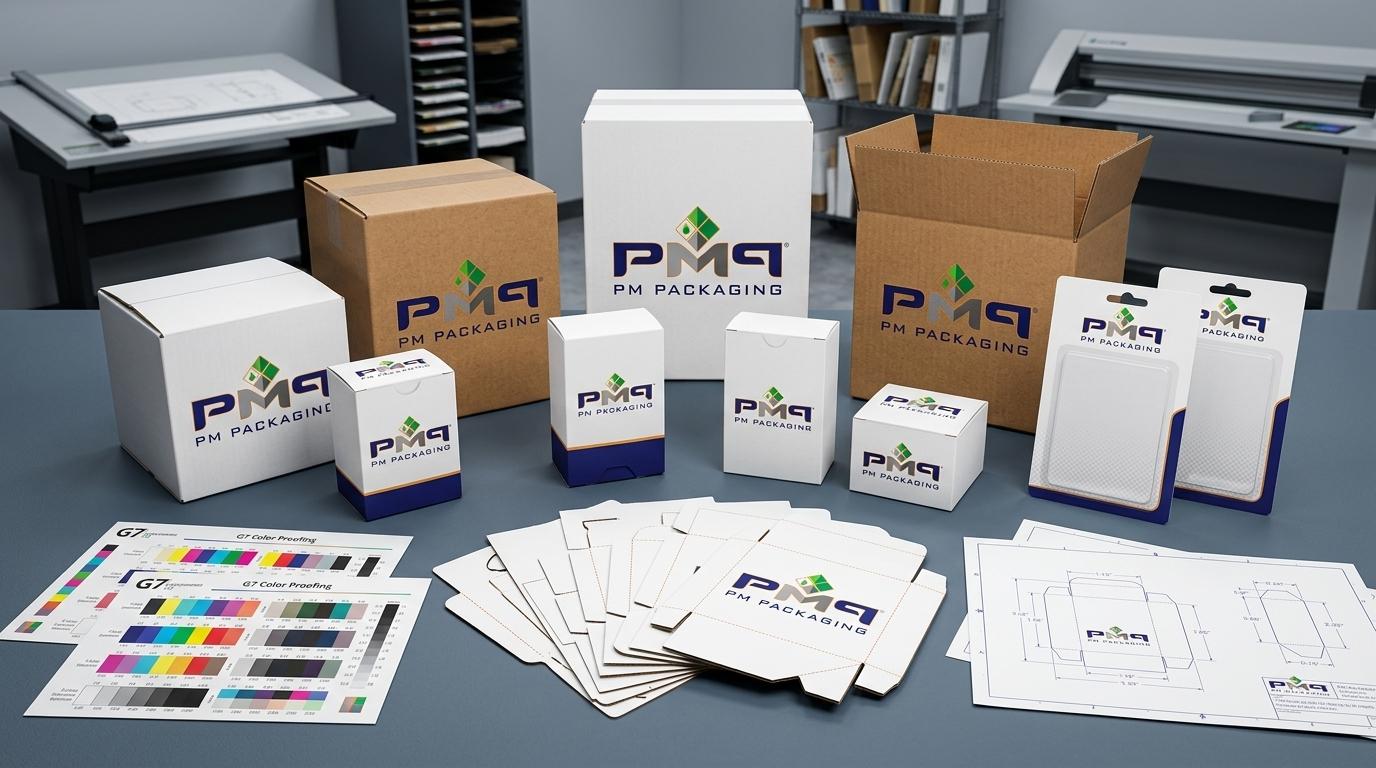
Custom folding cartons, laminated microflute packaging, luxury rigid setup boxes, POP displays, and printed paperboard blister cards with the shared-run qikCombo™ program.
Dual-Plant Resilience
High-capacity converting infrastructure designed to handle large-scale enterprise rollouts with built-in redundancy and sub-4-hour production migration agility.
G7 Master Certified Printing
Flawless photographic print fidelity, inline UV coatings, soft-touch matte finishes, and precision embossing calibrated to ΔE < 1.5 color uniformity.
Agile Replenishment
Fast ground delivery across the US-Mexico border, supported by VMI staging hubs in San Diego, keeping multi-plant manufacturing operations running at full efficiency.
Strengthen Your Multi-Plant Packaging Supply Chain
Auditing your nearshore packaging capacity is essential to safeguarding your multi-plant manufacturing footprint against downtime, freight volatility, and retail compliance failures.
Partnering with an experienced, dual-plant nearshore manufacturer ensures your primary and secondary packaging arrives on schedule, runs smoothly on your lines, and commands attention on retail shelves.
Ready to Evaluate Your Nearshore Packaging Strategy?
Connect with the enterprise packaging specialists at PM Packaging to schedule a capacity audit and discuss your multi-plant production requirements today.
Schedule an Enterprise Packaging Capacity Audit
Evaluate how PM Packaging’s bi-national engineering and dual-plant manufacturing campuses can optimize your supply chain, eliminate single-source vulnerability, and accelerate your cross-border speed to market.
- Engineering Headquarters: San Diego, California
- Dual Manufacturing Campuses: Tijuana & Mexicali, Baja California
- Core Formats: Custom Folding Cartons, SFL Microflute Corrugate, Blister Cards (qikCombo™), Retail POP Displays, Luxury Rigid Boxes.