
In the medical device and healthcare technology sectors, packaging reliability directly impacts clinical availability, regulatory compliance, and commercial launch milestones.
Whether packaging surgical instruments, diagnostic test kits, patient monitoring hardware, or home health therapies, secondary folding cartons do far more than enclose a product. They protect primary sterile barriers, present required regulatory labeling and Unique Device Identifiers (UDI), and convey brand credibility to clinicians and healthcare administrators.
For enterprise medical device manufacturers, relying on overseas packaging supply chains introduces substantial operational vulnerabilities. Transpacific ocean freight, unpredictable port demurrage, customs holds, and 6 to 12-week transit times create persistent supply chain risks.
When a shipment of secondary folding cartons is delayed at a seaport, finished medical devices cannot be boxed, sterile lots cannot be released, and hospital delivery contracts are compromised. To build supply chain resilience and eliminate maritime bottlenecks, leading medical device procurement directors and packaging engineers are transitioning secondary packaging to nearshore, USMCA-compliant folding carton manufacturing.
The Hidden Costs of Overseas Medical Packaging Sourcing
While overseas packaging converters once offered low unit prices, extended global supply chains introduce severe operational frictions:
Medical device packaging follows strict staging schedules. If folding cartons are stalled in ocean transit or customs queues, finished devices cannot be boxed or distributed, causing production downtime and delayed revenue.
Medical packaging requires frequent copy revisions due to evolving regulatory standards, updated Instructions for Use (IFU), or multi-language market expansions. When cartons take 8 to 12 weeks to arrive by sea, implementing artwork updates becomes sluggish, creating significant scrap risk for obsolete packaging.
Long transit windows force medical device enterprises to hold months of bulky folding carton inventory in domestic warehouses. This ties up working capital and inflates storage overhead for packaging that could otherwise be replenished on demand.
Seaport labor disputes, container shortages, and transpacific shipping volatility inject unpredictability into product rollouts. Unexpected port storage and demurrage fees quickly erode anticipated unit cost savings.
Strategic Pillars of Nearshore USMCA Folding Carton Manufacturing
Nearshoring secondary packaging within North America under the United States-Mexico-Canada Agreement (USMCA) transforms packaging from a logistical risk into a strategic advantage:
1. Rapid Ground Logistics and Agile Replenishment
Nearshore manufacturing replaces multi-week ocean voyages with reliable cross-border ground freight. Finished folding cartons reach West Coast and Southwest medical device hubs in just 1 to 3 days (3 to 5 days nationwide). This accelerated speed allows procurement teams to run lean, demand-driven replenishment schedules that minimize warehouse footprint.
2. 100% Tariff-Free USMCA Trade and Frictionless Borders
Operating under USMCA trade rules ensures tariff-free status for qualifying paperboard packaging, eliminating exposure to overseas import duties and customs bottlenecks at oceanic ports. Pre-cleared cross-border freight moves seamlessly from converting facilities directly into North American cleanroom assembly and kitting lines.
3. Certified Quality Management and Print Consistency
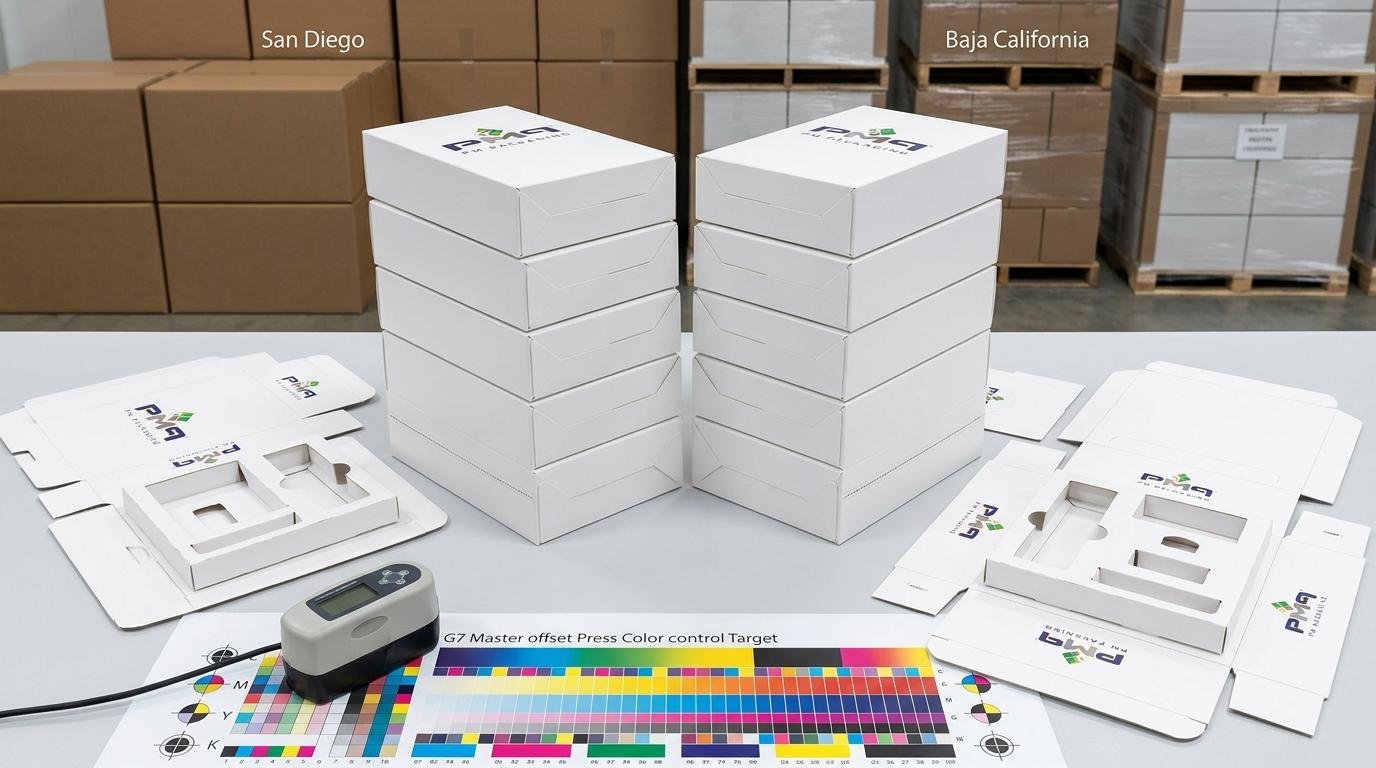
Medical device packaging requires uncompromising manufacturing standards. Leading nearshore converters operate under certified ISO 9001 quality management systems and maintain G7 Master certified color consistency. This guarantees crisp print clarity for scannable barcodes, regulatory symbols, and clean brand graphics across every production run on lint-free virgin paperboard.
4. Rapid Design Iteration and Pre-Press Speed
Whether engineering auto-bottom cartons for fast manual pack-out or straight-tuck formats for automated cartoning lines, same-time-zone structural engineering accelerates development. Structural prototyping and pre-press approvals occur in days rather than weeks, keeping new product introductions on schedule.
Packaging Sourcing Strategy Comparison
Evaluating production and logistics models illustrates why enterprise medical device brands are moving away from overseas sourcing:
| Strategic Metric | Overseas Sourcing (Asia) | Traditional Domestic Only | Integrated Nearshore USMCA (PM Packaging) |
|---|---|---|---|
| Total Turnaround & Transit | 8 to 12 weeks (Ocean freight) | 4 to 8 weeks (Capacity constrained) | 1 to 3 days ground transit (Rapid replenishment) |
| Tariff & Customs Risk | High (Import tariffs, port delays, customs holds) | None (Domestic ground) | Zero (100% Tariff-Free USMCA compliance) |
| Artwork & Regulatory Agility | Very Low (High risk of obsolete inventory) | Moderate | High (Fast plate turnaround & agile run scheduling) |
| Inventory Holding Requirements | 60–90 days safety stock | 30–45 days stock | Lean, just-in-time staging (10–15 days) |
| Quality & Color Consistency | Variable (Difficult international press audits) | High (Standard domestic QC) | Superior (ISO 9001 certified, G7 Master print control) |
| Cross-Border Logistics Oversight | Complex freight forwarding & port agents | Simple domestic trucking | Single-source accountability with dedicated logistics |
The PM Packaging Advantage for Medical Device Packaging
With over 45 years of manufacturing excellence, PM Packaging provides enterprise healthcare brands with a dependable, high-capacity nearshore packaging infrastructure.
Headquartered with structural engineering and pre-press operations in San Diego, California, and operating high-capacity converting facilities in Baja California (Tijuana and Mexicali), PM Packaging delivers an agile manufacturing ecosystem:
- High-Capacity Folding Carton Production: High-speed die-cutting, folding, and gluing across custom straight-tuck cartons, auto-bottom cartons, and windowed cartons engineered for automated or manual pack-out lines.
- Comprehensive Secondary Packaging Formats: Single-source manufacturing across custom folding cartons, laminated microflute packaging for heavy diagnostic instruments, luxury rigid setup boxes for flagship surgical kits, and printed paperboard blister cards for sterile single-use disposables.
- Shared Run Efficiency with qikCombo™: For medical device lines with multiple SKUs or regional variations, our qikCombo™ program offers shared production runs with rapid 10-day turnaround, reducing tooling overhead and inventory risk.
- Certified Sustainable Materials: Sourcing certified virgin paperboard and eco-friendly recycled board from responsibly managed forests (FSC and SFI certified) to support corporate ESG goals.
Secure Your Medical Device Packaging Supply Chain
In medical manufacturing, uninterrupted product availability is essential for patient care and commercial success. By eliminating transpacific port bottlenecks and leveraging nearshore USMCA folding carton manufacturing, enterprise medical device brands secure the speed, cost predictability, and certified quality needed to scale.
Ready to eliminate port delays and optimize your secondary packaging operations? Connect with the packaging specialists at PM Packaging to review your structural dielines and build a resilient nearshore supply chain today.
Ready to Build a Resilient Nearshore Packaging Supply Chain?
Connect with the packaging specialists at PM Packaging today to request a structural review, sample prototype, or custom folding carton quotation for your medical device lines.
Partner with PM Packaging to combine high-speed auto-bottom dielines, precision paperboard workstation inserts, G7 Master print fidelity, and 100% tariff-free USMCA nearshore delivery.