
For enterprise Consumer Packaged Goods (CPG) brands, Vice Presidents of Supply Chain, Directors of Procurement, and Packaging Engineering teams, the modern manufacturing footprint is rarely confined to a single company-owned facility.
Scaling commercial hardware packaging requires targeted engineering: Hardware packaging must endure heavy metal tool weight, rough customer handling in big-box retail environments, and high-humidity warehouse storage without card delamination. PM Packaging partners with high-volume brands to ensure G7 color consistency, structural durability, and predictable replenishment.
While contract manufacturing delivers operational elasticity and capital efficiency, it introduces a severe systemic vulnerability: the fragmentation of secondary packaging procurement and quality governance across disparate third-party production nodes.
Rather than treating hardware packaging as generic paperboard, engineering teams must account for product geometry, hanging shelf wear, moisture barriers, and high-speed automated cartoning line tolerances.
With over 45 years of specialized converting expertise, dual-border operations headquartered in San Diego, CA, and advanced manufacturing plants in Baja California, PM Packaging provides the structural engineering, certified print consistency, regulatory architecture, and nearshore supply chain infrastructure required to unify packaging sourcing across distributed contract manufacturing networks.
1. The Strategic Dilemma: Turnkey Co-Man Sourcing vs. Brand-Directed Tolling
PM Packaging specializes in heavy-duty blister cards, trapped blister packaging, and fluted tool cartons for national hardware and industrial tool brands. High-speed gang printing and shared dielines reduce per-unit tooling costs while clear technical graphics guide buyers directly to the correct model.
Turnkey Co-Man Sourcing
- ×Co-man buys packaging locally from disconnected regional converters.
- ×15% to 30% hidden administrative and margin markups added to COGS.
- ×Decentralized dielines and redundant NRE tooling invoices per plant.
- ×Uncontrolled substrate variance (SBS vs. CCNB vs. FBB).
- ×High brand color drift (ΔE > 3.0) triggering retail compliance chargebacks.
Brand-Directed Tolling (PM Packaging)
- ✓Brand contracts a single enterprise converting partner with 100% price transparency.
- ✓Aggregated purchasing power across all co-mans captures top volume tiers.
- ✓Single master CAD dieline and G7 digital print curves across the network.
- ✓Standardized North American virgin paperboard specifications.
- ✓Strict spectral closed-loop control (ΔE < 1.5) and machine pre-breaking.
The Pitfalls of Turnkey Packaging Sourcing
Under a turnkey agreement, the CPG brand contracts the co-manufacturer to deliver a completely finished, packaged product—delegating the sourcing of folding cartons, corrugated shippers, and display trays to the co-man. While turnkey sourcing appears to minimize internal procurement overhead, it introduces severe commercial and operational inefficiencies:
- Opaque Co-Man Markups (15% to 30%): Contract manufacturers are contract packagers, not paperboard converters. When they purchase secondary packaging, they apply administrative handling fees and margin markups ranging from 15% to 30% over the converter's invoice cost. Multiplied across millions of units, this margin stack severely inflates cost of goods sold (COGS).
- Fragmented Purchasing Power: If an enterprise brand produces 10 million units annually split across four regional co-manufacturers, each co-man procures 2.5 million units independently. The brand forfeits the substantial volume discounts achievable by tendering the consolidated 10-million-unit packaging buy to a single, high-capacity converting partner.
- Proliferation of Redundant Tooling: Each co-man works with regional converters who generate their own structural dielines, cutting dies, embossing dies, and printing plates. The brand pays multiple tooling charges for identical SKUs, while inheriting subtle dimensional variations that complicate packaging automation.
- Catastrophic Brand Color Drift: When different converters print identical brand packaging using varied ink formulations, anilox rolls, press curves, and paperboard substrates, severe color variation occurs on the retail shelf. A primary brand color can shift significantly across products manufactured by Co-Man A in the Midwest versus Co-Man B in Mexico, violating mass-retail vendor compliance standards (such as Walmart GMI or Target color audits).
The Brand-Directed / Tolled Packaging Architecture
In a Brand-Directed (or Tolled) procurement model, the enterprise brand negotiates pricing, structural design, substrate specifications, and quality service level agreements (SLAs) directly with an enterprise-grade packaging converter like PM Packaging. The packaging converter then manufactures the secondary packaging and delivers it directly to the brand's distributed co-man network on a Just-In-Time (JIT) or Vendor-Managed Inventory (VMI) basis.
Strategic Comparison: Turnkey vs. Brand-Directed Packaging
| Decision Factor | Turnkey Co-Man Model | Brand-Directed Nearshore Model (PM Packaging) |
|---|---|---|
| Substrate & Unit Economics | Segmented volume; 15–30% markups; uncoordinated buys. | Enterprise-scale aggregated volume pricing; 100% price transparency; zero hidden markups. |
| Quality & Color Consistency | Uncontrolled; ΔE often > 3.0; high retail audit penalty risk. | Idealliance G7 Master certified; spectral closed-loop control; ΔE guaranteed < 1.5. |
| Structural Standardization | Varied dielines; inconsistent score stiffness; frequent line jams. | Single master CAD dieline; uniform 180° pre-breaks; machine-qualified across all co-mans. |
| Tooling & Asset Ownership | Fragmented tooling across vendors; redundant NRE invoices. | Brand-owned master digital plates & matched steel rule dies; centralized asset tracking. |
| Supply Chain Agility & Lead Times | Disjointed; regional reliance or 10-week ocean imports. | 1–3 days ground delivery to West/SW hubs; 24–48 hr emergency reruns; dedicated VMI. |
| Regulatory & Tariff Compliance | Complex border crossings; risk of 16% Mexican IVA tax. | 100% USMCA certified North American origin; seamless IMMEX Virtual Pedimento (V1/V5) flow. |
| Working Capital & Carrying Costs | Co-man demands high safety stock; cash tied up at multiple nodes. | Converter-managed VMI buffers; pay-on-pull terms; 75% reduction in network inventory. |
2. Structural Engineering & Dieline Standardization Across Disparate Co-Man Lines
One of the greatest operational hazards in contract manufacturing networks is the mechanical diversity of packaging equipment across co-man facilities. Co-Man A may operate continuous-motion horizontal cartoners running at 350 cartons per minute (cpm), Co-Man B may run intermittent-motion vertical cartoners at 120 cpm, and Co-Man C may operate semi-automated pack stations or manual kitting lines.
If the structural dieline is not engineered to satisfy the mechanical constraints of the most sensitive automated cartoner in the network while maintaining rapid manual erectability for kitting lines, line stoppages and labor overruns will destroy project margins.
Automated Continuous Cartoner
Auto-Bottom Crash Lock Base
Critical Engineering Parameters for Multi-Plant Packaging Machinability
1. 180° Crease Pre-Breaking on Folder-Gluers
High-speed automated cartoners (Bosch/Syntegon, Kliklok, Rovema, Marchesini, Douglas, Bradman Lake, Jones) use high-velocity rotary vacuum cups to snatch flat carton blanks from a feed magazine and erect them into continuous conveyor flights. If score lines #1 and #3 are not mechanically pre-broken to a full 180° during folder-gluer conversion, the board's internal elastic memory will resist opening, triggering optical sensor faults and stopping a $2,500/hour line. PM Packaging utilizes high-precision Bobst folder-gluers equipped with multi-stage mechanical pre-breakers, reducing carton opening resistance to under 40 gf/cm.
2. Fiber Grain Direction & Taber Stiffness Calibration
Paperboard possesses distinct mechanical stiffness properties depending on fiber alignment relative to score lines. Fiber grain must run strictly parallel to the carton's primary working creases. Running grain perpendicular creates erratic bending resistance, panel bowing under top-load compression, and tuck-flap jamming. Virgin paperboards such as Solid Bleached Sulfate (SBS), Coated Unbleached Kraft (CUK/SUS), and Folding Boxboard (FBB) provide superior stiffness-to-weight ratios compared to recycled CCNB.
3. Flap Geometries and Hot-Melt Knockout Blankets
Dust flaps must feature a 2° to 5° lead-in chamfer to ensure seamless entry into folding plows without catching on carton edges. Furthermore, PM Packaging utilizes digital CtP coating blankets to create precise knockout zones on glue flaps and date-coding panels. Applying aqueous or UV coating over glue flaps prevents hot-melt adhesive from penetrating the paperboard fibers, resulting in unglued carton pop-opens during distribution.
Packaging Dieline & Co-Man Machinability Matrix
| Dieline Style | Primary Substrates | Assembly Type | Operating Velocity | Best-Fit Co-Man Setup |
|---|---|---|---|---|
| Straight Tuck End (STE) with Glue Flap | 14pt – 24pt SBS / FBB / CUK | Fully Automated Continuous Cartoner | 200 – 450+ cartons/min | High-speed continuous motion horizontal cartoning lines |
| Reverse Tuck End (RTE) Friction Tuck | 16pt – 24pt SBS / CCNB / CRB | Automated or Semi-Auto Intermittent | 80 – 220 cartons/min | Intermittent vertical or horizontal cartoner lines |
| Auto-Bottom (Crash-Lock Base) | 18pt – 28pt SBS / CUK / CCNB | Semi-Automated / Manual Hand Erect | 25 – 45 units/min / operator | Manual kitting, promo multi-packs, seasonal gift sets |
| SFL E/F-Flute Master Pack / PDQ Tray | Single-Face Litho-Laminated Corrugate | Automated Wrap-Around or Manual Tray | 50 – 140 packs/min | Club store multipacks & heavy retail beverage lines |
| Trapped Heat-Seal Blister Card | 18pt – 24pt SBS w/ Water Varnish | Rotary Heat-Seal Sealing Carousel | 30 – 80 cycles/min | Hardware, OTC healthcare, personal care, electronics |
| Rigid Setup Box w/ Magnetic Closure | 40pt – 100pt Greyboard + C1S Wrap | Manual Pack & Finish w/ Custom Inserts | 10 – 20 units/min / operator | Prestige cosmetics, spirits, luxury tech electronics |
SFL for Club Store Multipacks
For club store multipacks (Costco and Sam's Club), PM Packaging laminates high-resolution offset litho-printed top sheets to microflute single-face profiles (E-Flute 1/16", F-Flute 1/32"), delivering heavy-duty Box Compression Test (BCT) strength capable of stacking 4 to 5 pallets high in distribution racks without sidewall buckling.
Blister Cards & qikCombo™
PM Packaging's proprietary water-based heat-seal varnishes match thermoformed blister flange chemistry (RPET, PETG, PVC) for complete fiber tear in 0.8–1.5s dwell times. The qikCombo™ program gangs multiple blister card SKUs onto large-format sheets, unlocking high-volume pricing with a 10-day turnaround.
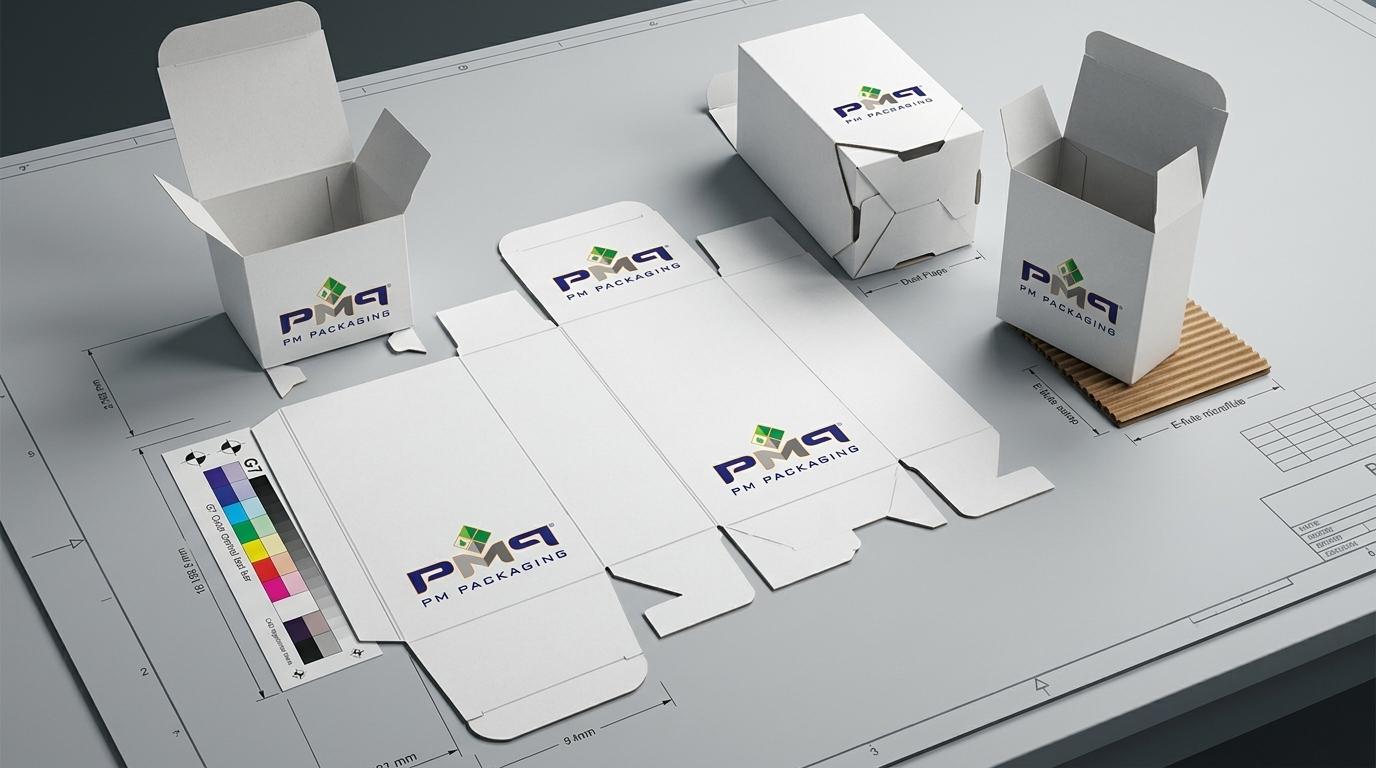
3. Brand Equity, G7 Master Color Standardization & Multi-Plant Print Governance
When consumer packaged goods sit on mass retail shelves, visual packaging uniformity is paramount. Variations in brand color saturation, flesh tones, or logo tint between two adjacent boxes on a Walmart shelf instantly erode consumer trust and trigger formal retailer chargebacks.
G7 Master Printer Certification and Spectral Control
PM Packaging is an Idealliance Certified G7 Master Printer. Unlike legacy print operations that rely solely on subjective visual inspection or solid ink density (SID) targets, G7 methodology calibrates the print press to achieve visual gray balance across the CMYK tonal scale:
- Substrate Compensation: Paperboard substrates vary in base whiteness. SBS exhibits a 90–94 brightness rating with a blue-white cast, while recycled CCNB exhibits yellow-brown undertones. PM Packaging applies spectrophotometric curve calibration (CxF3 digital data) to compensate for substrate base tint, ensuring brand colors match whether printed on virgin SBS cartons, SFL microflute displays, or blister cards.
- Strict Delta-E (ΔE) Thresholds: PM Packaging maintains a Delta-E tolerance of ΔE < 1.5 against the brand's master digital color targets throughout production runs. In comparison, uncoordinated regional converters often operate with ΔE variances exceeding 3.5 to 5.0.
- Retail Print Compliance (GMI Certified): PM Packaging complies with Graphic Measures International (GMI) and mass-retail print certification programs (Walmart, Target, Walgreens, CVS), insulating brand owners from costly print-quality penalties and packaging rejections.
High-Speed Inline Coatings and Specialty Embellishments
Secondary packaging must survive rigorous physical handling across automated conveyor belts, robotic pick-and-place grippers, and multi-tier pallet transit. PM Packaging applies inline high-slip, scuff-resistant aqueous topcoats and tactile soft-touch finishes that resist abrasion during high-speed feeding.
For prestige retail programs, PM Packaging integrates inline cold foil stamping, hot foil stamping, precision multi-level embossing and debossing, raised spot UV, and strike-through gloss/matte contrasts—providing luxury shelf impact while maintaining high-speed cartoning machinability.
4. Nearshore Logistics Architecture: IMMEX, USMCA & Multi-Node JIT Replenishment
As enterprise brands expand contract manufacturing into North America's premier nearshore corridor—Baja California, Mexico (Tijuana, Mexicali, Tecate)—secondary packaging logistics become critical. Sourcing packaging from Asia or distant domestic suppliers introduces customs bottlenecks, high shipping costs for low-density goods, and severe lead-time risks.
IMMEX Virtual Transfers
In-country virtual transfers (Pedimento V1/V5) eliminate the 16% Mexican IVA tax on raw materials and remove customs border holds.
USMCA / T-MEC Origin
100% North American mill-certified virgin paperboards avoid Section 301 tariffs (25%+) and qualify for tariff-free entry into the U.S.
FAST & C-TPAT Lanes
Expedited FAST commercial border crossing at Otay Mesa / Calexico East bypasses 4-to-8-hour cargo queues during peak retail seasons.
Nearshore vs. Offshore Supply Chain Benchmarks
| Supply Chain Metric | Offshore (Asia / Pacific) | Domestic U.S. (Midwest) | PM Packaging (San Diego/Baja) |
|---|---|---|---|
| Converting Production Lead Time | 4 – 6 Weeks | 3 – 5 Weeks | 1 – 2 Weeks (qikCombo: 10 d) |
| Transit Time to Baja Co-Man | 30 – 45 Days (Ocean) | 5 – 8 Days (Interstate) | 1 – 3 Days (Direct Ground) |
| Total Order Replenishment Lag | 8 – 12 Weeks | 4 – 6 Weeks | 1 – 3 Weeks (Kanban: 24–48 h) |
| Emergency Rerun Capability | Impossible (< 8 Weeks) | 2 – 3 Weeks + Air Freight | 3 – 5 Days Expedited Ground |
| Customs Clearance Protocol | Port Drayage + Import Pedimento | Physical Border Cross | IMMEX Virtual Pedimento (V1/V5) |
| Tariff Assessment | Subject to Sec. 301 (25%+) | 0% (Domestic) | 100% USMCA Certified (0%) |
5. Inventory Optimization: VMI, Dynamic Kanban & Co-Man Warehouse Capacity
Contract packaging facilities operate on finite warehouse footprints. Co-packers allocate warehouse square footage to high-margin assembly, blending, bottling, and cartoning lines—not long-term storage of bulky empty paperboard boxes.
When a brand floods a co-packer's warehouse with 90 days of empty folding cartons or corrugated master cases, the co-packer incurs congestion, risks material damage from forklift handling, and charges the brand inventory holding fees.
1. Centralized Buffer Warehousing
PM Packaging maintains a 30-to-60-day safety stock buffer of converted, flat-folded packaging blanks in its San Diego and Baja California warehouse facilities.
2. Daily / Semi-Weekly Kanban JIT Deliveries
Rather than shipping an entire production run in a single bulk delivery, PM Packaging coordinates directly with each co-packer's shift-level Master Production Schedule (MPS), delivering secondary packaging in optimized pallet increments via dedicated daily shuttles.
3. Pay-on-Pull Working Capital Advantage
Enterprise brands reduce working capital commitments by transitioning from pre-paid bulk orders to pay-on-consumption or pay-on-pull billing terms, releasing cash flow for marketing and product development.
4. Zero Packaging-Induced Line Downtime
If an enterprise brand experiences an unexpected retail surge order from Costco or Walmart, packaging is pulled immediately from the local VMI buffer and delivered to the co-packer within 24 hours, eliminating the 8-to-12-week lead-time lag of offshore sourcing.
6. Total Cost of Ownership (TCO) Financial Model & Network Economic Analysis
Evaluating secondary packaging sourcing based strictly on initial purchase order unit price creates a false economy. Uncoordinated sourcing models incur massive hidden costs in freight, customs broker fees, buffer warehousing, machine jam downtime, and scrap waste.
Total Cost of Ownership (TCO) Comparison: 1,000,000-Unit Multi-Co-Man Program
| Cost Component | Turnkey Co-Man Sourcing | Asia / Offshore Sourcing | PM Packaging (Nearshore) |
|---|---|---|---|
| Base Converting / Unit Cost | $0.215 | $0.165 | $0.190 |
| Co-Man Markup / Handling (15-20%) | $0.038 (17.5% Avg.) | $0.000 (Direct Buy) | $0.000 (Direct Buy) |
| Ocean / Long-Haul Freight per Unit | $0.015 | $0.052 | $0.008 |
| Tariffs, Brokerage & Border Drayage | $0.012 | $0.041 (Sec. 301) | $0.000 (IMMEX V1) |
| Working Capital Carrying Cost (10%) | $0.011 (40-Day) | $0.024 (90-Day) | $0.003 (10-Day) |
| Line Downtime & Machine Scrap | $0.016 (2.8% Scrap) | $0.022 (4.0% Scrap) | $0.002 (<0.4% Scrap) |
| Co-Man Buffer Storage Fees | $0.008 | $0.014 | $0.000 (VMI Buffer) |
| Effective Landed Cost / Unit | $0.315 | $0.318 | $0.203 |
| Total Spend (1M Units) | $315,000 | $318,000 | $203,000 |
| NET PROGRAM SAVINGS | BASELINE | +$3,000 (+0.95%) | -$112,000 (35.6% SAVINGS) |
Net Cost Reduction
Eliminating markups, transpacific ocean freight, tariffs, and cartoner scrap yields 35.6% landed savings per SKU.
Cash-to-Cash Speed
Compress pipeline inventory from 90 ocean days to 5–10 localized days, unlocking significant working capital.
Cartoner Line Scrap
180° pre-broken creases and calibrated Taber stiffness protect high-speed cartoning lines from costly downtime.
7. Enterprise Implementation Framework & Procurement Audit Checklist
Transitioning an enterprise brand from fragmented contract manufacturing packaging to a centralized, brand-directed nearshore model requires a structured, five-phase implementation roadmap:
Audit all co-man cartoner makes, models, speeds, vacuum cup configurations, and glue systems. Collect historical scrap rates, substrate calipers, and existing dielines.
Harmonize dielines into single master CAD templates engineered for the most sensitive cartoner in the network. Standardize on certified North American virgin SBS/FBB/CUK.
Establish IMMEX Virtual Pedimento (V1/V5) accounts with Mexican contract packagers for 0% IVA routing. Prepare master USMCA Certificates of Origin for 100% tariff-free border entry.
Cut master steel rule dies and run 500-unit pilot trial blanks across all co-man lines. Calibrate G7 press curves to achieve master Delta-E (ΔE < 1.5) brand color consistency.
Establish 30-to-60-day safety stock buffers in PM Packaging nearshore warehouse facilities. Launch EDI forecast integration and initiate daily/semi-weekly JIT Kanban delivery schedules.
The Packaging Procurement Audit Checklist
| # | Technical Procurement Requirement | Standard Target | PM Packaging Spec |
|---|---|---|---|
| 01 | Co-Man Machinery Mapping | Audit make, model, speed, vacuum cups across plants | ✓ Standard |
| 02 | 180° Score Pre-Breaking | Creases #1 & #3 mechanically pre-broken to 180° | ✓ Bobst Folder-Gluers |
| 03 | Fiber Grain Direction Alignment | Parallel to primary working score lines | ✓ Calibrated |
| 04 | Adhesive & Date-Code Knockouts | CtP coating blankets with clean flap knockouts | ✓ 100% Fiber Tear |
| 05 | Blister Varnish Chemistry Match | Matched to RPET, PETG, or PVC blister flange | ✓ Water-Based Seal |
| 06 | Idealliance G7 Master Qualification | Spectral closed-loop control maintaining ΔE < 1.5 | ✓ G7 Master Certified |
| 07 | IMMEX Virtual Transfer Capability | In-country Pedimento (V1/V5) routing at 0% IVA | ✓ Full IMMEX Flow |
| 08 | USMCA Tariff-Free Compliance | 100% North American mill-certified paperboards | ✓ 0% U.S. Tariffs |
| 09 | Vendor-Managed Inventory (VMI) | 30–60 day localized buffer with 24–48h JIT pull | ✓ San Diego & Baja |
| 10 | Direct Brand Tolling Agreement | Contract volume directly to eliminate 15–30% markups | ✓ Aggregated Buy |
8. Why Enterprise CPG Brands Partner With PM Packaging
For more than 45 years, PM Packaging has served as the strategic packaging manufacturing partner for Fortune 500 CPG corporations, high-growth consumer brands, and multi-facility contract manufacturing networks across North America. Our integrated dual-border operations provide the optimal infrastructure for unifying secondary packaging across distributed contract packagers:
By combining structural packaging engineering in Southern California with large-format, high-speed offset printing and converting in Baja California, PM Packaging eliminates the lead-time risks, color variations, and high costs that plague fragmented co-man packaging supply chains.
About PM Packaging
For over 45 years, PM Packaging has engineered and manufactured high-performance folding cartons, litho-laminated single-face laminate (SFL) microflute packaging, luxury rigid setup boxes, blister cards, and high-impact retail displays for North America's leading consumer brands. Operating advanced manufacturing facilities in San Diego, CA and Baja California, PM Packaging combines certified G7 Master Printer lithographic quality, GMI compliance, SQF food safety certification, and seamless USMCA nearshore logistics to power national retail programs at scale.
Ready to Unify Packaging Across Your Co-Man Network?
Eliminate co-man packaging markups, prevent packaging line downtime, and unify your brand presence across North American retail channels.
By locking in G7 Master spectral curves, standardizing master CAD dielines, and deploying dual-border JIT replenishment, enterprise CPG brands capture substantial margin savings while protecting brand equity on every retail shelf.
Contact PM Packaging today to schedule a network-wide packaging audit, request machine-qualified trial blanks, or consult with our dual-border structural engineering specialists.