
In omnichannel commerce and national mass retail distribution, inventory availability is the ultimate competitive moat. For enterprise brand owners, Directors of Procurement, and Vice Presidents of Supply Chain managing high-velocity SKUs across Walmart, Target, Costco, Sam's Club, Home Depot, Sephora, and Ulta, an out-of-stock event represents far more than temporary lost revenue. It triggers severe financial penalties, algorithmic de-ranking in supplier scorecards, forfeited endcap placement, and permanent erosion of retail shelf real estate.
Yet, conventional packaging supply chains remain structurally ill-equipped to handle modern demand volatility. When enterprise brands rely on transpacific offshore converters or rigid domestic batch-manufacturing models, secondary packaging—including folding cartons, litho-laminated Single Face Laminate (SFL) microflute corrugated displays, blister cards, and rigid setup boxes—becomes the single most frequent failure point stalling contract packaging lines.
The Packaging Supply Chain Dilemma: Offshore vs. Border VMI
High Risk & Working Capital Drag
- • High minimum batch runs (MOQs) trap millions in unallocated safety stock working capital.
- • Inability to surge during viral retail demand spikes (Lead-time lag = 60 to 90 days).
- • 100% Brand liability for obsolete packaging when artwork, UPCs, or regulatory warnings change.
- • Failure to satisfy Walmart/Target OTIF (98% On-Time In-Full threshold) = 3% COGS penalty fines.
Demand-Driven 24–48 Hr Pull Architecture
- • Pay-on-Consumption / Pay-upon-Pull terms (Zero working capital locked in unpulled inventory).
- • Dynamic Min/Max safety stock buffer absorbs 300%+ unexpected retail replenishment spikes.
- • 1–3 Day ground delivery eliminates transpacific demurrage, port congestion, and tariff liabilities.
- • 100% USMCA tariff-free compliance and seamless IMMEX V1 virtual pedimento transfers.
To break this cycle, Fortune 500 CPGs, fast-scaling direct-to-consumer enterprises, and multinational consumer electronics brands are shifting to Vendor-Managed Inventory (VMI) Hubs strategically positioned along the U.S.-Mexico border corridor (San Diego / Otay Mesa, Calexico, El Paso, and Laredo).
With over 45 years of specialized packaging engineering, high-capacity offset converting, and dual-border manufacturing infrastructure, PM Packaging provides enterprise procurement teams with end-to-end VMI programs that synchronize folding carton, SFL microflute, and blister card manufacturing with real-time retail demand. This comprehensive technical guide provides supply chain executives, procurement leaders, and packaging engineers with the structural, financial, mathematical, and operational blueprint required to deploy a resilient border VMI packaging program.
1. The Real Cost of Retail Stockouts & The Packaging Bottleneck
To justify a structural shift to border VMI, procurement and supply chain executives must quantify the total financial damage caused by packaging-induced stockouts.
1.1 The Retail Penalty Matrix: OTIF and Scorecard Deduction Costs
Major retail conglomerates enforce rigorous supplier performance scorecards backed by direct margin deductions:
- Walmart On-Time In-Full (OTIF): Enforces a strict 98.0% OTIF benchmark for both general merchandise and consumables. Shipments delivered outside the specified delivery window or short by even a fraction of an order incur a non-negotiable 3.0% fine on the Cost of Goods Sold (COGS) of the affected cases.
- Target Supplier Performance Index (SPI): Penalties for Late and Short shipments combine direct monetary deductions ($50 to $250 administrative fee per late purchase order plus 3–5% invoice chargebacks) with algorithmic reductions in automated inventory reordering.
- Costco & Sam's Club Floor Date Cancellations: Club store pallet pack and PDQ display programs are strictly date-certain. Missing a designated club floor drop date by 48 hours frequently results in total purchase order cancellation, forced markdown allowances, or full return-to-vendor (RTV) freight penalties.
Financial Impact of Packaging-Induced Retail Penalties
| Retail Partner Benchmark | Compliance Threshold | Direct Financial & Commercial Penalty |
|---|---|---|
| Walmart OTIF | 98.0% On-Time, In-Full | 3.0% penalty on total COGS of shorted cases |
| Target SPI / Fill-Rate | 95.0% - 98.0% Delivery Window | 3.0% - 5.0% invoice deduction + $150 PO fee |
| Costco Wholesale Floor Drops | 100% On-Date Delivery | Order cancellation / Mandatory 15-25% markdown |
| Home Depot / Lowe's | 95.0% On-Time In-Full | Vendor chargebacks + loss of seasonal endcaps |
| Amazon 1P (Vendor Central) | 95.0% PO Acceptance / 48-Hr Ship | 1.0% - 3.0% chargebacks + Buy Box suppression |
1.2 The "Packaging-First" Bottleneck in Contract Manufacturing
In more than 65% of contract packaging (co-pack) delays, the primary product (the hardware tool, nutritional supplement bottle, cosmetic cream jar, or audio headphone) is manufactured and ready for pack-out. The entire line stalls because the secondary folding carton, printed microflute tray, or heat-seal blister card has not arrived.
When primary goods sit unpackaged in cleanrooms or staging bays:
- Idle Line Charges: Contract manufacturers charge brand owners $800 to $2,500 per hour for idle multi-head cartoning and kitting lines.
- Double-Handling & Storage Surcharges: Bulk unpackaged units must be transferred back into secure racking, consuming warehouse staging footprints.
- Carrier Cancellation Fees: Booked full-truckload (FTL) and intermodal freight appointments must be cancelled at short notice, incurring dry-run fees and spot-market freight rate spikes.
2. Structural Architecture of U.S.-Mexico Border VMI Hubs
A Border VMI Hub is not merely a static cross-dock warehouse. It is a dynamically synchronized inventory buffer, staging platform, and quality assurance hub that bridges high-volume converting facilities in Mexico with contract packaging networks and retail distribution hubs across the United States.
U.S.-Mexico Border VMI Operational Workflow
Tijuana & Mexicali, Baja CA
High-speed 6-8 color large-format offset litho presses, inline UV/aqueous coatings, cold foil stamping, precision platen die-cutting & folding-gluing. G7 Master Printer, ISO 9001:2015, SQF Food-Grade Certified.
San Diego / Otay Mesa / Calexico
Humidity-controlled barcoded racking storing pre-converted folding cartons, SFL trays, and blister cards. Real-time EDI 852/850/856/846 integration with Pay-on-Consumption accounting.
Co-Packers & National DCs
Same-day / 24-hr JIT pull to Southern California and Baja co-packers; 1–3 day standard ground freight to West Coast, Midwest, and Eastern retail distribution centers.
2.1 The Strategic Geographic Moat: Otay Mesa and Calexico Corridors
The Pacific border corridor anchoring San Diego/Otay Mesa and Calexico/Mexicali serves as the primary nearshore logistics hub for North American enterprise manufacturing:
- Proximity to Converting Plants: PM Packaging's state-of-the-art manufacturing plants in Baja California are situated within 25 to 60 miles of our San Diego and Otay Mesa logistics hubs. Production runs can be completed on press, die-cut, folded, glued, palletized, and cross the border into U.S. VMI racking within 12 to 24 hours.
- C-TPAT & OEA Fast-Track Clearance: PM Packaging maintains Tier-II C-TPAT (Customs-Trade Partnership Against Terrorism) and OEA (Operador Económico Autorizado) security certifications, granting access to dedicated FAST (Free and Secure Trade) lanes. Shipments bypass conventional commercial border queues, eliminating customs dwell times.
- Immediate Proximity to Major Western Distribution Nodes: From the San Diego border hub, standard ground freight reaches the Inland Empire logistics basin (Ontario, Jurupa Valley, San Bernardino, Moreno Valley) in under 3 hours, Phoenix/Tucson in 6 to 8 hours, Central California (Stockton/Tracy) in 8 hours, and Texas distribution centers (Dallas/Fort Worth) in 24 to 36 hours.
Transit Time Comparison: Asia vs. U.S. Border VMI Hub
| Logistics Leg & Process | Transpacific Offshore Sourcing | PM Packaging Border VMI Hub |
|---|---|---|
| Press & Converting Lead Time | 3 to 4 Weeks | 5 to 7 Days (or Pre-Staged in VMI) |
| Ocean / Transit Duration | 28 to 45 Days (Transpacific) | 0 Days (Already Staged in U.S.) |
| Port Congestion & Dwell | 5 to 14 Days (LA/Long Beach) | 0 Days (FAST Border Lane: <2 Hours) |
| Customs Clearance (CBP/FDA) | 2 to 7 Days | Pre-Cleared (C-TPAT / USMCA Duty-Free) |
| Final Delivery to Co-Packer/DC | 3 to 5 Days (Intermodal Rail) | Same-Day to 48 Hours Ground Freight |
| TOTAL REPLENISHMENT LEAD TIME | 8 TO 14 WEEKS (60-100 DAYS) | 24 TO 72 HOURS |
3. Financial & Balance Sheet Optimization: Pay-on-Consumption Dynamics
Traditional packaging procurement imposes severe working capital constraints on enterprise balance sheets. Large enterprise brands typically must purchase large economic batch sizes (e.g., 250,000 to 1,000,000 units) to capture volume scale pricing, forcing them to prepay invoices and absorb 90 to 180 days of inventory holding costs.
Working Capital Dynamics: Traditional PO vs. Border VMI
Day 0: Issue PO for 500,000 Cartons ($250,000 Spend)
Day 30: Pay Supplier Invoice Net 30 ($250,000 Cash Outflow → 100% Liability on Brand Books)
Day 30 to 180: Cartons sit consuming warehouse space, labor, and risking obsolescence.
Day 0: PM Converts 500k Cartons at Scale (100% Owned by PM in VMI Hub)
Week 1: Co-Packer pulls 50,000 units → Brand invoiced only for $25,000 Net 30
Brand retains $165,000 to $225,000 in working capital to fund growth.
3.1 Eliminating Inventory Holding & Carrying Costs
Carrying finished secondary packaging in commercial enterprise warehouses incurs substantial operational costs beyond the unit purchase price:
Where: Ccapital is cost of working capital tied up (8% to 15% based on WACC); Cstorage is physical pallet rack space, forklift labor, and handling (6% to 10%); Cservice is insurance, property taxes, and auditing (2% to 4%); and Crisk is shrinkage, damage, humidity degradation, and artwork obsolescence (4% to 8%).
Annual Packaging Holding Cost Savings Matrix (On $4M Annual Spend)
| Carrying Cost Component | Traditional Warehousing (24% Rate) | PM Packaging Border VMI (0% Brand Holding) |
|---|---|---|
| Cost of Capital (WACC at 10%) | $400,000 / year | $0.00 (Working Capital Retained) |
| Pallet Storage & Labor (8%) | $320,000 / year | $0.00 (Absorbed by VMI Hub) |
| Insurance & Tax Surcharges (3%) | $120,000 / year | $0.00 (PM Packaging Responsibility) |
| Scrap / Obsolescence Risk (5%) | $200,000 / year | < $10,000 (Managed Safety Stock Runouts) |
| TOTAL ANNUAL CARRYING COST | $1,040,000 PER YEAR | < $10,000 PER YEAR |
| NET ANNUAL DIRECT SAVINGS | — | $1,030,000 CASH FLOW IMPROVEMENT |
3.2 Mitigation of Artwork & Regulatory Obsolescence Risk
In fast-moving retail categories—such as OTC pharmaceuticals, cosmetics, consumer electronics, and functional food/beverage—regulatory mandates and marketing requirements change rapidly:
- FDA Nutrition Facts and Supplement Facts panel updates
- Prop 65 warning modifications
- Retailer barcode / QR code updates and French Canadian / bilingual labeling shifts
- Sustainability claims and recyclability labeling revisions (How2Recycle logo updates)
Under PM Packaging's VMI model, converting runs are calculated against rolling 30-to-60-day consumption profiles rather than 365-day macro orders. When marketing or regulatory revisions are scheduled, PM Packaging's planning software calculates exact burn-down dates, throttling press runs to reduce scrap exposure to near-zero before introducing the revised dieline or graphics.
4. Min/Max Mathematical Modeling & EDI Replenishment Architecture
The backbone of an enterprise VMI packaging program is the algorithmic synchronization between retail point-of-sale (POS) data, co-packer consumption schedules, and converting press capacity.
4.1 Formulating Dynamic Safety Stock and Reorder Points
PM Packaging engineers utilize dynamic statistical modeling to compute the exact Safety Stock (SS) and Reorder Point (ROP) for each SKU residing in the border VMI hub:
Where: Z = Service Level Factor (e.g., Z = 2.33 for a 99.0% service level guaranteeing Walmart OTIF compliance); D̄ = Average daily consumption rate; σD = Standard deviation of daily consumption; L̄ = Replenishment lead time from Baja plant to border hub (2 to 4 days); and σL = Lead time standard deviation (near-zero via FAST lanes).
Because PM Packaging's nearshore converting lead time L̄ is only 2 to 4 days (compared to 60 to 90 days for transpacific ocean converters), the required safety stock buffer is reduced by 80% to 85% while simultaneously achieving a 99.9% fill-rate reliability.
4.2 EDI Electronic Data Interchange Workflows
Enterprise VMI programs run on automated, touchless Electronic Data Interchange (EDI) protocols integrated with the brand's Enterprise Resource Planning (ERP) platform (SAP S/4HANA, Oracle NetSuite, Microsoft Dynamics 365) and contract packaging Warehouse Management Systems (WMS):
Daily Consumption Feeds
Transmitted daily by co-packers or brand ERP, detailing units consumed on cartoning lines, units damaged in pack-out, and scrap rates.
Real-Time VMI Portal Visibility
Provides full visibility of units On-Hand in the VMI hub, In-Transit across FAST lanes, In-Production on press, and Available-to-Promise (ATP).
Automated JIT Dispatch
Authorizes the immediate physical pick, stage, and dispatch of palletized packaging from the border hub to the co-packer's loading dock.
GS1-128 Pallet Barcode Serialization
Communicates GS1-128 barcoded pallet serialized shipping container codes (SSCC), enabling rapid dock-to-stock receiving in under 15 minutes.
5. Substrate Integrity, Warehousing Engineering & Structural Durability
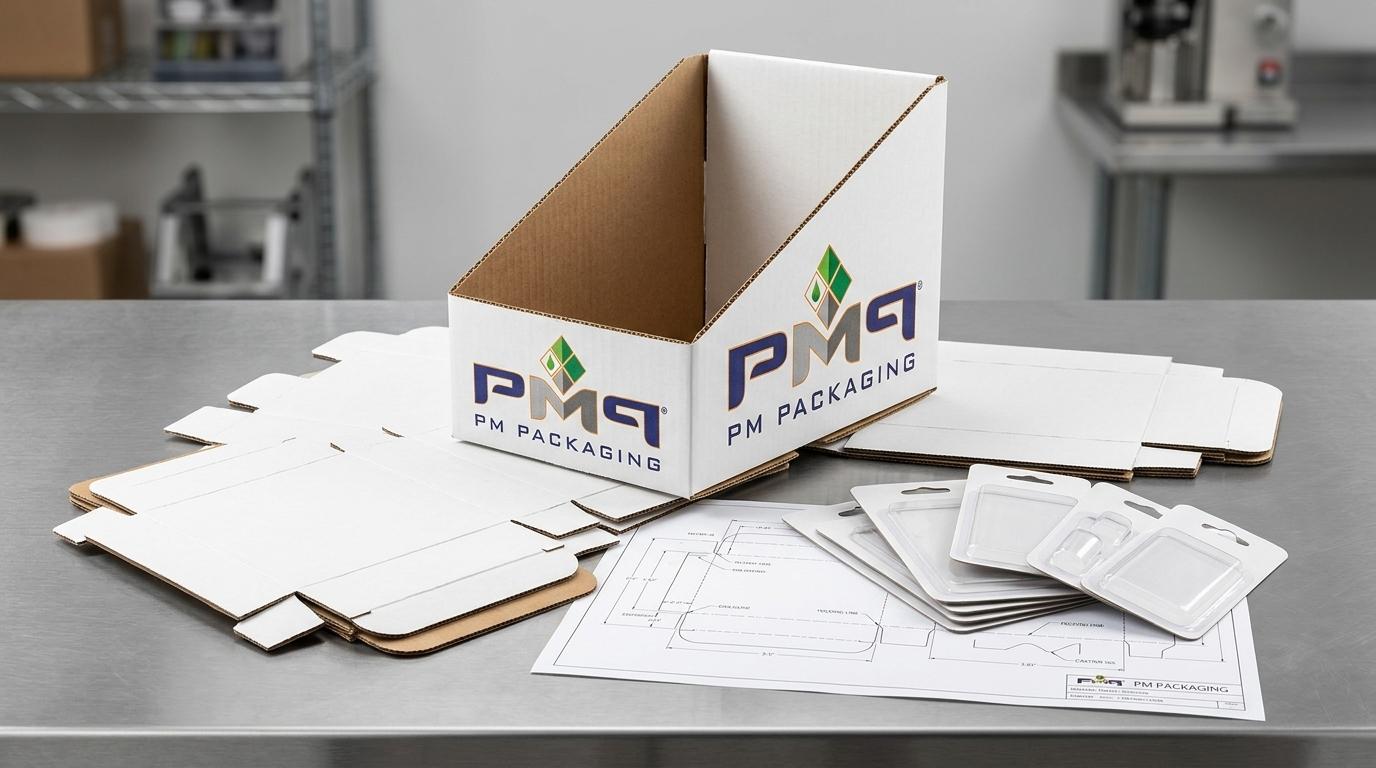
Staging high-volume packaging blanks in border logistics hubs requires strict packaging engineering protocols. Paperboard, corrugated microflutes, and heat-seal blister cards are hygroscopic materials that absorb and desorb atmospheric moisture, directly impacting structural compression strength and performance on automated high-speed cartoning lines.
Atmospheric Hygroscopic Equilibrium in Paperboard & SFL
| Packaging Substrate Type | Optimal Storage RH & Temp | Failure Mode if Warehoused Improperly |
|---|---|---|
| Solid Bleached Sulfate (SBS) | 45% - 55% RH / 65°F - 75°F | Edge-curl, scoring crack, glue-flap spring-back |
| Coated Recycled Board (CRB) | 40% - 50% RH / 65°F - 72°F | Delamination, caliper swelling, feeder jams |
| Litho SFL Microflute (E/F Flute) | 45% - 55% RH / 60°F - 75°F | Washboarding, fluting crush, ECT degradation |
| Blister Cards (Heat-Seal Coat) | 40% - 50% RH / 65°F - 70°F | Coating blocking (cards sticking), seal failure |
| Rigid Setup Greyboard (80pt+) | 40% - 55% RH / 65°F - 75°F | Board warping, wrap peeling, corner tear-out |
5.1 Warehouse Environmental Control & Moisture Equilibration
PM Packaging's border VMI facilities enforce climate-managed warehousing standards to maintain paperboard moisture content between 6.0% and 7.5%, the industry benchmark for high-speed cartoning performance:
- Eliminating Cartoner Feeder Jams: In automated cartoning machines (such as R.A Jones, Bosch/Syntegon, or Kliklok equipment operating at 200 to 450 cartons per minute), a curl variance of greater than 0.035 inches (0.89 mm) causes vacuum cup misfeeds, line stoppages, and carton crush.
- VMI Acclimatization Protocols: When skids are dispatched from the border hub to regional contract packagers, pallet loads remain sealed in 80-gauge stretch wrap with top-caps until reaching thermal and hygroscopic equilibrium with the co-packer's packaging floor (a mandatory 24-hour staging protocol).
5.2 Compression Resistance & BCT in Multi-Tier VMI Racking
In border VMI hubs, packaging is stored as flat-folded blanks or nested trays in multi-tier pallet racking. To ensure that master cartons and pallet loads withstand prolonged warehouse stacking without structural failure, PM Packaging engineers calculate the Box Compression Test (BCT) using the McKee Formula:
Where ECT is Edge Crush Test (lbs/in), U is outer box perimeter (2L + 2W in inches), and d is caliper thickness of the fluted corrugated board. To prevent long-term creep deformation, PM Packaging integrates a Safety Factor (SF) of 3.5 to 4.5 for all master shipping containers.
6. SFL Microflute & Club Store Pallet Pack VMI Execution
Club store retail formats (Costco Wholesale and Sam's Club) impose the most demanding packaging requirements in mass retail. Goods must be displayed on 48" x 40" GMA full pallets, in multi-tiered Single Face Laminate (SFL) E-flute or F-flute master trays, engineered to survive multi-layer stacking without corrugated stretch wrap on the sales floor.
6.1 Solving the Volume Bulk Dilemma with Flat-Folded SFL Staging
Fully assembled club store display trays and pallet packs occupy massive physical cube space. Transporting assembled trays from an offshore or distant converter wastes thousands of dollars per truckload in "shipping air." PM Packaging resolves this by designing patented auto-locking, pre-glued SFL display trays:
Flat-Staged Density
Trays are warehoused flat in our border VMI hub, maximizing pallet pack density (up to 1,200 flat trays per pallet vs. 60 assembled trays).
Instant Line-Side Erection
The tray pops open and locks into a rigid 44 ECT display tray in under 3 seconds without hot-melt glue guns, tape, or tools.
G7 Color Consistency
High-impact offset lithographic print laminated to E-flute or F-flute ensures flawless brand color across 500+ warehouse club locations.
7. Multi-SKU Hardware & Consumer Goods: The qikCombo™ Blister Program
For enterprise brands marketing extensive product lines—such as architectural hardware, consumer electronics cables, hand tools, cutting accessories, cosmetics, and OTC pharmaceuticals—managing dozens of distinct packaging SKUs creates extreme inventory fragmentation.
How qikCombo™ Streamlines Multi-SKU Border Inventory
PM Packaging's proprietary qikCombo™ Program groups 5 to 20 distinct part numbers onto consolidated offset print forms, providing enterprise procurement teams with unmatched flexibility:
- Low Minimums at High-Volume Pricing: Run short-run SKUs (5k to 15k units) alongside hero SKUs (100k+ units) without short-run penalties.
- Fast 10-Day Production Turnaround: Continuous gang-run cycles replenish border VMI racking dynamically.
- Certified Heat-Seal Coatings: Precision water-based coatings calibrated for automated lines (Alloyd, Sonoco, Starview), guaranteeing fiber-tearing seals.
8. Cross-Border Customs, IMMEX V1 Transfers & USMCA Compliance
A critical advantage of PM Packaging's border VMI infrastructure is the seamless integration between U.S. warehousing and Mexican export manufacturing regulations.
IMMEX V1 Virtual Transfer & Cross-Border Regulatory Matrix
| Regulatory / Customs Element | PM Packaging Border VMI Program | Non-IMMEX / Offshore Sourcing |
|---|---|---|
| Mexican IVA Tax (16%) | 0% Cash Outlay (AAA Certified) | 16% Cash Trapped for 6-18 Months |
| Customs Declaration Mechanism | Pedimento V1 (Virtual Transfer) | Clave A1 (Definitive Commercial Import) |
| Anexo 24 / 30 Automated Tracking | 100% Automated Discharges | Manual customs audit reconciliation risk |
| USMCA Rules of Origin | 100% Duty-Free (North American) | Section 301 China Tariffs (7.5% - 25.0%) |
| Border Inspection Lanes | C-TPAT / OEA Dedicated FAST | Standard commercial queues (4-12 hr delays) |
8.1 IMMEX Virtual Transfers (Pedimentos V1) for Mexican Co-Packers
For enterprise brands assembling products in Baja California maquiladoras (Tijuana, Mexicali, Tecate) or interior Mexican manufacturing clusters, packaging moves line-side within Mexico without crossing the U.S. border, eliminating double-drayage freight expenses and the 16% Mexican Value-Added Tax (IVA) cash outlay.
8.2 USMCA Tariff-Free Compliance
All paperboard, folding cartons, and SFL microflutes converted by PM Packaging satisfy USMCA Rules of Origin. Converted from certified North American virgin and recycled paperboard mills, our products enter the United States 100% tariff-free, completely eliminating exposure to Section 301 tariffs (7.5% to 25.0%) that penalize goods imported from China.
9. Comprehensive Procurement Comparison Matrix
To assist corporate procurement committees, supply chain directors, and CFOs in evaluating a transition to PM Packaging's Border VMI model, the matrix below details the operational, financial, and strategic trade-offs across all primary packaging sourcing channels.
Total Cost of Ownership (TCO) & Sourcing Strategy Comparison
| Evaluation Criteria | Transpacific Offshore (Asia) | Domestic US Converter | PM Packaging Border VMI |
|---|---|---|---|
| Replenishment Lead Time | 8 to 14 Weeks (60-100 Days) | 4 to 8 Weeks (Batch Queues) | 24 to 72 Hours (JIT) |
| Working Capital Terms | 100% Prepayment / LC (Net 0) | Net 30 from Ship Date | Pay-on-Consumption |
| Minimum Order Quantity | Very High (100k - 250k/SKU) | Moderate (25k - 50k/SKU) | Flexible Scaled MOQs |
| Carrying Cost Impact | 20% - 25% of Annual Spend | 12% - 18% of Annual Spend | 0% (Converter Owned) |
| Walmart/Target OTIF Risk | Critical / High Fail Rate | Moderate Supply Friction | < 0.1% Stockout Risk |
| Artwork Revision Scrap | High ($50k - $250k write-off) | Moderate Scrap Exposure | Near-Zero (Runouts) |
| Section 301 Tariffs | 7.5% to 25.0% Duty Penalties | 0% | 0% (USMCA Origin) |
| Quality & Print Standards | Inconsistent Delta-E Shifts | Variable Across Plants | G7 Master / GMI / SQF |
| Border Security Clearance | Port Customs Dwell (5-10 Days) | None | C-TPAT / OEA FAST |
| Carbon / Freight Footprint | Extreme Ocean / Port Drayage | High Cross-Country Freight | Optimized Nearshore |
10. Implementation Roadmap: Deploying an Enterprise Border VMI Program
Transitioning an enterprise packaging program to a border VMI model follows a structured, milestone-driven onboarding methodology to ensure zero interruption to active retail fulfillment lines:
Historical Consumption & Buffer Formulation
Ingest historical POS sell-through, co-packer consumption logs, and promotional calendars. Calculate SKU-by-SKU Min/Max thresholds, safety stock buffers (SS), and Reorder Points (ROP).
CAD Auditing & Stacking Optimization
San Diego CAD lab audits existing dielines for auto-locking efficiency and cartoning line speeds. Perform McKee formula BCT compression testing and material substrate optimization (SBS, CRB, SFL Microflute).
Data Bridging & SLA Governance
Map EDI 852, 846, 856, and 940 transaction sets between brand ERP / Co-Packer WMS and PM Packaging VMI Portal. Formalize Pay-on-Consumption terms, inventory ownership boundaries, and SLA performance scorecards.
Offset Press Runs & VMI Staging
High-speed offset press runs at Baja plants under G7 Master color control and GMI target certification. Transport initial 60-day safety stock buffer into San Diego / Otay Mesa VMI Hub under C-TPAT FAST border protocols.
Continuous JIT Pulls & Dynamic Tuning
Initiate automated daily JIT consumption pulls to co-packers and regional DCs. Transition to dynamic, touchless auto-replenishment with zero retail stockout exposure.
10.1 Key Performance Indicators (KPIs) for VMI Contract Governance
Enterprise procurement contracts with PM Packaging are governed by measurable, audited Service Level Agreements (SLAs):
- On-Time In-Full (OTIF) Delivery: ≥ 99.5% compliance to agreed staging pull schedules.
- Dock-to-Stock Pull Speed: Same-day release for orders received before 12:00 PM PST; guaranteed under 24 hours for standard ground dispatches.
- Inventory Discrepancy Rate: Less than 0.01% variance across annual barcode cycle counts.
- Color Consistency Metric: Delta-E (ΔE00) < 1.5 from approved master color targets across all production cycles, verified by spectrophotometric G7 press logs.
11. Conclusion: Securing Your Retail Supply Chain with PM Packaging
In mass retail and modern omnichannel distribution, packaging cannot be managed as an isolated, transactional procurement commodity. It is an integral component of your supply chain's physical operating infrastructure. When packaging fails, your entire distribution network grinds to a halt.
By establishing a Vendor-Managed Inventory (VMI) Hub along the U.S.-Mexico border, enterprise brands eliminate transpacific lead-time lag, unlock millions of dollars in trapped working capital, protect against packaging obsolescence, and guarantee strict compliance with Walmart, Target, and Costco OTIF mandates.
For over 45 years, PM Packaging has served as the trusted packaging engineering and manufacturing partner to the world's most demanding brands. With our dual-border presence, certified G7 Master offset printing, advanced SFL microflute converting, and automated border VMI logistics, we engineer resilience directly into your packaging supply chain.
Request an Enterprise VMI & Packaging Audit
Is your brand scaling into national mass retail or seeking to eliminate co-packer downtime and working capital drag? Contact PM Packaging's supply chain engineering team today to schedule a comprehensive packaging audit, dieline efficiency evaluation, and custom border VMI proposal.
Technical Consultation & Structural CAD Inquiries
San Diego HQ • Otay Mesa Logistics Hub • Baja California Converting Plants • Folding Cartons • Litho-Laminated SFL • qikCombo™ Blister Cards • IMMEX V1 Transfers • USMCA Duty-Free • C-TPAT • G7 Master • ISO 9001:2015 • SQF Certified