
For enterprise consumer brands supplying national retailers—such as Walmart, Target, Costco, Sam's Club, The Home Depot, Sephora, and Ulta—secondary packaging is the vital bridge between manufacturing and retail revenue.
When packaging arrives on schedule, retail shelves stay stocked and brand momentum builds. But when a packaging supply chain falters, the consequences are immediate: retailer chargebacks, missed planogram resets, and empty store shelves.
Historically, procurement teams concentrated folding carton volume with a single converting facility to maximize volume pricing. Today, high-velocity enterprise brands recognize that single-plant sourcing represents a major operational vulnerability. Unplanned machine downtime, regional logistics bottlenecks, or sudden demand spikes can bring an entire retail supply chain to a halt.
To eliminate single-source risk without sacrificing cost efficiency, forward-thinking procurement leaders are structuring resilient, multi-plant nearshore carton manufacturing programs.
The Operational Vulnerabilities of Single-Plant Packaging Sourcing
Relying on a single manufacturing facility exposes enterprise brands to severe operational bottlenecks:
Unplanned Downtime
When a single-facility converter experiences unexpected mechanical downtime, carton production stalls with no internal backup. Without an active sister facility running identical tooling, operations remain at a standstill until repairs finish.
Peak Capacity Bottlenecks
During promotional surges, holiday rollouts, or club store pack-outs, a single plant's capacity can saturate, extending lead times and delaying shipments across core retail product families.
Geographic Vulnerability
Single-site domestic converters leave brands vulnerable to regional freight delays, while transpacific overseas suppliers expose operations to 6 to 12 weeks of ocean transit, port congestion, and customs holds.
Tooling Lock-In
When packaging dielines and tooling are configured strictly for one converter's proprietary machinery, transitioning production to an alternate supplier in an emergency requires weeks of re-tooling and substantial capital expense.
Key Pillars of a Resilient Multi-Plant Nearshore Network
True packaging resilience is built upon an integrated, multi-plant nearshore ecosystem designed for seamless redundancy and rapid scalability.
Mirrored Converting Lines and Standardized Dielines
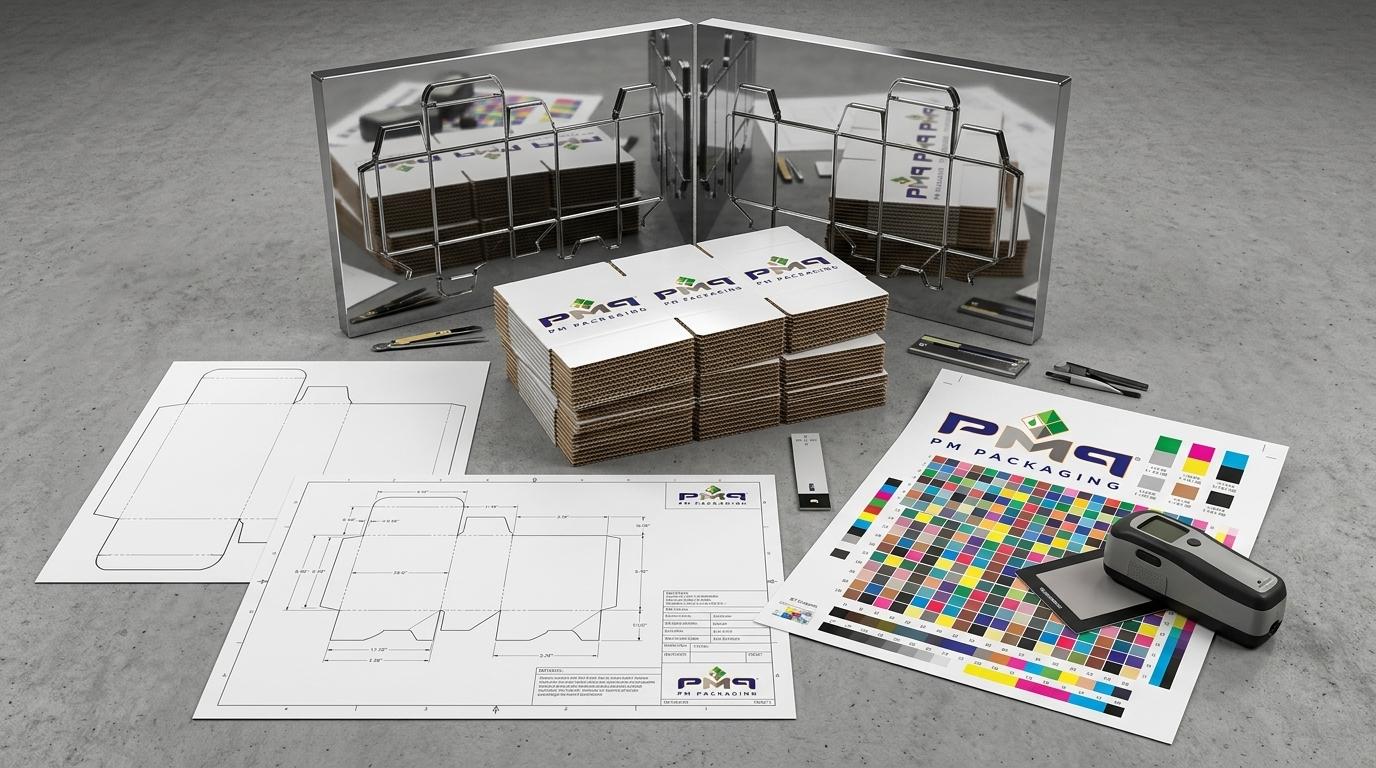
A robust multi-plant strategy standardizes structural carton dielines across all manufacturing locations. Cutting dies, stripping stations, and pre-press digital assets are engineered to be fully interchangeable between facilities. If one plant experiences peak volume, production shifts smoothly to a sister facility without altering carton dimensions or requiring assembly line adjustments.
Centralized Engineering and Pre-Press Architecture
Redundancy succeeds only when structural integrity and print quality remain uniform across facilities. By centralizing structural CAD engineering, pre-press proofing, and dieline management at a single technical hub—such as PM Packaging's headquarters in San Diego—brands ensure identical dieline files, print tolerances, and structural parameters govern production across every manufacturing floor.
G7 Master Certified Color Standardization
When folding cartons produced across multiple plants arrive on retail shelves, visual consistency is paramount. Certified G7 Master color management establishes strict calibration across all printing presses, ensuring that custom folding cartons, laminated microflute packaging, and printed blister cards maintain exact color consistency across every production run.
Dynamic Capacity Balancing and Surge Management
A multi-plant network allows procurement leaders to dynamically balance production volumes across plants based on seasonal demand surges. High-volume baseline runs proceed steadily at one facility while rapid-turn promotional cartons run in parallel at a sister plant, protecting delivery schedules.
Comparing Packaging Sourcing Models
Structuring secondary packaging across a coordinated multi-plant nearshore network delivers significant risk mitigation and operational flexibility:
Packaging Sourcing Model Strategic Comparison
| Strategic Metric | Single-Plant Domestic Converter | Overseas Supplier (Transpacific) | Multi-Plant Nearshore Network (PM Packaging) |
|---|---|---|---|
| Disaster Recovery & Redundancy | Low (Single point of failure) | Very Low (High transit vulnerability) | High (Seamless workload transfer between twin plants) |
| Peak Volume Scalability | Limited to single-facility capacity | High capacity, but rigid scheduling | Elastic (Dynamic capacity balancing across plants) |
| Transit Lead Times | 2 to 5 days domestic ground | 6 to 12 weeks ocean freight | 1 to 3 days ground (West Coast/Southwest) |
| Tariff & Customs Risk | None | High (Subject to tariffs and port delays) | Zero (100% Tariff-Free USMCA Compliance) |
| Tooling & File Portability | Converter-locked tooling | Incompatible formats & re-tooling costs | Fully standardized, cross-plant interchangeable |
| Brand Color Uniformity | Consistent within one plant | High batch-to-batch variation | G7 Master certified across all facilities |
The Nearshore Advantage: Dual-Facility Agility Along the Border
With over 45 years of packaging expertise, PM Packaging provides enterprise brands with the security of a multi-plant nearshore manufacturing network. Headquartered with structural design and engineering teams in San Diego, California, PM Packaging operates modern converting facilities in Baja California (Tijuana and Mexicali).
This dual-facility infrastructure offers distinct advantages for enterprise supply chains:
Built-In Facility Redundancy
Twin manufacturing hubs in Tijuana and Mexicali provide active production backup, ensuring continuous supply and disaster recovery for national retail programs.
100% Tariff-Free USMCA Security
Fully compliant North American trade eliminates transpacific import tariffs and geopolitical customs delays, securing duty-free cross-border replenishment.
Rapid Ground Distribution
Finished folding cartons reach West Coast and Southwest distribution centers within 1 to 3 days (3 to 5 days nationwide), supporting just-in-time assembly and lean inventory.
Comprehensive Format Capabilities
Seamless production across custom folding cartons (virgin bleached paperboard, eco-friendly kraft, and recycled board), laminated microflute packaging, rigid setup boxes, POP displays, and paperboard blister card packaging.
Build a Resilient Packaging Supply Chain with PM Packaging
Single-source packaging dependencies introduce unnecessary risk to national retail rollouts. Transitioning to a multi-plant nearshore manufacturing model safeguards production schedules, protects retailer relationships, and delivers the capacity agility required to scale.
Whether expanding into national club store programs, mitigating single-converter risk, or optimizing cross-border logistics, PM Packaging delivers the structural design excellence, certified print quality, and multi-plant capacity your brand demands.
Ready to Eliminate Single-Source Packaging Risk?
Connect with the packaging specialists at PM Packaging to schedule a structural packaging audit and explore our multi-plant nearshore manufacturing solutions today.
Consolidated Multi-Plant Packaging Services
Partner with PM Packaging to secure dedicated engineering, standardized universal tooling, and dual-facility active production redundancy across North America.
- Engineering Headquarters: San Diego, California
- Dual Manufacturing Campuses: Tijuana & Mexicali, Baja California
- Core Capabilities: Custom Folding Cartons, Single Face Lamination (SFL), Blister Cards, Counter PDQs, and Luxury Rigid Boxes.