
For Vice Presidents of Supply Chain, Directors of Procurement, and Senior Packaging Engineers managing national retail distribution across North America, few operational crises are as costly or preventable as emergency air-freight expedites for secondary packaging.
In high-volume consumer packaged goods (CPG), consumer electronics, over-the-counter (OTC) healthcare, cosmetics, and industrial hardware, secondary packaging—whether a printed folding carton, a thermoformed blister card, a litho-laminated Single Face Laminate (SFL) microflute box, or a Point-of-Purchase (POP) display tray—sits directly on the critical fulfillment path. When primary products are manufactured, filled, and staged on assembly lines, they cannot be palletized, cross-docked, or shipped to retail distribution centers without their secondary packaging.
When an offshore packaging pipeline from East Asia breaks down due to maritime delays, port terminal congestion, or sudden retail forecast surges, enterprise brands face a catastrophic commercial dilemma: pay hundreds of thousands of dollars in emergency international air freight to fly empty paperboard across the Pacific, or face severe retail On-Time, In-Full (OTIF) chargebacks, shelf delisting, and factory shutdowns.
The Offshore Sourcing Trap
- × 10–14 week total lead time (3–4 wk press + 4–6 wk ocean + port dwell).
- × High-altitude air freight cost: $4.50 to $9.00 / chargeable kg.
- × Air-cargo freight cost equals 5x to 15x base paperboard value.
- × Board moisture desorbs to < 4.5%, inducing score cracking & cartoner jams.
The PM Packaging Nearshore Model
- ✓ 2–3 week total turnaround (10–14 day press run + 1–3 day ground freight).
- ✓ 100% USMCA tariff-free; zero Section 301 punitive duties.
- ✓ Dedicated FAST lane commercial border clearance in 30–60 minutes.
- ✓ Same-day / next-day ground hot-shot delivery absorbs retail demand spikes.
With over 45 years of commercial packaging engineering and large-format converting excellence, dual-border operations headquartered in San Diego, CA, and advanced manufacturing campuses across Baja California (Tijuana and Mexicali), PM Packaging eliminates the structural vulnerabilities that force brands into emergency air-freight spending.
By positioning high-capacity 6-to-8 color offset lithographic printing, litho-laminated Single Face Laminate (SFL) microflute converting, blister card production, and luxury rigid setup box manufacturing directly along the U.S.–Mexico border, PM Packaging empowers enterprise brands to replace 12-week overseas ocean pipelines and $100,000+ air charters with 1 to 3 business days of reliable, low-cost ground freight.
1. The Physics and Economics of Air-Freighting Paperboard Packaging
Air cargo is fundamentally priced on cubic space, not just dead weight. For secondary packaging, which is rigid, bulky, and structurally voluminous, the mathematics of international air transport create an immediate financial penalty.
The Packaging Air-Freight DIM Weight Trap
International air cargo carriers (IATA standards) charge based on the greater of Actual Gross Weight or Volumetric (Dimensional) Weight:
Steel Machine Hardware
- • Pallet Dimensions: 40" × 48" × 20"
- • Actual Weight: 2,200 lbs (998 kg)
- • DIM Weight: 276 lbs (125 kg)
- ✓ Billed on: Actual Weight (No DIM penalty)
Die-Cut Glued Folding Cartons
- • Pallet Dimensions: 40" × 48" × 60"
- • Actual Weight: 950 lbs (431 kg)
- • DIM Weight: 828 lbs (Imperial) / 629 kg (IATA)
- × Billed on: DIM Weight (+46% Surcharge for Trapped Air)
The 100,000-Carton Emergency Air-Freight Scenario: A Financial Post-Mortem
To illustrate the severity of this spend, consider a national consumer brand manufacturing high-velocity personal care hardware packaged in an 18pt Solid Bleached Sulfate (SBS) Straight Tuck Folding Carton (dimensions: 5" × 3" × 8"):
- • Order Volume: 100,000 units.
- • Unit FOB Price (China): $0.24 per carton ($24,000 total material spend).
- • Packaging Palletization: 20 pallets (each 40" × 48" × 54"), gross weight ~18,000 lbs (8,165 kg), volumetric weight ~10,600 kg.
- • Ocean Logistics Failure: Transpacific container rolled at Ningbo port; 4-week ocean delay threatens a mandatory promotional set date at Target and Walmart.
- • The Expedite Decision: Supply chain management authorizes emergency commercial air freight from Shanghai (PVG) to Los Angeles (LAX) to keep co-packers running.
Emergency Air-Freight vs. Nearshore Ground Landed Cost Audit (100k Cartons)
| Cost Component | Asia Standard (Ocean) | Asia Emergency (Air Cargo) | PM Packaging (Nearshore) |
|---|---|---|---|
| Base Carton Manufacturing Cost | $24,000 ($0.240/unit) | $24,000 ($0.240/unit) | $27,000 ($0.270/unit) |
| International Freight (Port/Door) | $4,200 (Container Share) | $74,200 ($7.00/kg chg wt) | $1,400 (Dedicated FTL) |
| Airport Terminal / Handling / Fuel | $0 | $8,600 | $0 |
| Section 301 U.S. Import Tariffs | $1,800 (7.5% HTS 4819) | $1,800 | $0 (100% USMCA Duty-Free) |
| Local Drayage / Final Mile Truck | $850 | $1,450 (Airport to Plant) | Included in FTL |
| Customs Brokerage & Entry Bonds | $350 | $650 | $150 |
| TOTAL LOGISTICS & MATERIAL SPEND | $31,200 | $110,700 | $28,550 |
| EFFECTIVE DELIVERED UNIT COST | $0.312 / carton | $1.107 / carton | $0.285 / carton |
| TRANSIT TIME (CONVERTER TO DOCK) | 35 – 50 Days | 4 – 7 Days | 1 – 2 Days Ground |
| EXPEDITE VARIANCE VS BASELINE | Base Baseline | +$79,500 (+255% Cost Overrun) | -$2,650 (Net Landed Savings) |
In this real-world scenario, the brand paid $1.107 per unit for a $0.24 carton—an expedite penalty of $79,500 that wiped out the quarterly gross margin for the entire product SKU. By contrast, sourcing the identical program through PM Packaging’s Baja California converting facility delivers a landed unit cost of $0.285 via 1-to-2 day dedicated ground freight into Southern California contract packaging facilities, completely bypassing both the 6-week transpacific ocean lead time and the catastrophic $79,500 air-freight charge.
2. The Atmospheric & Structural Risks of Air-Transported Packaging
Beyond financial waste, air-freighting secondary packaging introduces severe structural and mechanical defects that frequently cripple downstream high-speed automated cartoning and packing lines.
How High-Altitude Cargo Flight Degrades Paperboard Physics
Paperboard is a hygroscopic, viscoelastic material designed to operate at 6.0%–7.5% moisture content (TAPPI T402).
Rapid Desorption
Unconditioned cargo hold relative humidity drops to 5%–10%. Cellulose fibers lose bound water, dropping paperboard moisture content below 4.5%.
Uneven Re-Hydration
Rapid moisture re-absorption induces asymmetric Cross-Direction (CD) fiber expansion, causing carton blanks to cup, warp, and twist across pallets.
Feeder Jams & Cracking
Score stiffness increases 30%–50%, carton flaps fracture along crease channels, and rotary vacuum cups mispick blanks on 300+ CPM cartoner lines.
1. Board Moisture Shock and Equilibrium Loss
Paperboard is a hygroscopic, viscoelastic material manufactured to maintain an optimal internal moisture content of 6.0% to 7.5% at standard ambient conditions (73°F / 50% RH, TAPPI T402). During a 14-to-18 hour transpacific flight at 35,000 feet, ambient relative humidity in cargo freighters plunges to under 10%:
Fiber Brittleness & Flap Delamination: As moisture drops below 4.5%, cellulose fibers lose elasticity. When carton flaps are folded along pre-creased scores during high-speed packaging, the outer coated liners crack along the fold lines, destroying brand graphics and exposing raw white or grey fibers.
Crease Stiffness (Taber) Distortion: Score-line bending resistance increases exponentially as moisture leaves the sheet. Folding carton flap resistance can increase by 30% to 50%, exceeding the mechanical torque limits of high-speed cartoner tucking fingers.
2. Dimensional Warping and Automated Line Downtime Multipliers
When dry cartons land at sea-level distribution or contract packaging facilities in humid climates (e.g., Southern California, Texas, Florida, or the Midwest), rapid re-absorption of ambient moisture induces differential expansion across the sheet:
Curling Along Grain Direction: Because paperboard fibers expand up to 4x to 5x more in the Cross Direction (CD) than the Machine Direction (MD), uneven re-humidification causes carton blanks to cup or twist.
Rotary Vacuum Feeder Misfires: High-speed automated cartoning machines (such as Bosch/Syntegon, R.A. Jones, Bradman Lake, or Kliklok operating at 200 to 400+ cartons per minute) rely on pneumatic suction cups to pull flat carton blanks from magazines and open them. Warped or cupped blanks cause mispicks, double-feeds, and catastrophic feeder jams.
Downtime Multipliers: Contract packagers bill machine downtime back to the brand at rates between $750 and $1,500 per hour, completely erasing any perceived time savings gained from air transport.
Substrate Performance Under Rapid Logistics & Automation
| Substrate Category | Air Transport Sensitivity | Automated Line Feeder Risk | PM Packaging Nearshore Control |
|---|---|---|---|
| Solid Bleached Sulfate (SBS) 14pt – 26pt Caliper | High (Flap cracking, loss of Taber crease ratio) | Moderate-High (Vacuum cup mispicks from cupping) | Controlled equilibrium transit; conditioned ground FTL loads |
| Clay Coated Newsback (CCNB) 16pt – 30pt Caliper | Severe (Recycled fibers fracture easily at low RH) | High (De-lamination under high-speed folder-gluing) | Moisture-stabilized converting; precision matrix creasing |
| Single Face Laminate (SFL) E-Flute / F-Flute Corrugate | Critical (Flute curl, asymmetric liner tension) | Critical (Magazine jam, improper squaring) | Litho-lamination in controlled environment; zero air-shock |
| Blister Cards (Heat-Seal) 20pt – 28pt SBS / Recycled | High (Card warp breaks heat-seal platen contact) | High (Blister sealing nest misalignment) | Flatbed die-cut with dedicated matrix; 100% flat presentation |
3. The Nearshore Sourcing Architecture: Baja California & San Diego Footprint
The permanent operational solution to packaging air-freight expedites is geographic proximity combined with high-capacity converting infrastructure. PM Packaging operates a synchronized dual-border footprint that unites U.S. corporate engineering, CAD structural design, and client service in San Diego, California, with high-capacity manufacturing campuses across Tijuana and Mexicali, Baja California.
PM Packaging Dual-Border Infrastructure
San Diego HQ & Packaging Lab
- • Structural CAD & 3D Prototyping (24–48 hr samples)
- • G7 Color Management & Prepress CTP Workflow
- • Executive Client Engineering & Account Management
- • Dual-Border Freight & Customs Coordination Hub
Baja Advanced Converting Campuses
- • 6-to-8 Color Large-Format Offset Presses (UV & Aqueous)
- • SFL Microflute Inline Corrugators & Laminators
- • High-Speed Flatbed Die-Cutters & Multi-Point Gluers
- • ISO 9001, SQF, GMI, FSC/SFI Chain-of-Custody Certified
Dedicated Ground Transit Times Across Major Retail Logistics Corridors
By eliminating transpacific ocean transit, customs dwell at marine terminals, and port drayage bottlenecks, PM Packaging converts packaging logistics from an unpredictable multi-month endeavor into a predictable, scheduled ground delivery schedule:
Southern California Hubs
Same Day / 24hInland Empire (Ontario, Fontana, Chino), Los Angeles, Orange County, San Diego.
Transit: 4 to 12 hours dock-to-dock via dedicated FTL shuttle.
Southwest & Central Valley
1 – 2 DaysPhoenix, AZ; Las Vegas, NV; Tracy / Stockton / Patterson / Central Valley, CA.
Transit: 24 to 48 hours direct line-haul dry van transport.
Pacific Northwest & Intermountain
2 – 3 DaysSeattle / Tacoma, WA; Portland, OR; Salt Lake City, UT; Reno, NV.
Transit: 48 to 72 hours via Interstate 5 and Interstate 15 corridors.
Midwest, Texas & Southeast
3 – 5 DaysDallas / Fort Worth, TX; Memphis, TN; Chicago, IL; Atlanta, GA.
Transit: 3 to 5 business days via dedicated cross-country team drivers.
Emergency Escalation Agility: Same-Day Hot-Shot vs. Overseas Air Charters
When a mass retail buyer at Walmart, Target, or Costco suddenly issues a purchase order for an additional 40,000 units with an aggressive 5-day delivery window:
The Offshore Reality: Sourcing from an Asian converter requires emergency air cargo chartering. Total cost: $35,000 to $85,000+ in air-freight fees, with airport customs clearance risking delivery deadlines.
The PM Packaging Nearshore Reality: PM Packaging pulls pre-staged safety stock or runs an agile press batch, loading finished packaging onto a dedicated cross-border Sprinter van or hot-shot straight truck. The shipment clears the Otay Mesa commercial border crossing in under an hour and arrives at the customer’s Southern California packing facility within 6 hours. Total expedite logistics cost: $600 to $1,500—eliminating 98% of the expedite expense while guaranteeing 100% on-time retail delivery.
4. Trade Mechanics & Border Logistics: USMCA, IMMEX, and FAST Clearance
A critical concern for procurement directors evaluating Mexico manufacturing is cross-border trade friction. PM Packaging has engineered a frictionless trade ecosystem that leverages North American trade agreements and certified security programs.
1. 100% Tariff-Free Under USMCA / T-MEC
Unlike packaging imported from China, which remains subject to Section 301 punitive tariffs ranging from 7.5% to 25%+ on paperboard and packaging products (Harmonized Tariff Schedule Chapter 48), PM Packaging’s products qualify for 100% duty-free treatment under USMCA / T-MEC. All virgin and recycled paperboard, liners, and fluting mediums are sourced from qualified North American paper mills (HTS 4819.10, HTS 4819.20, and HTS 4821.10).
2. IMMEX Virtual Transfers (Pedimento V1) for Co-Packers in Mexico
For multinational consumer brands operating manufacturing, kitting, or assembly maquiladoras in Baja California, PM Packaging utilizes IMMEX Virtual Transfers (Pedimentos Clave V1). Packaging materials manufactured in Baja are transferred directly to the brand’s contract packaging plant without crossing the physical U.S. border first, eliminating Mexican IVA (16%) cash outlays and optimizing working capital.
3. C-TPAT Tier II and FAST Lane Border Clearance
Border crossing delays are eliminated through rigorous supply chain security certifications: C-TPAT (Customs-Trade Partnership Against Terrorism) and FAST (Free and Secure Trade) dedicated commercial lanes at Otay Mesa and Calexico, completing customs processing in 30 to 60 minutes.
5. Agile Production Programs That Preempt Emergency Shortages
Air-freight expedites are almost always the symptom of rigid, inflexible production schedules and massive offshore Minimum Order Quantities (MOQs). PM Packaging employs advanced production programs specifically designed to absorb demand volatility and eliminate the need for emergency logistics.
1. qikCombo™ Gang-Run Program
Multi-SKU- • Combines 5 to 20 discrete SKUs on a single large-format press sheet.
- • Economical run volumes: 5,000 to 100,000 units per SKU.
- • Rapid 10-business-day manufacturing turnaround.
- • Eliminates dead inventory while balancing tooling and plate costs.
2. VMI & Safety Stock Staging
Replenishment- • 30 to 60 days of safety stock held in San Diego / Baja warehouses.
- • Automated min-max EDI replenishment triggers based on co-packer burn.
- • 24–48 hour call-off releases delivered direct to packaging lines.
- • Zero stockouts during unexpected retailer promotional surges.
3. Rapid Prepress & Tooling Lab
Prototyping- • In-house CAD sample tables and CTP laser plate imaging in San Diego.
- • Steel rule die and blanking cassette milling in 24–48 hours.
- • G7 Master digital color drawdowns on actual production board.
- • Instant structural revisions without overseas shipping lag.
4. Dual-Plant Redundancy
Continuity- • Mirrored large-format offset press capacity across Tijuana and Mexicali.
- • Dual-facility operational redundancy prevents single-point failure.
- • Standardized substrate stockpiles (SBS, CCNB, CUK, E/F-flute).
- • High-speed Bobst flatbed die-cutting and multi-point gluing redundancy.
6. Comprehensive Product Lines & Technical Substrate Specifications
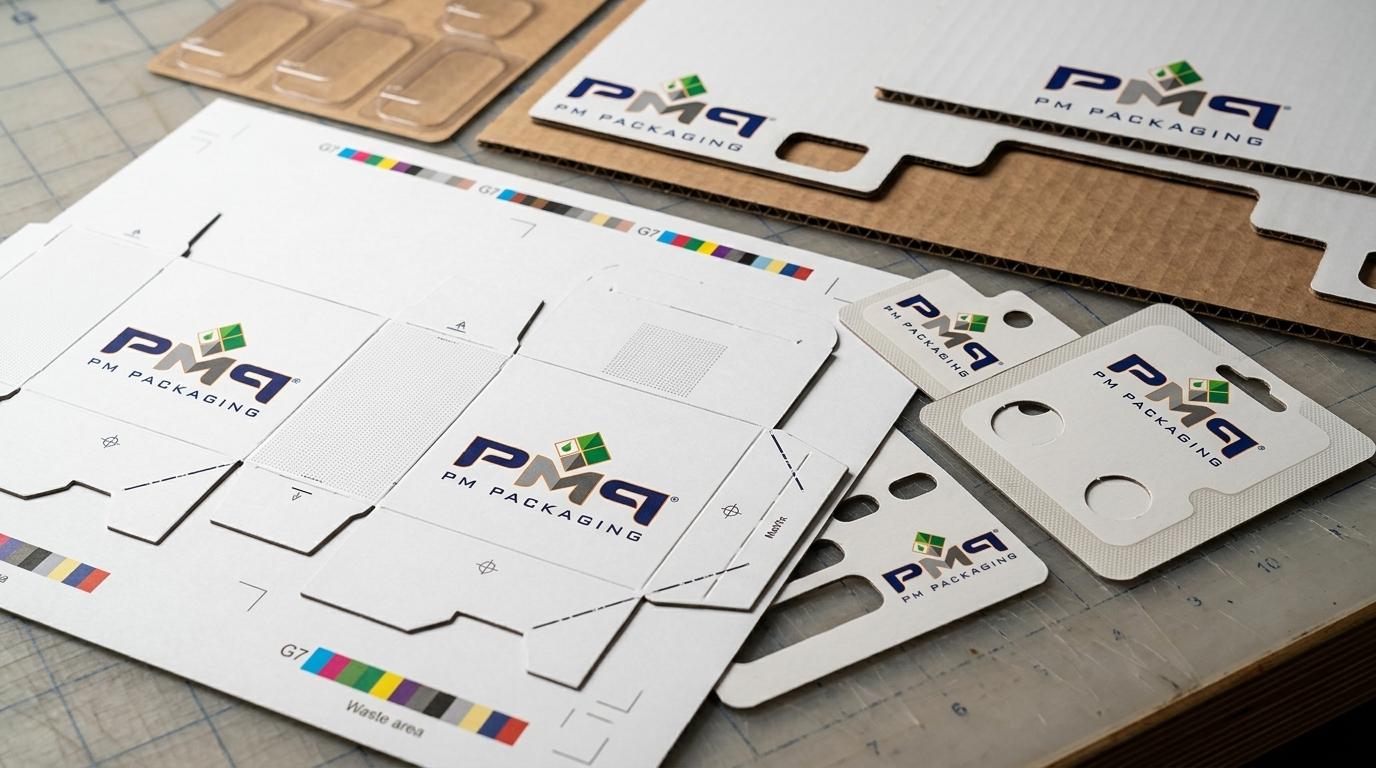
PM Packaging manufactures full-spectrum commercial packaging systems across folding cartons, litho-laminated Single Face Laminate (SFL) microflute, luxury rigid setup boxes, and blister cards:
PM Packaging Commercial Product Lines & Capabilities
| Product Line | Caliper & Substrate Specs | Structural Dieline Formats | Target Retail Applications |
|---|---|---|---|
| Folding Cartons Automated High-Speed | 12pt to 32pt SBS, CCNB, and CUK / Kraft board | Straight Tuck (STE), Reverse Tuck (RTE), Auto-Bottom, Snap Lock | Cosmetics, OTC Pharma, Personal Care, Consumer Tech (Target, Walmart) |
| Single Face Laminate (SFL) Microflute Corrugate | Litho-laminated top sheet to E-Flute, F-Flute, B-Flute, N-Flute | 4-Corner Beers Trays, RETF Mailers, Glued Auto-Bottom Master, Handles | Power Tools, Hardware, Beverage Multipacks, Club Store Pallet Packs (Costco) |
| Luxury Rigid Setup Boxes High-End Presentation | 40pt to 120pt Greyboard wrapped in litho art paper or soft-touch | Book-Style Magnetic Box, 2-Piece Shoulder/Neck Box, Sliding Drawer | Premium Spirits, Fragrances, Luxury Eyewear, Audio, VIP Seeding Kits |
| Blister Cards & Inserts qikCombo™ Compatible | 20pt to 28pt SBS / Recycled with specialty heat-seal coatings | Single-Seal Face Blister, Fold-Over Trapped Blister, Slide-Blister | Hardware, Auto Parts, Stationery, Pet Accessories (Home Depot, AutoZone) |
| Retail Displays & POP Floor-Ready Merchandising | E/B-Flute SFL or B/C-Flute Corrugated litho-laminated to high gloss | Countertop PDQ Displays, Sidekicks / Power Wings, Full Pallet Trays | High-Velocity Front Endcaps, Club Store Pallets, Checkout Impulse |
7. Protecting Mass Retail OTIF Benchmarks & Brand Equity
In modern omni-channel and brick-and-mortar retail, packaging delivery reliability directly impacts vendor standing and bottom-line profitability. Missing a delivery slot triggers non-negotiable fines and long-term modular penalties.
Retail Channel Delivery Benchmarks & Penalties
| Retail Channel | Vendor Delivery Benchmark | Financial & Operational Penalty for Delay |
|---|---|---|
| Walmart U.S. | OTIF ≥ 98% (Strict 1-day delivery window) | Non-negotiable 3% COGS invoice fine; loss of preferred vendor tier; reduction in shelf facings. |
| Target Corporation | MBD ≥ 95% (Narrow 2-day delivery slot) | 5% invoice penalty; mandatory supply chain audit; chargebacks on late inbound appointments. |
| Costco Wholesale | Strict 2-Day Appointment Window | Immediate cancellation of promotional purchase order; mandatory pallet rework fees ($500–$2,500). |
| Sam’s Club / Home Depot | Supplier Performance Index (SPI) | Chargebacks per delayed PO; forfeiture of endcap and sidekick displays to competing brands. |
| Amazon AWD / FBA | Inbound Carrier Appointment Slot | Receiving appointment cancellations; inventory placement surcharges; lost “Buy Box” priority. |
Eliminating the Co-Packer Domino Effect
When packaging is late, the operational damage extends far beyond the converter invoice:
1. Line Rescheduling Penalties: Contract packagers book production shifts weeks in advance. If secondary cartons fail to arrive on schedule, the co-packer assigns the shift to another client, pushing the delayed brand’s run back by 2 to 4 weeks.
2. Idle Labor Billing: Co-packers often bill brands for standby labor ($25 to $45 per worker-hour) when automated lines are halted mid-run due to packaging stockouts.
3. Primary Product Spoilage: For temperature-sensitive cosmetics, food items, or active chemical products, delays in secondary packaging staging risk inventory expiration before goods reach retail shelves.
8. Enterprise Procurement Migration Framework: The 6-Step Nearshore Playbook
For procurement directors, category managers, and supply chain VPs seeking to eliminate air-freight risks, transitioning packaging from overseas converters to PM Packaging follows a structured, risk-mitigated methodology:
Step 1: Historical Expedite Audit & SKU Vulnerability Mapping
Review past 24 months of logistics general ledger accounts for air-freight expedites, airport handling surcharges, port demurrage, and retail OTIF chargebacks. Identify high-volatility SKUs.
Step 2: Dieline Standardization & Cartoning Optimization
PM Packaging’s San Diego CAD engineering team conducts a structural audit of existing dielines, converting manual configurations to high-speed auto-bottom or straight tuck end designs optimized for 300+ CPM automated feeding.
Step 3: Substrate Specification Rationalization
Evaluate caliper and basis weights: 16pt/18pt SBS for high-graphic beauty/pharma, 20pt–28pt CCNB for dry goods/hardware, and Single Face Laminate (E/F-flute) for products requiring heavy retail stacking strength.
Step 4: Prepress Color Management & G7 Profiling
Ingest brand digital assets into PM Packaging’s certified G7 color workflow. Execute digital proofing, CTP plate imaging, and physical spectrophotometric ink drawdowns on specified production board within 24 to 48 hours.
Step 5: VMI Buffer & Min-Max Reorder Trigger Modeling
Establish dynamic safety stock levels based on POS demand data, lead times (10–14 days converting + 1–3 days freight), and retail promotional calendars with floor-stock staging in San Diego or Baja.
Step 6: Co-Packer Line Trial & Commercial Cutover
Run a 5,000-to-10,000 unit pilot run across the client’s automated cartoning or blister packaging equipment to verify score stiffness, flap folding, and glue adhesion before completing full nearshore transition.
Summary & The PM Packaging Strategic Advantage
Air-freight packaging expedites are an expensive symptom of an outdated, over-extended offshore supply chain. When enterprise brands rely on overseas converters for secondary packaging, they trade apparent unit-cost discounts for severe supply chain fragility, working capital drag, board degradation, and multi-thousand-dollar emergency freight bills.
Why Enterprise Leaders Partner With PM Packaging
| Core Pillar | The PM Packaging Competitive Advantage |
|---|---|
| 45+ Years Leadership | Deep engineering expertise in folding cartons, SFL microflute, blister cards, and luxury rigid setup boxes for national brands. |
| Dual-Border Footprint | San Diego, CA headquarters & packaging engineering lab paired with advanced high-capacity manufacturing campuses across Tijuana and Mexicali. |
| Lead Time Advantage | 1 to 3 business days ground freight to West Coast/Southwest DCs; 10–14 day production turnaround vs 10–16 weeks transpacific ocean logistics. |
| 100% USMCA Tariff-Free | Complete duty-free trade qualification under USMCA / T-MEC; IMMEX Pedimento V1 virtual transfers; zero Section 301 tariffs; C-TPAT FAST clearance. |
| Certified Print & Quality | G7 Master Printer Certified, ISO 9001:2015, GMI Certified (Walmart/Target), SQF certified, FDA compliant, FSC/SFI chain-of-custody certified. |
| Agile Production Programs | Proprietary qikCombo™ multi-SKU shared press runs; Vendor Managed Inventory (VMI) safety stock replenishment; same-day cross-border hot-shot delivery. |
Eliminate Emergency Packaging Expedites Today
In modern enterprise retail distribution, secondary packaging is a mission-critical link in your supply chain. Relying on distant overseas converters exposes your brand to unmanageable risks of container rollovers, port delays, board desiccation, and multi-thousand-dollar emergency air-freight bills.
A structured nearshore transition to PM Packaging provides 1-to-3 day ground delivery, G7 Master certified color precision, 100% USMCA tariff-free entry, and agile VMI buffer stock to secure your critical path.
Schedule Your Nearshore Supply Chain Review
- Freight & Landed Cost Audit: Analyze current overseas packaging landed costs vs nearshore ground economics.
- Rapid CAD Dielines & Samples: Receive precision 24–48 hour physical structural drawdowns from our San Diego engineering lab.
- VMI & qikCombo™ Onboarding: Implement automated replenishment and shared press runs to minimize working capital.