
For enterprise brand owners, Directors of Procurement, and VP/Directors of Supply Chain, the mega-manufacturing corridor spanning Tijuana, Mexicali, and Tecate in Baja California represents North America’s most critical contract manufacturing and contract packaging (co-packing / CPO) hub.
Multinational enterprises across medical devices, OTC healthcare, consumer electronics, specialty food & beverage, automotive aftermarket, and retail consumer goods rely on Baja California contract packagers to assemble, kit, pack out, and fulfill high-volume product lines destined for U.S. and Canadian retail distribution.
However, a recurring operational bottleneck threatens these supply chains: the structural disconnect between primary product co-packing in Mexico and distant secondary packaging sourcing.
Fragmented Legacy Model
- × 8–12 week transpacific ocean lead times from Asia ($15k+ freight volatility).
- × Double border crossings, customs broker holds, and port demurrage.
- × Uncoordinated score stiffness causing cartoner jams at 300+ CPM.
Synchronized PM Packaging Model
- ✓ San Diego structural engineering + Baja high-speed converting.
- ✓ 100% USMCA tariff-free origin and IMMEX Virtual Transfers (V1/V5).
- ✓ Daily JIT Kanban replenishment with 1–3 day ground transit to U.S. DCs.
When an enterprise brand manufactures or bottles product in Baja California but procures folding cartons, litho-laminated single-face laminate (SFL) microflute displays, blister cards, or rigid setup boxes from Asia or distant domestic converters, friction compounds rapidly. Shipping “empty air” across oceans or cross-country trucking corridors drives up freight costs, multiplies carbon footprints, introduces border tariff entanglements, and exposes operations to catastrophic packaging line downtime when minor dieline variations stall automated cartoners.
With over 45 years of specialized converting expertise, dual-border operations headquartered in San Diego, CA, and high-capacity manufacturing facilities in Baja California, PM Packaging provides the structural engineering, certified manufacturing, regulatory infrastructure, and Just-In-Time (JIT) logistics required to flawlessly synchronize secondary packaging with Baja contract packagers.
1. The Baja California Contract Packaging Landscape & Core Failure Modes
Baja California hosts over 1,100 advanced manufacturing plants operating under Mexico’s IMMEX (Maquiladora) framework. Contract Packaging Organizations (CPOs) and third-party logistics providers (3PLs) in the region operate state-of-the-art facilities equipped with high-speed automated cartoning lines, thermoform blister sealers, flow wrappers, shrink bundling tunnels, and multi-SKU retail display assembly lines.
Failure Mode 1: The “Air & Lead-Time Trap” of Offshore Packaging
Procuring folding cartons or corrugate from China, Vietnam, or Taiwan to supply a Baja California co-packer introduces an unsustainable 8-to-12-week lead time. Sourcing packaging across the Pacific locks brands into rigid production forecasts and renders rapid responses to retail surge orders virtually impossible.
Freight Penalty: Shipping high-cube, low-density paperboard blanks drives landed packaging costs up by 25% to 45% during container freight spikes, while doubling border customs touches via Ports of Los Angeles and Long Beach.
Failure Mode 2: Mechanical Mismatches on Automated Cartoning Lines
High-speed contract packaging lines running continuous-motion cartoners (such as Bosch/Syntegon, Rovema, Kliklok, Marchesini, Cama, or Douglas) at speeds of 200 to 450+ cartons per minute (CPM) have zero tolerance for dimensional or physical substrate deviations.
Root Cause: If a distant converter skips 180° crease pre-breaking or cuts blanks with grain perpendicular to primary scores, blanks fail to open square in the machine’s vacuum erection station, stalling $2,000/hour packaging lines.
Failure Mode 3: Mismanaged Customs, IMMEX & Double-Taxation Friction
Cross-border freight is governed by Mexico’s IMMEX program, Pedimento customs declarations, and USMCA (T-MEC) Rules of Origin. When an uncertified domestic U.S. supplier ships cartons into Mexico for co-packing, shipments are frequently misclassified as permanent commercial imports.
Financial Impact: Triggers immediate 16% Mexican Value-Added Tax (IVA) assessments and customs brokerage bonded yard holds in Otay Mesa or Calexico.
Common Nearshore Packaging Sourcing Failures
| Sourcing Strategy | Operational Breakdown | Commercial & Financial Impact |
|---|---|---|
| Asia / Offshore Sourcing | 8–12 week ocean pipeline; port congestion; container demurrage. | Inability to respond to retail surge orders; trapped working capital; high logistics costs. |
| U.S. Midwest / East Coast | 5–8 day cross-country freight; high LTL freight costs; blind spots. | High freight cost; multi-leg border clearance; delayed response to line tooling emergencies. |
| Unsynchronized Converters | No co-packer line qualification; incorrect crease matrix/stiffness. | Machine jams (30%+ scrap rates); line downtime; missed retail ship windows; co-packer chargebacks. |
| Non-IMMEX Compliant Vendor | Misfiled Pedimentos; lack of USMCA Certificate of Origin. | 16% IVA cash tie-ups; customs broker holds; surprise tariff assessments on finished goods. |
2. Structural Engineering & Machine-Qualification for Baja Co-Packing Lines
To achieve zero downtime and maximize throughput at a contract packager’s facility, packaging must be engineered specifically for the mechanical kinematics of their pack-out equipment. PM Packaging bridges structural packaging design and co-packer line engineering through early technical alignment.
Packaging Dieline & Co-Packer Velocity Matrix
| Dieline Style | Primary Substrate | Assembly Method | Packing Velocity | Best-Fit Co-Packer Line |
|---|---|---|---|---|
| Straight Tuck End (STE) with Glue | 16pt - 24pt SBS / FBB / CUK | Fully Automated Continuous Cartoner | 250 - 450+ CPM | Continuous motion inline horizontal cartoners |
| Auto-Bottom (Crash-Lock Base) | 18pt - 28pt SBS / CCNB / CRB | Semi-Automated / Manual Hand-Erect | 25 - 45 units/min / operator | Manual kitting lines & multi-component gift sets |
| SFL F-Flute / E-Flute RRP Tray | Litho-Laminated Single-Face Corrugate | Automated Tray Former or Wrap-Pack | 60 - 150 trays/min | Club store multipack & heavy liquid pack-out |
| Trapped Heat-Seal Blister Card | 18pt - 24pt SBS with Water Varnish | Rotary Heat-Seal Blister Carousel | 30 - 80 cycles/min (multi-cavity) | Hardware, OTC healthcare, electronics accessories |
| Magnetic Rigid Box with Custom Insert | 60pt - 100pt Chip wrapped in C1S Art | Manual Fulfillment with Precision EVA | 10 - 20 units/min / operator | Luxury fragrance, high-end beauty, influencer kits |
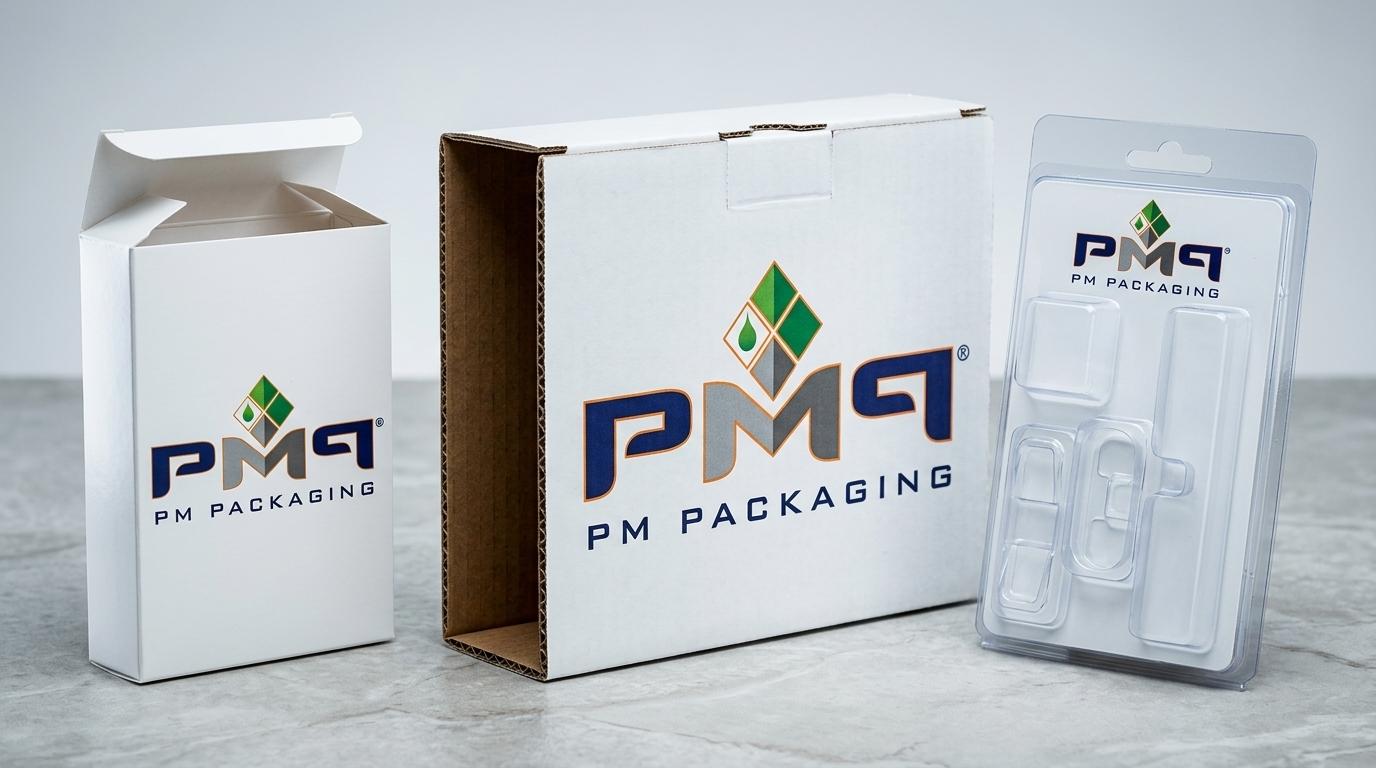
The qikCombo™ Advantage for Multi-SKU Blister Cards
For brands managing wide SKU matrices (5 to 50+ part numbers) running on rotary heat-seal carousels, PM Packaging’s proprietary qikCombo™ program gangs multiple blister card SKUs on large-format offset sheets. Brands achieve high-volume unit economics on short runs (5,000 to 100,000 units per SKU) with rapid 10-day turnaround, allowing Baja co-packers to fulfill dynamic demand without holding months of idle blister card inventory.
3. Cross-Border Customs Architecture: IMMEX, USMCA & FAST Border Logistics
Coordinating packaging with contract packagers in Baja California requires a comprehensive understanding of cross-border customs regulations. Mistakes in customs filings delay freight at the border and inflate landed costs through improper tariff assessments.
IMMEX Virtual Transfers
Transferred directly from PM Packaging’s Baja converting facilities under in-country Pedimentos Virtuales (V1/V5). Eliminates 16% Mexican IVA and import duty assessments completely.
USMCA / T-MEC Compliance
Converted from 100% North American mill-certified virgin and recycled paperboard. Immune to Section 301 tariffs (25%+) that penalize Asian-manufactured packaging entering the U.S.
C-TPAT & FAST Lanes
Commercial border crossing via dedicated FAST lanes at Otay Mesa and Calexico East averages 15 to 45 minutes, bypassing standard 4-to-8-hour peak shipping bottlenecks.
4. Operational Synchronization: JIT, VMI, and Pilot Line Validation
Achieving true operational alignment between an enterprise brand, a secondary packaging converter, and a Baja California contract packager requires a structured integration framework spanning CAD prototyping, line tooling verification, and Vendor-Managed Inventory (VMI).
Nearshore Logistics & Lead Time Benchmark Matrix
| Metric / Parameter | Offshore (Asia / Pacific) | Domestic U.S. (Midwest) | PM Packaging (San Diego/Baja) |
|---|---|---|---|
| Production Lead Time | 4 - 6 Weeks | 3 - 5 Weeks | 1 - 2 Weeks (qikCombo: 10 Days) |
| Transit Time to Baja CPO | 30 - 45 Days (Ocean) | 5 - 8 Days (Interstate) | 1 - 3 Days (Direct Local JIT) |
| Total Order Cycle Time | 8 - 12 Weeks | 4 - 6 Weeks | 1 - 3 Weeks (Kanban: 24-48 Hrs) |
| Pipeline Inventory Carrying | 60 - 90 Days Working Cap. | 30 - 45 Days Working Cap. | 5 - 15 Days Working Capital |
| Emergency SKU Reruns | Impossible (< 8 Weeks) | 2 - 3 Weeks + Air Freight | 3 - 5 Days Expedited Ground |
| Customs Clearance Protocol | Complex (US Port + Mexico) | Physical Pedimento Cross | IMMEX Virtual Pedimento (V1/V5) |
| USMCA Tariff Status | Subject to Sec. 301 (25%) | 0% (Domestic) | 100% USMCA Certified (0%) |
5. Total Cost of Ownership (TCO): Nearshore vs. Offshore Financial Model
Procurement evaluations that focus exclusively on initial per-unit purchase price overlook the substantial hidden costs embedded in transpacific freight, inventory holding, customs overhead, and packaging line downtime.
Total Cost of Ownership (TCO) Comparison: 500,000 Folding Cartons
| Cost Component | Asia / Offshore Sourcing | U.S. Midwest Converter | PM Packaging (Nearshore) |
|---|---|---|---|
| Base Unit Purchase Cost | $0.180 | $0.235 | $0.205 |
| Ocean / Long-Haul Truck Freight | $0.055 | $0.038 | $0.008 |
| Border Customs, Drayage & Tariffs | $0.045 (Sec. 301 + Fees) | $0.012 (Pedimento Import) | $0.000 (IMMEX Virtual V1) |
| Working Capital Carrying Cost (10%) | $0.022 (90-Day Pipeline) | $0.010 (35-Day Pipeline) | $0.003 (10-Day Pipeline) |
| Co-Packer Line Downtime & Scrap | $0.018 (3.5% Scrap Rate) | $0.008 (1.5% Scrap Rate) | $0.002 (<0.3% Scrap Rate) |
| Buffer Warehousing & Holding Fees | $0.015 | $0.007 | $0.000 (Included in VMI) |
| Total Landed Cost / Unit | $0.335 | $0.310 | $0.218 |
| Total Spend & Savings (500k Units) | $167,500 (Baseline) | $155,000 (-7.5%) | $109,000 (-34.9% Net Savings) |
6. Why Enterprise Brands Partner With PM Packaging
For more than 45 years, PM Packaging has served as the preferred secondary packaging manufacturing partner for leading consumer brands, national retailers, and Fortune 500 enterprises operating across North America. Our integrated dual-border infrastructure provides the ideal bridge for brands manufacturing and co-packing in Baja California:
Dual-Border Operational Scale
- San Diego HQ: Structural CAD engineering, pilot prototyping, & client service.
- Baja Converting Hubs: High-capacity converting plants in Tijuana & Mexicali.
- High-Speed Finishing: Bobst automated die-cutting & 180° pre-break folding-gluing.
- G7 Master Pressrooms: 6-to-8 color large-format offset lithography.
Supply Chain Agility & Compliance
- 1 to 3 Days Transit: Direct local ground delivery to Baja CPOs & U.S. retail DCs.
- IMMEX Virtual (V1/V5): 100% tax-free in-country material transfers.
- USMCA Certified: 100% North American origin, zero Section 301 tariffs.
- Global Standards: ISO 9001:2015, SQF Food Safety, FSC, and C-TPAT / OEA.
Ready to Synchronize Your Nearshore Packaging Operations?
Optimize your Baja California co-packing velocity, eliminate cross-border friction, and capture 30% to 35% net TCO savings.
Whether your program requires high-speed folding cartons running at 400 CPM, heavy-duty litho-laminated SFL club store displays, or multi-SKU blister card runs via qikCombo™, PM Packaging delivers the structural precision, color uniformity, and logistics agility your nearshore operations demand.
Contact PM Packaging today to schedule a comprehensive packaging line audit, request sample pilot blanks, or consult with our dual-border structural engineering specialists.