
For Directors of Procurement, VP/Directors of Supply Chain, Brand Managers, and Plant Operations Executives managing high-velocity consumer goods, consumer electronics, medical devices, automotive components, and commercial hardware, secondary packaging represents one of the most volatile variables in production scheduling.
Scaling commercial automotive packaging requires targeted engineering: Automotive replacement parts require rigorous corrosion protection, high structural crush resistance for dense cast iron components, and strict barcode readability for automated distribution centers. PM Packaging partners with high-volume brands to ensure G7 color consistency, structural durability, and predictable replenishment.
Enterprise Cross-Border Kanban & VMI Replenishment Architecture
Converting & Buffer WIP
CAD engineering, G7 Master offset printing, Bobst 180° pre-break folder-gluers, SFL fluting, and master roll stock staged near the border.
FAST Lanes & Pedimento V1
C-TPAT / OEA dedicated lanes at Otay Mesa/Calexico; 100% USMCA duty-free and IMMEX Virtual Pedimento transfers to line-side stations.
Continuous Pull Loops
2-bin/3-bin floor scans or automated EDI 862 triggers replenish 24–48 hr buffers directly to cartoning lines without stockout risk.
When enterprise brands rely on batch-and-queue procurement from overseas suppliers (requiring 8 to 14 weeks of transpacific ocean transit) or rigid domestic suppliers with multi-week lead times, they absorb massive working capital drag, bloated warehouse footprints, and crippling exposure to forecast volatility. Worse, a single stockout of folding cartons, litho-laminated single-face laminate (SFL) master cartons, or heat-seal blister cards halts an automated packaging line costing $3,000 to $5,000 per hour in downtime, risking catastrophic retailer chargebacks and cancelled purchase orders.
Backed by over 45 years of specialized packaging converting experience, dual-border operations headquartered in San Diego, CA, and advanced manufacturing and converting facilities in Baja California, PM Packaging provides the structural CAD engineering, large-format offset print capacity, IMMEX customs mechanics, and dedicated Kanban infrastructure necessary to execute enterprise-scale pull programs.
1. The Financial & Operational Anatomy of Push vs. Pull Replenishment
Rather than treating automotive packaging as generic paperboard, engineering teams must account for product geometry, hanging shelf wear, moisture barriers, and high-speed automated cartoning line tolerances.
Push Procurement vs. Cross-Border Kanban Pull
| Operational Parameter | Legacy Push Model (Offshore/Bulk) | Cross-Border Kanban Pull (PM Packaging) |
|---|---|---|
| Replenishment Lead Time | 8 to 14 weeks (Ocean + DC) | 24 to 72 hours (Ground milk-run) |
| Production Trigger | Long-range forecast (Speculative) | Actual line-side consumption (Pull) |
| Inventory Title & Ownership | Buyer-owned upon FOB port departure | Vendor-Managed Inventory (VMI) / Pay-on-Pull |
| Line-Side Buffer Storage | 60 to 90 days of floor storage | 2 to 5 days staged buffer stock |
| Warehouse Footprint Cost | Extreme ($0.85–$1.20+/sq ft/mo) | Minimal (Frees production floor) |
| SKU Revision Agility | 10 to 16 weeks to purge & cut in | 5 to 10 business days for print/dieline cut-in |
| Scrap / Obsolescence Risk | High (Entire ocean pipeline at risk) | Near-zero (WIP held in unprinted rolls) |
| Tariffs & Customs Duty | 25% Section 301 tariffs + port delays | 100% USMCA Tariff-Free, IMMEX Virtual |
The Carrying Cost of Bulky Secondary Packaging
Secondary packaging—folding cartons, corrugated microflute boxes, and blister cards—is characterized by high volume-to-weight ratios. In high-cost manufacturing regions such as Southern California and northern Mexico, where industrial floor space commands $0.85 to $1.20+ per square foot per month, allocating warehouse space to store 60 to 90 days of empty paperboard boxes severely degrades plant unit economics.
1. Facility Carrying Drag
Direct square footage lease rates, warehouse utilities, insurance, staging labor, and handling equipment amortized across empty packaging blanks.
2. Assembly Opportunity Cost
High-value manufacturing square footage diverted from active revenue-generating automated packaging cells, cleanroom kitting, or assembly.
3. Substrate Degradation
Prolonged floor storage exposes paperboard to humidity fluctuations, degrading Taber stiffness and triggering carton jams on automated lines.
2. Cross-Border Kanban Mechanics: Sizing Buffers, Takt Times & Trigger Loops
PM Packaging manufactures engineered automotive parts packaging, line-side kits, and retail aftermarket cartons with certified Delta-E color consistency and high-speed box converting. High-speed gang printing and shared dielines reduce per-unit tooling costs while clear technical graphics guide buyers directly to the correct model.
Closed-Loop Kanban Replenishment Signal Flow
Continuous-motion cartoner consumes unit pack-outs from line-side staging racks.
Primary bin emptied; operator barcode scan or automated WMS sensor trips the pull signal.
EDI 862 Shipping Schedule transmits real-time consumption data to PM Packaging MES.
C-TPAT / OEA validated truck dispatched; EDI 856 ASN with GS1-128 pallet data issued.
2–4 hour transit in Baja California; 24–72 hours to U.S. West Coast/Southwest DCs.
Cartoner operates uninterrupted while empty bin is rotated for the next replenishment cycle.
Mathematical Buffer Sizing for Nearshore Cross-Border Pull
The safety stock (SS) required to protect an automated packaging line against stockouts is calculated using the classical multi-echelon safety stock formula:
Where Z = Service level factor (2.33 for 99% line uptime), D = Average daily demand, σD = Daily demand standard deviation, L = Average lead time (days), and σL = Lead time standard deviation (days).
Real-World Case: 50,000 Units/Day Automated Cartoning Line
Lead Time: 70 days (σL = 14 days)
SS: 1,632,000 units (~272 pallets)
Requires 32+ days of staging warehouse space.
Lead Time: 2 days (σL = 0.25 days)
SS: 35,200 units (~6 pallets)
Eliminates 1.59M units of idle packaging inventory.
3. Customs, Regulatory & Logistics Infrastructure: The Cross-Border Engine
A cross-border Kanban system is only as reliable as its customs clearance and regulatory architecture. A delivery truck delayed at an international border checkpoint for 24 hours destroys the mathematical integrity of a JIT pull system.
IMMEX Virtual Transfers
Executed under Mexican customs law (Ley Aduanera Article 112). Packaging converted in Baja is transferred directly to maquiladora assembly plants under in-country Pedimentos Virtuales (V1) without paying 16% IVA or IGI duties.
C-TPAT & OEA FAST Lanes
Validated Tier-2 supply chain security certifications enable dedicated FAST lane access at Otay Mesa and Calexico East crossings, reducing commercial crossing wait times from 6–10 hours down to 15 to 30 minutes.
USMCA 100% Origin
Engineered from North American mill-certified virgin and recycled paperboard compliant with USMCA Chapter 48 Rules of Origin. 100% duty-free entry into the U.S., completely immune to 25% Section 301 tariffs.
4. Packaging Substrate & Dieline Engineering for High-Velocity Kanban
A packaging Kanban program cannot succeed if structural packaging creates bottlenecks during line-side staging, automated erection, or manual packing. Structural packaging must be engineered for high-density flat packing, instant machine erection, and regional climate resilience.
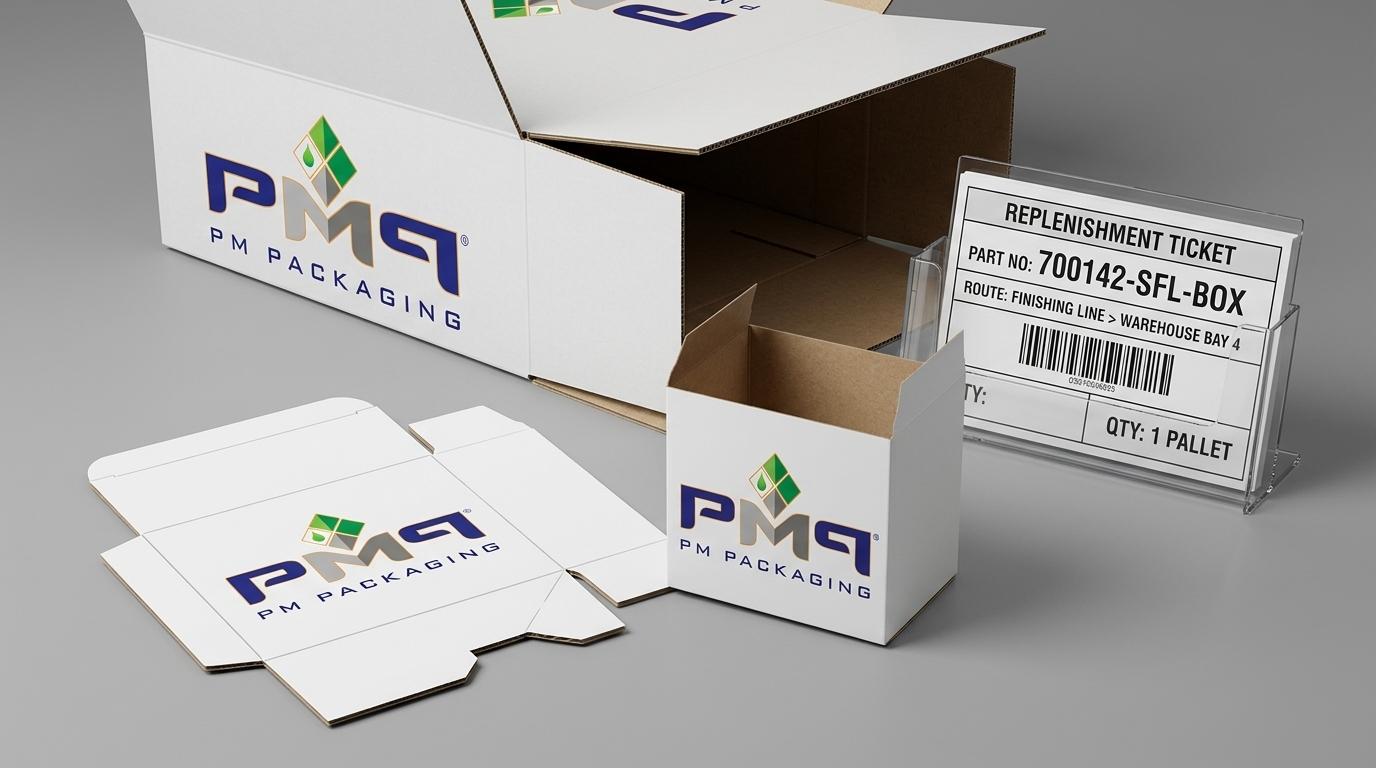
Structural Packaging Dieline Velocity Matrix
| Dieline Style | Assembly Velocity & Line Speed | Kanban Staging & Storage Profile |
|---|---|---|
| Straight Tuck End (STE) / Reverse Tuck End (RTE) | 250–450 CPM on continuous-motion cartoners. Requires 180° pre-broken scores. | Highest pallet cube density; lowest line-side staging footprint. Ideal for OTC, CPG, and electronics. |
| Pre-Glued Auto-Bottom (Crash-Lock Base) | 25–40 CPM manual/semi-auto. Pops open instantly by hand without taping. | 20–30% lower pallet density than tuck end. Best for kitting cells and multi-SKU gift sets. |
| Litho-Laminated SFL (E-Flute / F-Flute / B-Flute) | 60–120 CPM with automated tray/case formers; heavy product containment (5–40 lbs). | Flat-shipped blanks optimize trailer cube; high BCT/ECT rigidity directly replaces plain RSC shippers. |
| qikCombo™ Blister Cards (Single / Trapped) | 15–30 cycles/min on rotary heat-sealers (multi-cavity tooling). | Ultra-compact master cartons staged line-side. Ideal for multi-SKU hardware & tackle catalogs. |
SFL Microflute Structural Profile Comparison
| Flute Designation | Caliper | Flutes / Linear Ft | Primary Commercial & Kanban Applications |
|---|---|---|---|
| N-Flute | ~0.020" (0.50 mm) | 170 ± 5 | Ultra-thin profile; direct SBS paperboard replacement with enhanced rigidity for cosmetics. |
| F-Flute | ~0.032" (0.80 mm) | 125 ± 4 | High-end electronics, OTC wellness, gourmet food; excellent surface for cold foil stamping. |
| E-Flute | ~0.062" (1.60 mm) | 90 ± 3 | Power tools, countertop appliances, automotive parts, retail shelf-ready PDQ display trays. |
| B-Flute | ~0.125" (3.20 mm) | 47 ± 3 | Heavy commercial hardware (20–50 lbs), master pack shippers, full-pallet club store displays. |
The qikCombo™ Program for Multi-SKU Blister Packaging
For brands managing extensive catalogs (5 to 20+ distinct SKUs) in hardware, electronics, or sporting goods, PM Packaging’s qikCombo™ program gangs multiple SKUs onto shared large-format press sheets with scheduled 10-day production cycles. This eliminates 80% of excess SKU safety stock and allows brands to pull only what the packaging line needs for upcoming production.
Climate-Engineered Substrates for Cross-Border Microclimates
The manufacturing corridors of the Southwest and Baja California encompass extreme environmental contrasts: coastal marine humidity (70% to 90% RH in Tijuana/San Diego) versus extreme desert aridity (<15% RH and 115°F+ in Mexicali/Phoenix). PM Packaging conditions all paperboard to maintain an equilibrium moisture content of 6.5% to 7.5%, using tailored creasing matrices and high-elasticity hot-melt glues to prevent outer liner score cracking and box panel bulging.
5. Digital Visibility, EDI Integration & Vendor Managed Inventory (VMI) Models
A modern cross-border Kanban program relies on automated, frictionless data exchange between the enterprise resource planning (ERP) system and PM Packaging’s manufacturing execution system (MES).
Blanket PO & Kanban Release
EDI 850 sets master pricing tiers; EDI 862 triggers automated pull dispatches the moment a line-side pallet barcode is scanned on the assembly floor.
ASN with GS1-128 & VMI Stock
Advance Ship Notices (EDI 856) with serialized GS1 labels enable instant dock-to-line receiving; EDI 846 reports real-time dual-border WIP balances daily.
VMI Commercial Billing Architectures
| Commercial Model | Model 1: Pay-on-Pull / Pay-on-Scan | Model 2: Staged Delivery Invoicing |
|---|---|---|
| Title Transfer Point | Transfers only when pallet is scanned at active pack-out station. | Transfers upon dispatch from nearshore manufacturing hub. |
| Balance Sheet Impact | Zero inventory carrying cost on brand balance sheet. | Carried as raw material inventory for only 2 to 5 days. |
| Cash Flow Profile | Payment terms align directly with finished goods retail sale. | Standard Net 30/60 terms triggered upon delivery. |
6. Total Cost of Ownership (TCO) Financial Model
Inexperienced procurement teams often evaluate packaging solely on initial FOB unit price. Enterprise supply chain executives evaluate Total Cost of Ownership (TCO):
Annual TCO Comparison: 1,200,000 Folding Cartons (18pt SBS)
Basis: 100,000 units/month high-velocity retail program.
| Cost Component | Transpacific Push (Asia) | PM Packaging Nearshore Kanban |
|---|---|---|
| Unit Price (FOB Plant) | $0.180 / unit ($216,000) | $0.210 / unit ($252,000) |
| Freight & Drayage | $0.045 / unit ($54,000) | $0.015 / unit ($18,000) |
| Customs Tariffs & Duties | $0.045 / unit ($54,000) (25% S301) | $0.000 (100% USMCA Duty-Free) |
| Inventory Carrying (15% WACC) | $0.027 / unit ($32,400) (90-day WIP) | $0.003 / unit ($3,600) (5-day Buffer) |
| Warehouse Floor Space Cost | $0.018 / unit ($21,600) (2000 sq ft) | $0.002 / unit ($2,400) (150 sq ft) |
| Obsolescence & Graphic Scrap | $0.009 / unit ($10,800) | $0.001 / unit ($1,200) |
| Air Freight Expedites & Downtime | $0.040 / unit ($48,000) | $0.000 (Eliminated via Pull) |
| TOTAL ANNUAL LANDED COST | $0.364 / unit ($436,800) | $0.231 / unit ($277,200) |
| NET ANNUAL ENTERPRISE SAVINGS | BASELINE | $159,600 / YEAR (36.5% SAVINGS) |
7. Executive Implementation Playbook: 5-Phase Transition Roadmap
Transitioning an enterprise packaging program to a cross-border Kanban pull system follows a structured 5-phase execution plan:
SKU Velocity Profiling & Buffer Sizing
ABC SKU stratification, takt time consumption mapping across packing stations, and Min/Max trigger threshold calculations based on guaranteed 24–48 hr ground delivery.
Structural CAD Optimization & Tooling Prep
Dieline redesign for 15–30% higher pallet cube density, Bobst 180° pre-break scoring tooling, and G7 Master spectral color target calibration (ΔE < 1.5).
EDI Data Bridging & Customs Mapping
EDI 850/862/856 protocol validation, IMMEX Pedimento Consolidado and V1 transfer routing, and dedicated FAST lane dispatch schedules.
Pilot Line-Side Kanban Trial
Controlled 2-bin pull trial on top 3 Class A SKUs; auditing dock-to-line transit, ASN scan accuracy, carton opening force (COF), and zero-jam machine throughput.
Full Catalog Onboarding & Dynamic Tuning
Full catalog migration, qikCombo™ multi-SKU gang-run activation, and monthly algorithmic safety stock reviews to sustain peak inventory turns.
8. Why Enterprise Supply Chains Partner with PM Packaging
For enterprise brands scaling high-volume retail and commercial product lines, executing a flawless cross-border Kanban program requires an experienced manufacturing partner with end-to-end structural, print, and logistical capabilities:
Dual-Border Manufacturing Footprint
- San Diego HQ: CAD design, pre-press G7 proofing, and executive account management.
- Baja Manufacturing: Large-format offset presses, Bobst die-cutting, and SFL lamination.
- Finishing Excellence: 180° pre-break folder-gluers for 450 CPM cartoners.
Cross-Border Logistics Leadership
- FAST Lane Expedited: C-TPAT & OEA validated 15–30 min commercial border crossing.
- IMMEX Virtual (V1): In-country duty/IVA tax-free maquiladora transfers.
- USMCA 100% Certified: Zero tariffs on North American paperboard substrates.
Ready to Build Your Cross-Border Packaging Kanban Program?
In high-volume manufacturing, secondary packaging should never dictate your production schedule, tie up millions in idle working capital, or expose your brand to retail stockouts.
Connect with PM Packaging’s structural engineering and supply chain specialists today to audit your packaging catalog, model your total landed cost savings, and engineer a customized cross-border Kanban replenishment program tailored to your production velocity.
Technical Consultation & Structural CAD Inquiries
San Diego HQ • Baja California Converting Hubs • Folding Cartons • Litho-Laminated SFL • Rigid Setup Boxes • qikCombo™ Blister Cards • IMMEX • USMCA • C-TPAT • G7 Master • ISO 9001:2015 • SQF Certified