
In high-velocity modern manufacturing, secondary packaging is frequently the single most critical point of failure in an otherwise synchronized production line. For Directors of Procurement, VP/Directors of Supply Chain, Brand Operations Managers, and Packaging Engineers managing operations across the United States and Mexico, the margin for logistics error is virtually zero.
Whether your facilities assemble Class II medical devices in Tijuana, consumer electronics in Mexicali, automotive hardware in Juarez, or high-volume fast-moving consumer goods (FMCG) across Southern California and the American Southwest, automated production lines consume folding cartons, litho-laminated single-face laminate (SFL) microflute shippers, and heat-seal blister cards at rates exceeding tens of thousands of units per shift.
When secondary packaging runs out, assembly halts immediately. The finished goods cannot be packed, palletized, or staged for retail distribution. A single container or truckload of paperboard boxes held at a commercial border crossing for secondary customs inspection cascades into severe operational and financial damage:
$3,000 to $10,000+/Hr
Automated packaging and kitting lines sit idle while operational overhead and labor burn continuous capital.
$5,000 to $35,000
Scrambling for emergency air charters or dedicated hot-shot box trucks to bridge uncertified carrier delays.
3% Gross Deductions
Missing strict delivery windows triggers punitive OTIF vendor chargebacks from Walmart, Target, Home Depot, and Costco.
To eliminate this supply chain volatility, enterprise manufacturing networks have abandoned transpacific offshore sourcing (with its 8-to-12-week ocean lead times) and uncertified domestic/cross-border carriers. Instead, they rely on Customs-Trade Partnership Against Terrorism (C-TPAT) certified and Operador Económico Autorizado (OEA) certified nearshore packaging partners.
Cross-Border C-TPAT & JIT Packaging Replenishment Architecture
CAD Engineering & G7 Proofing
Structural dieline optimization, 180° pre-break crease scoring, G7 Master spectral color proofing, and 45+ years of packaging engineering mastery.
Large-Format Offset & Bobst Converting
6-to-8 color litho presses, high-speed Bobst folder-gluers, SFL microflute lamination, IMMEX AAA certified, and C-TPAT / OEA validated security protocols.
30 to 60 Min Border Clearance
C-TPAT / OEA FAST lane transit at Otay Mesa and Calexico; 100% USMCA duty-free, zero secondary inspection holds, and 24–72 hour JIT replenishment across U.S. hubs.
In-Country Maquiladora Transfers
Direct 2-to-4 hour milk-run deliveries to OEM assembly plants in Tijuana and Mexicali with 100% duty-free and cash-VAT-free virtual pedimento transfers.
With over 45 years of packaging converting experience, dual-border operations headquartered in San Diego, CA, and high-capacity manufacturing facilities in Baja California (Tijuana and Mexicali), PM Packaging provides the structural CAD engineering, large-format lithographic print firepower, IMMEX customs mechanics, and accredited C-TPAT / OEA logistics infrastructure required to execute flawless cross-border Just-In-Time packaging programs.
1. The Anatomy of Cross-Border Packaging Delays: Why Standard Logistics Fail
To understand why C-TPAT certification is mandatory for Lean enterprise supply chains, procurement teams must examine the friction inherent in standard, non-certified cross-border freight movements.
The United States–Mexico commercial border is one of the highest-volume trading corridors in the world. Commercial ports of entry (POEs)—including Otay Mesa (San Diego/Tijuana), Calexico East (Mexicali/Imperial Valley), Tecate, Nogales, and Laredo—process tens of thousands of commercial tractor-trailers daily.
Cross-Border Transit Time: Standard vs. C-TPAT FAST Lane
| Logistics Stage | Standard Non-Certified Carrier | C-TPAT / OEA / FAST Dedicated Pipeline |
|---|---|---|
| Border Wait in Queue | 4 to 8+ hours (General traffic) | 15 to 30 minutes (Dedicated FAST Lane) |
| Primary Inspection Time | 10 to 20 minutes (Manual review) | 1 to 3 minutes (Automated transponder scan) |
| Secondary Inspection Probability | 15% to 35% (Random & Risk Algo) | < 1% (Statistically minimal inspection rate) |
| Non-Intrusive Imaging (VACIS) | 2 to 6 hours if flagged | Bypassed under Tier-Certified status |
| Physical Cargo Exam (Tailgate) | 24 to 72 hours (Offload & Reload) | Eliminated except under active red alerts |
| Total Border Clearance Window | 6 to 72+ hours (Highly volatile) | 30 to 60 minutes (Predictable, clockwork) |
| JIT Line-Side Deliveries | Unviable (Requires 30-day buffer) | Seamless (Enables daily / bi-daily milk-runs) |
The Mechanism of Secondary Inspection Holds
When an uncertified carrier transports paperboard packaging across the border, U.S. Customs and Border Protection (CBP) evaluates the shipment through automated targeting algorithms. Because secondary packaging consists of hollow, bulky, multi-layered corrugated boxes, master shippers, and densely palletized folding cartons, CBP targeting systems classify uncertified shipments as higher-risk for cargo tampering, contraband concealment, or manifest discrepancies.
When flagged for secondary inspection:
- 1. Non-Intrusive Inspection (NII / VACIS): The truck is routed to gamma-ray or x-ray imaging portals, adding 2 to 6 hours of line delay.
- 2. Intensive Physical Examination (Tailgate / Devanning): If anomalies appear or random compliance audits trigger, CBP or contract drayage workers break the tamper seals, offload the pallets, slit open stretch wrap, unband corrugated corner boards, and physically open master cartons.
- 3. Packaging Degradation & Contamination: Secondary packaging subjected to manual border offloading frequently suffers crushed flute structures, scuffed retail print finishes, punctured folding carton edges, and ambient moisture absorption. By the time the load is restacked, re-wrapped, and released 48 hours later, the packaging is structurally compromised and will jam high-speed automated cartoning equipment.
Critical JIT Risk Note
For brands operating under Just-In-Time parameters, a 48-hour border hold is catastrophic—shutting down automated assembly cells and creating severe downstream retail shipment defaults.
2. What Is C-TPAT & OEA Certification? (Technical & Regulatory Overview)
C-TPAT (Customs-Trade Partnership Against Terrorism) is a voluntary public-private supply chain security program led by U.S. Customs and Border Protection (CBP). Mexico’s counterpart program is the OEA (Operador Económico Autorizado), administered by the Mexican Tax Administration Service (SAT) and the National Customs Agency of Mexico (ANAM).
Under the Mutual Recognition Arrangement (MRA) established between the United States and Mexico, companies holding certified status in both programs receive synchronized green-lane privileges on both sides of the border.
C-TPAT & OEA Core Security Pillars Matrix
| Compliance Dimension | Mandatory Operational Protocols at PM Packaging Facilities |
|---|---|
| 1. Physical Facility Security | 24/7 CCTV surveillance with 90-day archive retention, biometric & electronic badge access controls, perimeter fencing, high-lumen security lighting, monitored docks. |
| 2. Procedural & Loading Protocols | Segregated packaging staging areas, documented loading supervisors, 7-point container inspections, 17-point tractor inspections, immediate high-security seal verification. |
| 3. High-Security Bolt Seals (ISO 17712) | ISO 17712 certified barrier bolt seals applied to every cross-border shipment; dual-custody log verification, tamper-evident recording, and digital photo archiving. |
| 4. Personnel & Driver Vetting | Comprehensive multi-jurisdictional background checks, drug screenings, security identity badges, and strict compliance with U.S. and Mexican national security databases. |
| 5. Conveyance & Telematics | GPS-enabled fleet tracking, real-time geofencing, route deviation alerts, emergency panic protocols, and pre-vetted secure cross-border corridor routing. |
| 6. Information Security & EDI | SOC-compliant IT infrastructure, encrypted EDI transaction pipes (EDI 850/856/862), role-based digital access, and automated cloud redundancy for shipping manifests. |
The 7-Point Container and 17-Point Tractor Inspection Standard
Every single PM Packaging truckload departing Baja California converting facilities for U.S. distribution centers or Mexico assembly maquiladoras undergoes a rigorous physical audit before departure:
7-Point Container Inspection
- Front wall structural integrity
- Left side wall (no false panels or double bulkheads)
- Right side wall
- Floor (undamaged, clean, no concealed compartments)
- Ceiling / Roof (no false ceilings)
- Inside / Outside doors and locking mechanisms
- Undercarriage and exterior chassis
17-Point Tractor Inspection
Extends the inspection to the engine compartment, transmission exterior, drive shafts, fifth-wheel locking assembly, fuel tanks, battery boxes, air tanks, tires, and sleeper cabs.
3. The Mechanics of the FAST (Free and Secure Trade) Lane
The tangible operational advantage of C-TPAT certification is access to the FAST (Free and Secure Trade) dedicated commercial lanes at major land border crossings.
The FAST (Free and Secure Trade) Three-Way Handshake
Certified Importer / Brand
Holds validated C-TPAT Tier status for green-lane customs clearance.
Certified Converter (PM Packaging)
C-TPAT & Mexico OEA validated secure manufacturing and dock controls.
FAST Certified Carrier & Driver
Biometrically registered CBP FAST Commercial Driver Card with RFID transponder.
When a PM Packaging truck approaches the FAST gate at Otay Mesa or Calexico:
- RFID Transponder Interrogation: Overhead sensors read the truck’s RFID transponder and the driver’s FAST card while the vehicle rolls forward at 5 mph.
- Instantaneous Manifest Matching: The CBP system automatically cross-references the RFID payload with the pre-filed Automated Commercial Environment (ACE) e-Manifest and IMMEX Pedimento.
- Clearance Execution: The traffic barrier lifts, granting entry in under 60 seconds, bypassing miles of non-FAST commercial queues.
This speed and predictability transform international border crossing from an unpredictable supply chain risk into a synchronized 30-to-60-minute logistics bridge.
4. Enabling Just-In-Time (JIT) & Lean Kanban Replenishment
When border crossing volatility is eliminated, enterprise brands can implement true Lean manufacturing and pull replenishment systems for folding cartons, litho-laminated single-face corrugate, and blister cards.
Push vs. Pull Packaging Replenishment Model
| Supply Chain Metric | Traditional Push Model (Offshore) | Cross-Border C-TPAT JIT Pull (PM Packaging) |
|---|---|---|
| Order Trigger | Speculative 90-day forecast | Daily / Weekly line consumption pull |
| Production Lead Time | 8 to 14 weeks (Ocean freight + DC) | 24 to 72 hours (Ground milk-run delivery) |
| Line-Side Inventory Footprint | 30 to 60 days of floor stock | 24 to 48 hours of physical Kanban stock |
| Working Capital Allocation | Millions locked in transit WIP | Low (Vendor-Managed Inventory / Pay-on-Pull) |
| SKU Cut-In / Art Revision Speed | 12 to 16 weeks to exhaust pipeline | 5 to 10 business days for print cut-in |
| Moisture / Fiber Degradation Risk | High (Weeks in ocean containers) | Zero (Direct factory-to-line delivery) |
Implementing 2-Bin and 3-Bin Physical Kanban
For high-velocity contract packagers and OEMs in Tijuana, Mexicali, and Southern California, PM Packaging engineers physical Kanban replenishment loops directly at the packaging line:
8 to 12 Hours Supply
Pallets of folding cartons or SFL shippers positioned directly at the cartoning machine magazine feeding continuous runs.
8 to 12 Hours Supply
Secondary buffer staged in the plant cell, ready for instant switchover without machine stoppage when Bin 1 empties.
24-Hour Milk-Run
Barcode scan triggers automatic EDI 862 schedule to PM Packaging for next milk-run ground delivery directly to the cell.
5. Substrate Selection & Structural Integrity for High-Speed JIT Lines
In a Just-In-Time cross-border ecosystem, packaging must not only arrive on schedule—it must perform flawlessly on automated erecting, loading, and closing machinery. Packaging that warps, binds, or exhibits improper score stiffness causes carton feed jams, halting lines running at 150 to 400 cartons per minute.
PM Packaging manufactures full-spectrum substrates optimized for automated line speed and cross-border environmental resilience:
Substrate Performance Matrix for JIT Packaging Programs
| Substrate Class | Caliper / Flute | Key Technical Characteristics | Primary JIT Commercial Applications |
|---|---|---|---|
| Solid Bleached Sulfate (SBS) | 14pt to 28pt caliper | 100% virgin bleached fiber; ultra-high brightness, superior Taber stiffness, clean die-cuts. | OTC healthcare, medical devices, premium cosmetics, electronics, retail shelf cartons. Exceptional automated cartoner feeding. |
| Coated Recycled Board (CRB/CCNB) | 16pt to 30pt caliper | Recycled fiber core with white clay coating; cost-effective, high tensile strength. | High-volume consumer dry goods, household hardware, replacement parts, mass retail folding cartons with high sustainability ROI. |
| Coated Unbleached Kraft (CUK / SUS) | 16pt to 28pt caliper | Virgin unbleached kraft core; extreme tear resistance and wet-strength for demanding loads. | Heavy hardware, automotive parts, beverage multipacks, items requiring heavy puncture resistance on high-speed packing lines. |
| Litho-Laminated SFL Microflute | E-Flute (1/16"), F-Flute (1/32"), B-Flute (1/8") | 100% litho-printed top sheet laminated to single-face medium; extreme BCT / ECT crush strength. | Heavy countertop appliances, commercial LED fixtures, power tools, club store master packs, structural PDQ display trays. |
| Water-Based Heat Seal Blister Card | 18pt to 24pt SBS cardstock | Precision-coated SBS with water-based heat-seal dispersion; fast dwell time, clean fiber-tear. | qikCombo™ multi-SKU hardware assortments, mobile accessories, hand tools, plumbing replacement parts, consumer electrical items. |
Dieline Selection & Line Speed Comparison
| Dieline Style | Assembly Method | Setup Speed (Per Min) | Recommended Production Application |
|---|---|---|---|
| Straight Tuck End (STE) | Automated Cartoner | 150 to 400+ cartons/min | High-speed automated retail packaging |
| Reverse Tuck End (RTE) | Automated / Manual | 100 to 300 cartons/min | High-volume retail cartons & cosmetics |
| Auto-Bottom (Crash Lock) | Manual / Semi-Auto | 25 to 45 cartons/min | Fast manual pack-out lines & co-packers |
| 1-2-3 Snap Lock Bottom | Manual Assembly | 15 to 25 cartons/min | Medium-weight products on manual lines |
| Glued SFL Display Tray (PDQ) | Automated / Pre-set | 30 to 60 trays/min | Club store pallet displays & retail PDQs |
Critical Structural Engineering for JIT Automated Lines
To guarantee that folding cartons running through JIT pipelines never jam client cartoning machinery, PM Packaging enforces three stringent structural parameters:
- 1. 180-Degree Pre-Breaking of Creases: High-speed folder-gluers pre-break score lines 1 and 3 to 180 degrees before applying glue to score line 4. This breaks the initial memory of the paperboard fibers, reducing carton opening force (bending resistance) by up to 60%. When vacuum cups on an automated cartoner pull a flat carton blank from the feeder magazine, the carton pops open cleanly without bowing or misfeeding.
- 2. Grain Direction Orientation: CAD engineers align the paperboard grain direction perpendicular to the primary opening scores, maximizing carton squaring integrity and side-wall stiffness under top-load compression.
- 3. Humidity & Temperature Conditioning in Transit: Cross-border packaging moves between maritime coastal zones (San Diego/Tijuana) and arid inland regions (Mexicali/Imperial Valley). PM Packaging uses high-yield barrier stretch wrapping, corrugated top caps, and humidity-sealed pallet covers to ensure paperboard equilibrium moisture content stays within the optimal 6.5% to 7.5% range, preventing board curl and warping during JIT unpalletizing.
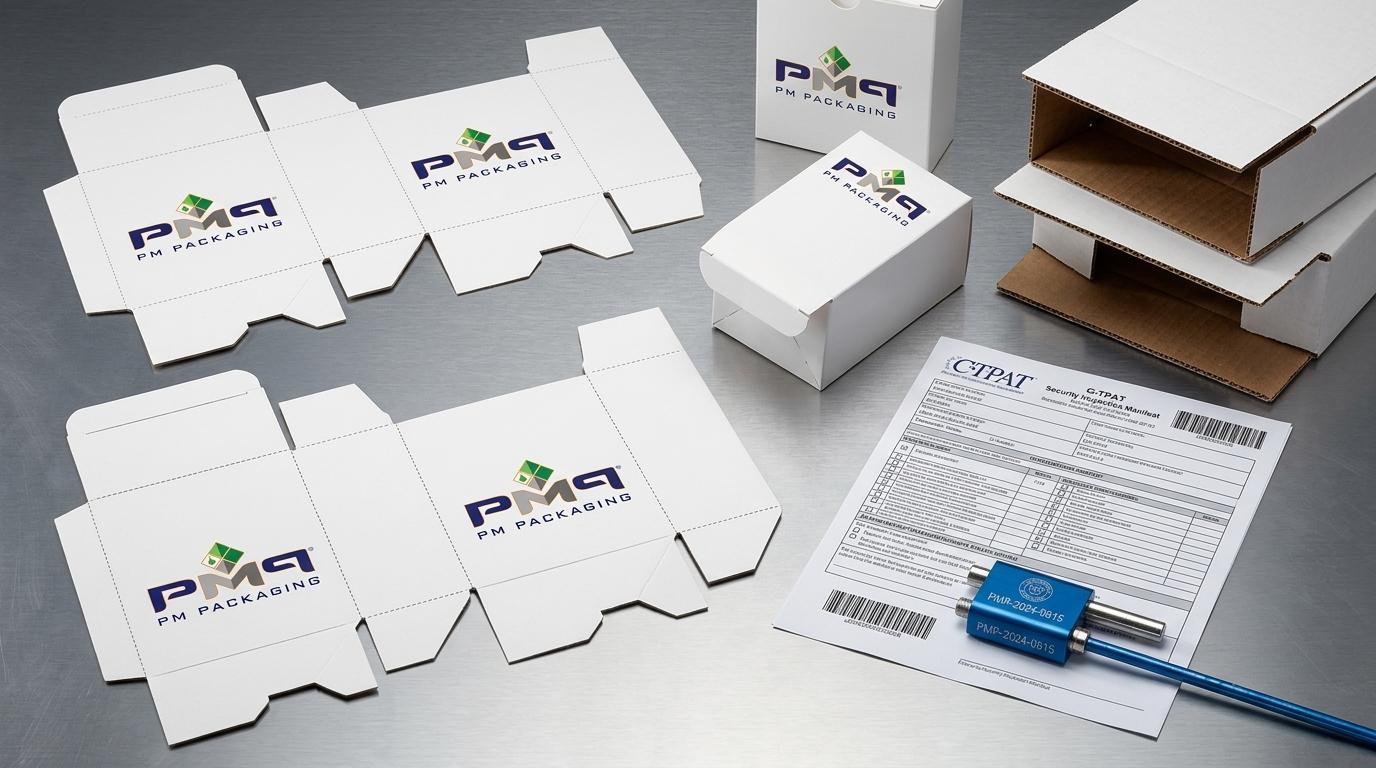
6. IMMEX & Pedimento V1/V5 Mechanics for Duty-Free Nearshore Packaging
A critical advantage of nearshoring packaging with PM Packaging is complete integration with Mexico’s IMMEX (Manufacturing, Maquiladora and Export Services Industry) regulatory framework.
IMMEX Virtual Pedimento (V1 / V5) Packaging Flow
Duty-Free Raw Substrate Import
Imports SBS, CUK, and linerboard under temporary IMMEX bond with 0% import duty and 0% VAT under certified AAA registration.
V1/V5 Virtual Transfer & USMCA Export
Direct 2-to-4 hour local milk-run delivery. Packed goods exported to U.S. retail 100% tariff-free under USMCA Chapter 4 Rules of Origin.
How Virtual Transfers Streamline Supply Chains
For enterprise brands with assembly facilities inside Mexico:
- No Double Crossing: The packaging does not need to be converted in the U.S., trucked into Mexico, packed, and trucked back. PM Packaging manufactures the packaging directly in Baja California.
- Pedimento V1 Transfers: The transfer of secondary packaging from PM Packaging’s manufacturing plant to the client’s assembly maquiladora is executed via an electronic Virtual Pedimento (Pedimento Virtual V1/V5).
- Zero Cash VAT Outlay: Under Mexico’s certified VAT/IEPS regime, temporary imports of packaging materials do not require cash VAT (IVA) payments, freeing up significant operational cash flow.
- 100% USMCA Compliance: Converted packaging meets all Chapter 4 Rules of Origin under the USMCA / T-MEC, allowing finished goods to enter the United States 100% tariff-free with valid Certificates of Origin.
7. The qikCombo™ Program: Gang-Run Agility for Multi-SKU Assortments
For brands managing catalogs with dozens or hundreds of SKUs—such as commercial hardware, hand tools, plumbing fixtures, electrical devices, and mobile phone accessories—maintaining JIT inventory across every individual part number is a notorious procurement headache.
Standard packaging converters demand high minimum order quantities (MOQs) of 50,000 to 100,000 units per individual dieline or artwork version. This forces brands to carry months of slow-moving SKU inventory while risking stockouts on fast-moving hero SKUs.
PM Packaging solves this challenge through our proprietary qikCombo™ program.
qikCombo™ Shared Production Run Architecture
6-to-8 Color Large-Format Litho Press Sheet (e.g., 40" x 56" Master Sheet Layout)
• Results: 7 distinct SKUs produced in a single combined press setup without individual setup penalties.
• Benefits: Zero plate change downtime • Shared tooling costs • 5,000-unit low-volume SKU viability • 10-day turns.
Strategic Benefits of the qikCombo™ Architecture
- 1. Low MOQs on Long-Tail SKUs: Brands can order as few as 5,000 units on secondary or tertiary SKUs while maintaining the high-volume per-unit pricing of a 100,000-unit master run.
- 2. Synchronized Turnarounds: By ganging 5 to 20 SKUs onto shared large-format press sheets with water-based heat-seal blister coatings or aqueous varnish, entire product lines are produced and delivered simultaneously in 10 business days.
- 3. Inventory Harmonization: Procurement teams order precisely what the assembly lines will consume over the next 15 to 30 days, eliminating obsolete packaging scrap during retail artwork updates or regulatory text revisions.
8. Total Landed Cost (TLC) Model: Quantifying C-TPAT JIT ROI
When evaluating packaging sourcing, experienced procurement directors calculate Total Landed Cost (TLC) rather than looking solely at unit price on a purchase order. Sourcing "cheap" packaging from uncertified overseas suppliers or non-compliant border carriers generates massive hidden costs.
Total Landed Cost (TLC) Comparison: 500,000 Units / Quarter
| Cost Component | Transpacific Offshore / Push | PM Packaging C-TPAT / Nearshore JIT |
|---|---|---|
| Base Unit Purchase Cost | $0.18 / unit ($90,000) | $0.20 / unit ($100,000) |
| Transpacific Ocean Freight | $12,500 (2 x 40ft HQ) | $0 (Ground freight only) |
| U.S. Port Drayage & PierPass | $2,400 | $0 |
| Demurrage / Container Per Diem | $1,800 (Avg port delay) | $0 |
| Section 301 / HTS Import Tariffs | $6,750 (7.5% - 25% tariff) | $0 (100% USMCA Tariff-Free) |
| Border Secondary Exam Holds | $1,500 (Uncertified delay) | $0 (C-TPAT FAST Lane clearance) |
| Emergency Air Expedites / Hot-Shot | $8,500 (Annualized avg) | $0 (Zero transit stockouts) |
| Warehouse Storage & Carrying Cost | $11,250 (90 days inventory) | $1,875 (5 days buffer / VMI hub) |
| Artwork Obsolescence & Scrap | $4,500 (Purged ocean WIP) | $0 (qikCombo™ agile batching) |
| Retail OTIF Vendor Chargebacks | $6,000 (Missed DC windows) | $0 (100% on-time delivery track record) |
| TOTAL LANDED COST (QUARTERLY) | $145,200 ($0.290 / unit) | $103,875 ($0.207 / unit) |
| NET FINANCIAL BENEFIT | BASELINE | $41,325 NET SAVINGS / QTR (28.5% REDUCTION) |
The Return on Investment Breakdown
- The offshore purchase order appears $10,000 cheaper on paper at initial purchase order creation.
- In reality, ocean freight, port handling, tariffs, warehouse carrying costs, scrap, and emergency expedites inflate the offshore landed cost to $0.290 per unit.
- By leveraging PM Packaging’s C-TPAT certified nearshore JIT manufacturing, the enterprise brand captures a 28.5% net financial reduction, saving over $165,000 annually on a 500k-unit quarterly program while completely eliminating supply chain risk.
9. Procurement Due Diligence: 10-Point C-TPAT Packaging Supplier Audit
When auditing a prospective nearshore packaging converter, corporate procurement and supply chain engineering teams should utilize this 10-point technical verification framework:
10-Point Procurement Audit Checklist for Nearshore Packaging
| No. | Audit Dimension | Mandatory Verification Criteria & Proof of Compliance |
|---|---|---|
| 01 | C-TPAT Certification Status | Request valid SVI (Status Verification Interface) number and active CBP Tier validation letter. Verify continuous compliance without lapses. |
| 02 | Mexico OEA Certification | Verify current SAT/ANAM Operador Económico Autorizado registry and compliance with Mexican customs mutual recognition requirements. |
| 03 | FAST Lane Eligible Carrier Network | Confirm supplier’s dedicated fleet or contracted logistics partners use valid FAST-card certified commercial drivers and transponder-equipped tractors. |
| 04 | ISO 17712 Bolt Seal Integrity | Inspect physical seal logs, dual-custody sign-off procedures, and high-security bolt seal inventory storage controls at the packaging loading dock. |
| 05 | 7-Point & 17-Point Audit Logs | Verify that written/digital 7-point container and 17-point tractor inspection sheets are completed, signed, and time-stamped for every departing trailer. |
| 06 | Plant Physical Security & CCTV | Audit 24/7 digital CCTV coverage over production, converting, staging, and loading dock bays with minimum 90-day secure recording retention. |
| 07 | IMMEX & USMCA Capabilities | Confirm active IMMEX program authorization, AAA VAT/IEPS certification, and in-house customs team experienced in Pedimento V1/V5 virtual transfers. |
| 08 | Print & Quality Certifications | Validate G7 Master Printer certification (color consistency), ISO 9001:2015 quality management, SQF food safety compliance, and FSC/SFI chain of custody. |
| 09 | Machine Redundancy & Scale | Ensure supplier operates multiple large-format litho presses (6 to 8 colors) and redundant high-speed die-cutters to eliminate single-machine bottleneck risk. |
| 10 | Real-Time EDI & Telematics | Audit automated EDI 856 ASN notification capabilities and GPS fleet tracking with active route geofencing and deviation alerting. |
10. Why Enterprise Brands Partner with PM Packaging
For more than 45 years, PM Packaging has served as the premier packaging partner for Fortune 500 brands, high-growth consumer technology innovators, national healthcare leaders, and tier-1 industrial manufacturers.
1. Dual-Border Infrastructure
- San Diego, CA: Executive Management, CAD Structural Design, Rapid Prototyping, Pre-Press, G7 Proofing.
- Baja California (Tijuana & Mexicali): Advanced high-volume manufacturing, printing, and converting hubs.
- Rapid Transit: 1 to 3 days ground transit to West Coast / Southwest DCs vs 6 to 12 weeks transpacific ocean freight.
2. Certified Quality & Compliance
- Security Leadership: C-TPAT Tier Certified • Mexico OEA Certified • FAST Lane Dedicated Logistics Fleet.
- Quality Systems: Certified G7 Master Printer • ISO 9001:2015 Certified • SQF Food Contact Certified • FSC & SFI Certified.
- Retail Compliance: GMI Certified Print Facility for Walmart, Target, Home Depot, and Costco.
3. End-to-End Product Lines & Capacity
- Folding Cartons: 12pt to 32pt SBS, CCNB, CRB, CUK; STE, RTE, Auto-Bottom Crash Lock, Snap Lock.
- Litho-Laminated SFL: E, F, N, B-Flute high-strength retail shippers & club store packaging.
- Luxury Rigid Setup Boxes: 40pt–120pt greyboard, magnetic book-style, shoulder-neck, sliding drawers.
- Retail Displays & Blisters: PDQ trays, power wings, and qikCombo™ heat-seal cards (10-day turnaround).
4. Financial & Supply Chain Mastery
- USMCA Duty-Free: 100% USMCA Tariff-Free Rules of Origin compliance.
- IMMEX Virtual: Seamless Pedimento Virtual (V1/V5) transfers for Mexico assembly maquiladoras.
- Kanban & VMI: Vendor Managed Inventory (VMI) & cross-border Kanban programs eliminating plant floor warehouse waste.
Ready to Streamline Your Cross-Border Packaging Supply Chain?
In an era of relentless supply chain disruptions, geopolitical uncertainty, rising freight tariffs, and punishing retail delivery windows, cross-border packaging logistics cannot be left to chance.
By partnering with a C-TPAT and OEA certified nearshore manufacturer, enterprise procurement leaders eliminate border bottlenecks, protect automated packaging line speeds, slash inventory carrying costs, and build a resilient Just-In-Time supply chain engineered for long-term commercial scale.
Technical Consultation & Structural CAD Inquiries
San Diego HQ • Baja California Converting Hubs • Folding Cartons • Litho-Laminated SFL • Rigid Setup Boxes • qikCombo™ Blister Cards • IMMEX • USMCA • C-TPAT • G7 Master • ISO 9001:2015 • SQF Certified