
For enterprise consumer brands supplying national retail and club store giants—such as Walmart, Target, Costco, Sam's Club, The Home Depot, Sephora, and Ulta—secondary packaging is the vital link between manufacturing and retail revenue. When packaging arrives on schedule and runs cleanly on pack-out lines, store shelves stay stocked and sales flow uninterrupted.
However, packaging disruptions trigger immediate consequences: steep On-Time In-Full (OTIF) vendor fines, missed planogram resets, and forfeited shelf placement. Historically, procurement teams concentrated packaging with a single converting plant for volume tiering. Today, leading supply chain executives recognize that single-plant sourcing creates an unacceptable single point of failure.
To eliminate single-source risk without sacrificing cost efficiency, brand leaders are structuring agile, dual-plant packaging contingency models within USMCA nearshore corridors.
Operational Vulnerabilities of Single-Plant Sourcing
Operating with lean inventory leaves retail brands vulnerable when secondary packaging supply chains stall:
Unplanned Facility Downtime
Mechanical breakdowns, utility outages, or maintenance backlogs halt production with no internal backup. Without a mirrored sister facility, any unplanned interruption halts the customer's product assembly lines immediately.
Peak Season Bottlenecks
During holiday pushes and promotional surges, single-plant capacity saturates, extending lead times and missing ship windows. When capacity is capped at one location, expanding order volumes force delays or steep overtime surcharges.
Transpacific Sourcing Risk
Overseas suppliers introduce 6 to 12 weeks of ocean transit, port congestion, and shifting tariffs. These extended transit windows tie up working capital in containerized safety stock and prevent rapid response to retail demand shifts.
Tooling Lock-In
When cutting dies are tailored to one converter's proprietary machinery, emergency transfers require costly re-tooling and weeks of delay. Standardizing dieline specifications across dual plants avoids this proprietary lock-in.
Synchronizing production across dual nearshore converting plants eliminates these vulnerabilities while preserving high-volume scale.
Core Pillars of a USMCA Dual-Plant Packaging Framework
A dependable contingency plan requires more than an idle backup contract. Leading brands partner with integrated nearshore converters operating twin facilities engineered for active load balancing.
1. Interchangeable Tooling and Unified CAD Dielines
Redundancy begins during structural design. CAD dielines, cutting forms, and stripping tooling are standardized to run interchangeably across both facilities. With centralized engineering—such as PM Packaging's technical hub in San Diego—structural dimensions, fold parameters, and gluing tolerances remain identical. If one plant encounters a capacity spike, production routes smoothly to the sister facility without packaging line adjustments.
2. Synchronized G7 Master Certified Color Calibration
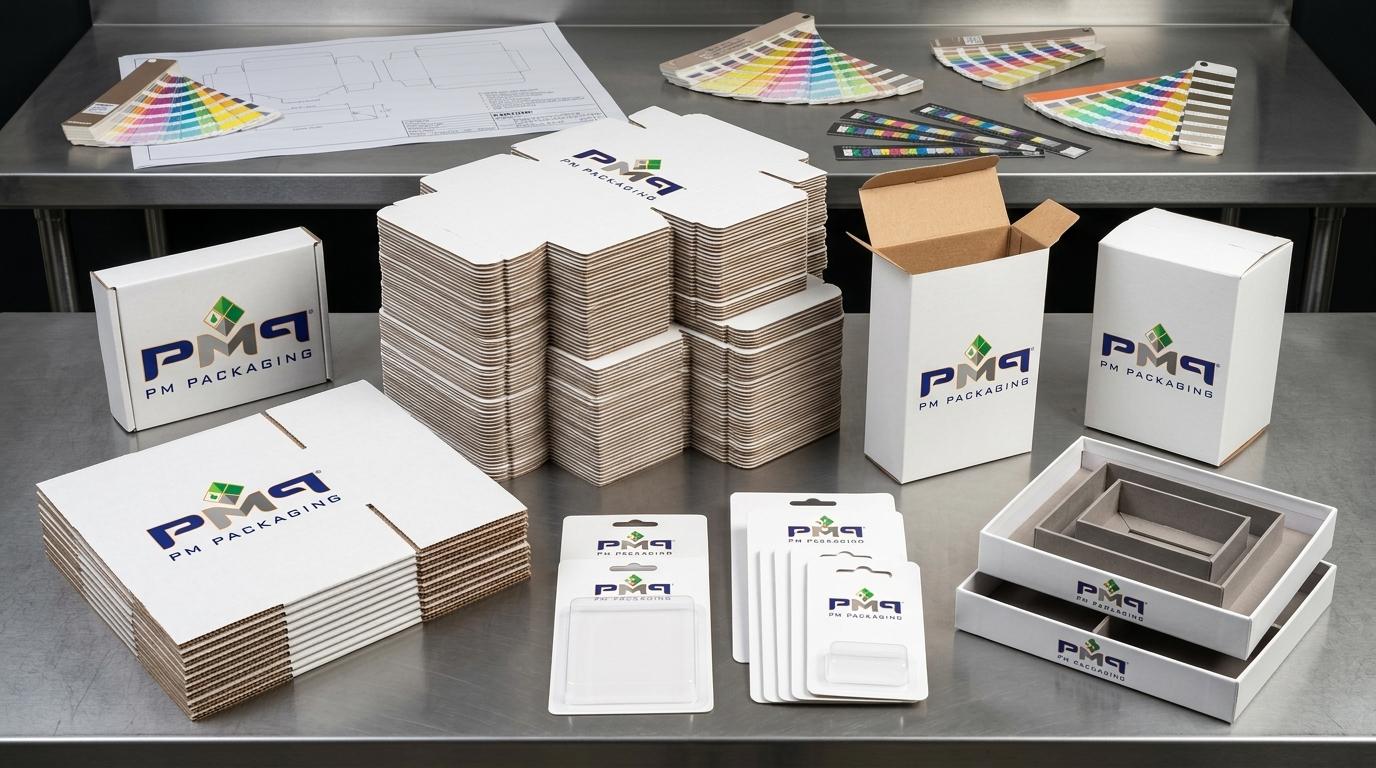
Multi-plant manufacturing must never create visual inconsistency on retail shelves. Certified G7 Master print standards ensure exact spectrophotometric calibration across all printing presses. Whether produced in Facility A or Facility B, custom folding cartons, laminated microflute packaging, and printed blister cards maintain exact brand color alignment.
3. Active-Active Capacity Allocation and Surge Balancing
Rather than maintaining an idle facility, an active-active model keeps both plants engaged in standard production. Core volumes balance dynamically based on logistics and seasonal demand. During major promotional rollouts, baseline cartons run steadily at one facility while promotional SKUs run in parallel at the sister plant, delivering instant capacity elasticity.
4. Tariff-Free USMCA Agility and Rapid Ground Delivery
Nearshore dual-plant networks along the US-Mexico border combine converting cost efficiencies with domestic delivery speed. Under 100% tariff-free USMCA compliance, packaging moves across borders without customs delays. Finished cartons reach West Coast and Southwest distribution centers within 1 to 3 days by ground freight (3 to 5 days nationwide).
Sourcing and Contingency Model Comparison
Evaluating nearshore multi-facility manufacturing against single-facility converters and transpacific suppliers reveals key strategic advantages for enterprise procurement:
Packaging Sourcing Model Strategic Matrix
| Strategic Metric | Single-Facility Domestic Converter | Single-Source Transpacific Supplier | Dual-Plant Nearshore Network (PM Packaging) |
|---|---|---|---|
| Disaster Recovery & Redundancy | Low (Single point of failure) | Very Low (Extended ocean transit risk) | High (Synchronized twin converting facilities) |
| Peak Volume Scalability | Rigid (Capped by single-plant schedule) | High capacity, but inflexible lead times | Elastic (Dynamic load balancing across twin plants) |
| Transit Lead Times | 2 to 5 days domestic ground | 6 to 12 weeks ocean freight | 1 to 3 days ground (West Coast/Southwest) |
| Tariff & Customs Exposure | None | High (Subject to tariffs and port congestion) | Zero (100% Tariff-Free USMCA Compliance) |
| Tooling & Asset Portability | Converter-locked tooling | Incompatible tooling standards | Standardized and interchangeable across facilities |
| Brand Color Consistency | Consistent within one facility | High batch-to-batch variation | G7 Master certified uniformity across both plants |
| Retail OTIF Protection | Vulnerable to local plant bottlenecks | Severe risk of retail chargebacks | Maximum protection via dual-facility agility |
Protecting Retail Compliance, Pallet In-Stocks, and Margins
National retailers enforce strict vendor scorecards that penalize late or incomplete deliveries. A well-structured dual-plant contingency strategy directly safeguards corporate margins:
PM Packaging: 45+ Years of Nearshore Converting Excellence
With over 45 years of packaging expertise, PM Packaging provides corporate brands with the operational security of an integrated, dual-plant nearshore manufacturing network. Headquartered with structural design and engineering in San Diego, California, PM Packaging operates twin converting facilities in Baja California (Tijuana and Mexicali).
Our core capabilities include:
Custom Folding Cartons
Retail cartons in premium virgin paperboard, eco-friendly kraft, and recycled board with straight-tuck, auto-bottom, and windowed options.
Laminated Microflute Packaging
Combining vibrant retail print with structural strength for heavier items and club store packaging.
Luxury Rigid Setup Boxes
Magnetic-closure gift boxes, two-piece boxes, and custom insert trays for premium unboxing experiences.
POP Displays & PDQ Trays
High-impact counter displays, sidekicks, and pallet displays engineered for rapid retail deployment.
Blister Card Packaging
Heat-seal cards, fold-over cards, and trapped blister cards backed by our rapid qikCombo™ program.
Certified Quality Standards
ISO 9001 quality management, food-grade compliance, and FSC/SFI certified sustainable paperboard sourcing.
Build Resilience into Your Packaging Supply Chain
Single-plant packaging sourcing introduces unnecessary vulnerability to national retail programs. Transitioning to a synchronized dual-plant nearshore model protects retail delivery timelines, eliminates tariff exposure, and provides the elastic capacity required for sustainable growth.
Ready to fortify your packaging supply chain? Connect with the packaging specialists at PM Packaging to schedule a structural packaging audit and explore our dual-facility nearshore solutions today.
Ready to Structure Your Dual-Plant Packaging Contingency Plan?
Connect with the packaging specialists and engineers at PM Packaging to review your SKU dielines, evaluate twin-facility production schedules, and ensure uninterrupted retail replenishment.
Integrated Cross-Border Packaging Capabilities
Partner with PM Packaging to secure domestic structural design, standardized interchangeable tooling, and twin-facility high-volume converting capacity across North America.
- Engineering Headquarters: San Diego, California
- Dual Manufacturing Campuses: Tijuana & Mexicali, Baja California
- Core Formats: Custom Folding Cartons, Litho-Laminated Microflute (SFL), Blister Cards, Counter PDQs, and Luxury Rigid Boxes.