
In the highly regulated and hyper-competitive consumer healthcare landscape, packaging is far more than a decorative outer shell.
For Over-the-Counter (OTC) monographs, dietary supplements, functional wellness formulations, and clinical cosmeceuticals, secondary packaging serves as a critical nexus of regulatory compliance, patient safety, automated packaging line throughput, and retail shelf dominance.
For Directors of Procurement, VP/Directors of Supply Chain, and Senior Packaging Engineers, managing high-volume OTC packaging programs presents a complex operational matrix.
A single packaging failure—whether an unreadable Drug Facts panel, an inconsistent tamper-evident seal, warped paperboard triggering continuous cartoner jams, or an out-of-spec color shift across regional retail endcaps—can trigger severe consequences: costly retailer chargebacks, distribution center rejections, FDA warning letters, product recalls, and multi-million-dollar supply chain disruptions.
The OTC Packaging Dual Mandate
Regulatory & Operational Integrity
- •FDA 21 CFR § 211.132 Tamper Evidence (TEP)
- •Strict Drug Facts & Supplement Facts Legibility
- •Zero-Defect Vision Inspection & Barcode Integrity
- •CPSC 16 CFR § 1700 Child-Resistant Formats
Commercial & Brand Velocity
- •G7 Master Color Consistency Across 50+ SKUs
- •High-Impact Shelf Differentiation in Retail
- •High-Speed Cartoning Line Velocity (300+ cpm)
- •Nearshore Agility for Peak Demand Spikes
With over 45 years of specialized packaging converting expertise, PM Packaging delivers enterprise-grade packaging programs engineered specifically for national OTC pharmaceutical, supplement, and wellness brands. This technical guide examines the structural engineering, substrate physics, compliance mandates, automated line economics, and nearshore logistics required to execute high-volume commercial packaging programs with zero defect tolerance.
1. Regulatory Compliance, Tamper Evidence & Patient Safety
Packaging commercial OTC drug products and regulated wellness formulations requires rigorous adherence to federal statutory frameworks and retail quality scorecards. Unlike standard dry consumer packaged goods, OTC secondary cartons and blister cards represent the primary barrier protecting product efficacy and consumer safety.
Tamper-Perforation & Zipper Tears
Precision micro-perforated score patterns integrated into carton flaps. Opening irreversibly delaminates paperboard fibers without the possibility of resealing.
Clean Fiber-Tear Hot Melt Systems
Surface tension and coatings are engineered to guarantee immediate, deep internal fiber tear when adhesive bonds on automated cartoners are stressed.
Trapped Blister Flange Locks
Thermoformed blister flanges are mechanically sandwiched and bonded between twin plies of high-density SBS board, eliminating exposed edges.
Varnish Knockouts for Wafer Seals
Precision varnishing knockout zones on carton tuck flaps ensure that clear or holographic tamper-evident wafer seals adhere with maximum peel strength.
FDA 21 CFR § 211.132 Tamper-Evident Packaging (TEP) Mandates
Under FDA 21 CFR § 211.132, all OTC human drug products intended for retail sale must feature one or more tamper-evident barriers. The packaging must bear a distinctive indicator or barrier to entry that, if breached or missing, provides visible evidence of tampering to consumers.
Child-Resistant (CR) & Senior-Friendly (SF) Formats
For OTC active ingredients requiring Poison Prevention Packaging Act (PPPA) compliance under CPSC 16 CFR § 1700 (such as iron-containing dietary supplements, high-dose acetaminophen, and NSAIDs), paperboard structures must balance child deterrence with senior accessibility:
- Push-and-Slide Internal Locking Sleeves: High-caliper SBS outer sleeves featuring hidden die-cut locking tabs that require simultaneous two-point lateral compression and sliding action.
- Reinforced Tear-Resistant Substrates: Integrating specialty internal polymer plies or multi-directional cross-laminated paperboard layers into carton closures to resist tearing under standard F=1 child bite and pull testing protocols.
Drug Facts & Supplement Facts Panel Precision (FDA 21 CFR § 201.66)
Regulatory legibility is a non-negotiable compliance gateway. FDA 21 CFR § 201.66 mandates precise font sizes, leading, graphical box formatting, contrast ratios, and structural layout for Drug Facts panels (and 21 CFR § 101.36 for Supplement Facts):
- Minimum Type Sizes & Bar Rules: Clear reproduction of 6pt body text, 4.5pt narrow-variant warnings, and precise 0.5pt to 2.5pt bounding bar lines without ink bleed, filling, or feathering.
- High-Density Plate Imaging: Utilizing high-resolution Direct-to-Plate (CtP) imaging at 2400+ DPI ensures that ultra-fine micro-text, active ingredient percentages, and warnings remain razor-sharp across massive print runs.
- Extended Content Solutions (5th Panel & Book-Leaf Cartons): When complex multi-symptom OTC formulations require multi-language translations (e.g., English, Spanish, French) and extensive clinical disclaimers, PM Packaging designs structural 5th-panel gatefolds and double-wall folding cartons that expand printable real estate by 100% without increasing retail shelf footprint.
2. Substrate Physics & Structural Dieline Selection
Selecting the proper paperboard substrate and structural dieline dictates not only retail visual elegance but also structural integrity, compression resistance, and pack-out line speed.
Solid Bleached Sulfate (SBS) — 14pt to 24pt
The undisputed benchmark for pharmaceutical and OTC healthcare packaging. Delivers 90+ GE brightness, zero cleanroom particulate shedding, superior crease elasticity, and razor-sharp Drug Facts panel legibility.
Cartoning Line: Up to 400+ cpmFolding Boxboard (FBB) — 15pt to 26pt
Features chemical outer plies sandwiching a mechanical pulp core. Delivers equivalent structural rigidity to SBS at 10–15% lower basis weight, optimizing raw material costs and transport freight.
Cartoning Line: Up to 350 cpmCoated Unbleached Kraft (CUK / SUS) — 18pt to 28pt
Provides maximum puncture and wet-strength burst resistance (200–350 psi). Essential for heavy liquid OTC products, 16oz cough syrups, glass tincture multipacks, and bulk digestive health liquids.
Cartoning Line: Up to 300 cpmSingle Face Laminate (SFL F-Flute & E-Flute)
Combines folding carton photographic printing with corrugated crush resistance. Engineered for multi-pack liquid bundles, heavy bulk powder tubs, club store pallet trays, and wellness devices.
Burst Strength: Extreme (250+ psi)Technical Substrate Selection Matrix for Healthcare & Wellness
| Substrate Grade | Caliper | GE Brightness | Cleanroom Purity | Cartoning Speed | Burst Strength | Relative Cost |
|---|---|---|---|---|---|---|
| SBS (Virgin Bleached) | 14 - 24pt | 90 - 94 | Exceptional | Up to 400+ cpm | 120 - 220 psi | Baseline |
| FBB (Multi-Ply Chem) | 15 - 26pt | 86 - 90 | Excellent | Up to 350 cpm | 110 - 190 psi | -5% to -10% |
| CUK / SUS (Kraft) | 18 - 28pt | 80 - 84 | Good | Up to 300 cpm | 200 - 350 psi | +5% to +12% |
| CRB / CCNB (Recycled) | 16 - 28pt | 78 - 82 | Moderate | Up to 250 cpm | 80 - 140 psi | -15% to -22% |
| SFL F-Flute (Litho) | 45 - 55pt | 90+ (top) | Good | Up to 150 cpm (tray) | 250+ psi | +25% to +40% |
Dieline Architecture & High-Speed Automated Cartoning Mechanics
For enterprise OTC brands running automated cartoning machinery (such as Bosch/Syntegon, Jones, Marchesini, or Bradman Lake), dieline geometry dictates packaging line efficiency:
- Straight Tuck End (STE): Both tuck flaps fold toward the rear panel, creating an unbroken, smooth front presentation face with no raw paperboard edges. Runs at peak speeds (300 to 450 cartons/min) on continuous-motion automated cartoners.
- Reverse Tuck End (RTE): The top closure tucks to the rear, while the bottom closure tucks to the front. Allows tighter interlocking on the printing sheet, improving sheet utilization by 4% to 8% and driving down unit cost on runs exceeding 500,000 units.
- Auto-Bottom (Crash-Lock / 1-2-3 Bottom): Pre-glued interlocking diagonal folds snap open and lock rigid when squared, reducing manual pack-out assembly time by 60–70% for contract packagers hand-loading promotional multi-component kits.
- Internal Partition & Shadowbox Cartons: Single-blank folding cartons featuring integral internal dividers that isolate delicate diagnostic droppers, glass ampoules, or dual day/night dosing bottles without secondary plastic trays.
3. High-Impact Visual Branding, Finishes & Anti-Counterfeiting
The retail healthcare aisle—whether in CVS, Walgreens, Target, Walmart, or specialty wellness retailers—is one of the densest retail environments in modern commerce. Products must project clinical efficacy, brand authority, and premium quality in under three seconds of shelf scan time.
Advanced Finishing & Coating Architecture
Certified G7 Master Printing & Color Consistency
Inconsistent shade variations across adjacent cartons destroy brand trust and signal counterfeit or expired product to consumers. As a certified G7 Master Printer, PM Packaging maintains tight delta-E tolerances (ΔE < 1.5) across entire press runs using spectral colorimetry and closed-loop spectrophotometer controls.
Anti-Counterfeiting and Brand Security Measures
Counterfeit OTC medications and gray-market dietary supplements pose grave health risks and severe brand liability. PM Packaging integrates overt, covert, and forensic anti-counterfeiting features directly into secondary packaging:
- Microtext & Guilloche Security Borders: Intricate, high-resolution vector patterns and microscopic text lines (<0.5pt) that blur into solid lines when reproduced by commercial counterfeit scanners or photocopiers.
- Holographic Inline Cold Foil: Precision-registered metallic diffractive foils applied inline at press speed, delivering dynamic optical authentication at a fraction of the cost of off-line hot foil stamping.
- Covert Taggants & Invisible UV Reactive Inks: Machine-readable chemical taggants embedded in overprint varnishes, readable only via proprietary handheld spectral scanners by supply chain auditors.
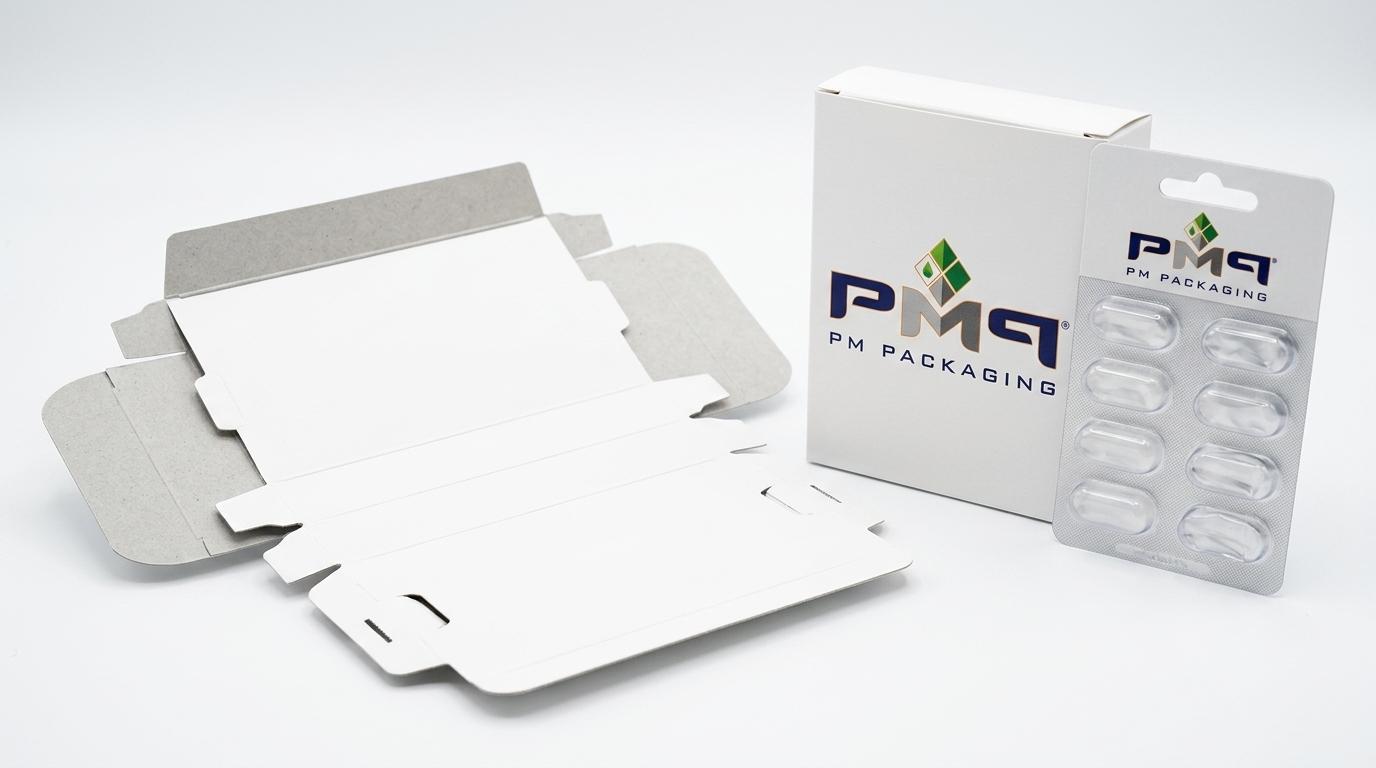
4. Blister Packaging Programs & the qikCombo™ Advantage
For unit-dose OTC tablets, gel capsules, lozenges, allergy caplets, and smoking cessation gums, carded blister packaging remains the dominant retail format.
Face-Seal Blister Cards (18pt to 28pt SBS)
Thermoformed cavities heat-sealed directly onto coated paperboard cards using water-based, solvent-free heat-seal coatings achieving 100% fiber-tear adhesion at rapid dwell times (1.2 to 2.2 seconds).
Trapped Blister Systems
Flanges trapped between two die-cut SBS panels. Eliminates heat-seal adhesive on visible graphics and allows 100% curbside paperboard recyclability upon consumer separation.
qikCombo™ Program vs. Conventional Dedicated Runs
| Commercial Parameter | Dedicated Custom Production Run | PM Packaging qikCombo™ Program |
|---|---|---|
| Minimum Order Quantity (MOQ) | 50,000 – 100,000 units per SKU | 5,000 – 25,000 units per SKU |
| Upfront Plate & Tooling Cost | $1,500 – $3,000 per SKU | Amortized across gang run (Minimal) |
| Production Turnaround Time | 4 – 6 Weeks | 10 Business Days |
| SKU Portfolio Agility | High financial carrying risk | Test 5–20 SKUs simultaneously |
| Best Suited For | Single hero SKU high-volume runs | Multi-symptom lines, seasonal peaks |
Through qikCombo™, PM Packaging groups 5 to 20 compatible blister card part numbers onto standardized master press sheets. Brands capture the low unit costs of massive offset lithography without over-committing working capital to slow-moving SKUs.
5. End-to-End Quality Systems: Zero Defect Manufacturing
In OTC and wellness manufacturing, quality assurance is an imperative backed by statutory liability. Secondary packaging must meet stringent ISO and cGMP requirements to guarantee zero mixed-SKU occurrences, flawless barcode scan rates, and precise lot code readability.
ISO 9001:2015, SQF Certified & FDA Food Contact Compliant
Rigorous quality management governing raw material caliper, moisture verification, color matching, and sanitary converting environments for ingestible wellness supplements.
100% Inline Optical Vision Inspection
High-speed camera inspection systems installed on folder-gluers scan every individual carton blank at speeds up to 100,000 units/hour, automatically rejecting defects.
Pharma-Code & 2D DataMatrix Verification
Electronic scanners verify optical security codes on every carton flap before gluing, completely eliminating the risk of SKU co-mingling during multi-SKU changeovers.
6. Multi-Channel Retail Execution: Drugstore, Mass, Club & E-Commerce
Modern OTC and wellness brands do not sell into a single retail environment. Successful commercial packaging programs require multi-channel structural versatility:
Pharmacy & Drugstore
Reinforced Delta and Euro-slot hang-tabs engineered to prevent peg-tear failures; turnkey Counter PDQ trays for high-impulse checkout placement.
Mass & Club Stores
Full-pallet display trays engineered for 4-high dynamic warehouse stacking; heavy-duty SFL F-flute multipacks with integrated carrying handles.
E-Commerce (ISTA-6A)
Ships-In-Own-Container (SIOC) and Frustration-Free Packaging (FFP) compliant folding cartons engineered to eliminate secondary bubble wrap and survive drop shock.
7. Nearshore US-Mexico Supply Chain Velocity & Risk Mitigation
For enterprise procurement teams, the geographical location of your packaging manufacturer is a core pillar of supply chain resilience. Relying on overseas packaging converters introduces severe transit delays, moisture degradation, and tariff risks into OTC supply chains.
Lead Time Compression: 1–3 Days vs. 6–12 Weeks
Ground freight from Baja California facilities directly to West Coast and Southwest distribution centers in 1 to 3 days (3 to 5 days nationwide), responding instantly to seasonal flu spikes and allergy surges.
Elimination of Ocean Transit Moisture Degradation
Avoiding humid ocean containers prevents paperboard warping, delamination, and adhesive failures on automated cartoning lines.
100% USMCA / T-MEC Tariff-Free Compliance
All folding cartons, blister cards, and microflute displays qualify for duty-free treatment under USMCA / T-MEC with IMMEX certification, avoiding unpredictable Section 301 tariffs.
C-TPAT & OEA Fast-Track Border Clearance
Certified logistics fleet utilizing dedicated FAST lanes for secure, uninterrupted cross-border transit.
Vendor Managed Inventory (VMI) & Safety Stock
30 to 90 days of safety stock maintained in Southern California warehousing for seamless Just-In-Time (JIT) replenishment.
8. Total Cost of Ownership (TCO) & Procurement Decision Framework
Savvy packaging procurement directors evaluate suppliers based on Total Cost of Ownership (TCO) rather than isolated unit purchase price. Substandard paperboard that saves pennies per unit can generate tens of thousands of dollars in line downtime, retail chargebacks, and discarded product.
Total Cost of Ownership (TCO) Evaluation Model
| Cost Driver | Low-Cost Commodity Converter | PM Packaging Engineered Program |
|---|---|---|
| Base Unit Purchase Price | Marginal initial discount | Highly competitive volume pricing |
| Automated Cartoner Jam Frequency | High (Inconsistent die-cuts/bowing) | Zero-jam precision score matrix |
| Packaging Line Pack-Out Speed | Sub-optimal (150 - 200 cpm) | Maximum efficiency (300 - 400+ cpm) |
| Retail Compliance Chargebacks | Frequent (Color shifts, barcoding) | Zero-defect GMI / G7 compliance |
| Working Capital Locked in Transit | 8 - 12 weeks ocean inventory | 1 - 3 days nearshore JIT inventory |
| Obsolescence from Regulatory Copy | High risk on massive overseas runs | Low risk via flexible qikCombo™ runs |
9. Strategic Implementation Roadmap: Launching an OTC Program
Executing a successful commercial packaging rollout requires structured, phase-gate collaboration between brand packaging engineers, procurement, and the converting manufacturing team:
Structural Audit & Monograph Alignment
Evaluate primary packaging dimensions, calculate Drug Facts surface area requirements, and select optimal paperboard caliper and dieline architecture.
CAD Prototyping & G7 Color Proofing
Produce production-grade CAD sample blanks on production SBS substrates and generate G7 color-calibrated proofs to verify legibility.
Co-Packer Pilot Line Validation
Deliver 5k-10k unit test blanks to validate automated cartoner erecting speeds, heat-seal dwell parameters, or manual kitting ergonomics.
Commercial Scale & VMI Integration
Ramp to full commercial production with inline optical inspection, establishing dedicated VMI safety stock buffers and automated JIT release schedules.
Partner with PM Packaging for Your Commercial OTC Program
For over 45 years, PM Packaging has served as the trusted packaging manufacturing partner for North America’s leading consumer healthcare, wellness, and pharmaceutical brands.
By combining world-class structural engineering, G7 Master certified print quality, SQF/ISO compliant manufacturing, the agile qikCombo™ blister program, and the strategic speed of our US-Mexico nearshore footprint, we empower healthcare and wellness brands to scale with zero defect tolerance.
Contact PM Packaging today to request CAD table prototypes, G7 contract color proofs, and a comprehensive nearshore Total Cost of Ownership (TCO) evaluation for your commercial healthcare product portfolio.