
The marine electronics and recreational boating accessories industry represents one of the most demanding, structurally complex sectors in consumer durables and commercial hardware manufacturing.
From multi-thousand-dollar multi-function displays (MFDs) and high-frequency CHIRP sonar chartplotters to solid bronze thru-hull transducers, high-output marine audio systems, IP67-rated VHF communications gear, and heavy 316-grade stainless steel deck hardware, marine equipment bridges the gap between high-acuity consumer electronics and rugged industrial machinery. Packaging must absorb punishing transit shock, neutralize coastal humidity, accelerate OEM boatbuilder staging, and command retail shelf authority.
Core Packaging Challenges in Marine Electronics & Boating Accessories
For Directors of Procurement, VP/Directors of Supply Chain, Brand Managers, and Packaging Engineers managing marine portfolios, packaging is far more than a decorative carton. It is an active structural defense system. Marine hardware combines extreme physical mass asymmetry with ultra-sensitive, high-value electronics that cannot tolerate transit deflection or environmental degradation.
This comprehensive technical guide outlines the structural substrate engineering, internal cushioning mechanics, dieline architectures, retail channel specifications, blister card programs, and nearshore supply chain strategies required to scale commercial packaging programs for marine electronics and boating accessories—drawing on PM Packaging’s 45+ years of structural design, large-format lithographic conversion, and advanced North American manufacturing.
1. Multi-Channel Commercial Distribution Ecosystem
Marine electronics and boating accessories navigate four distinct commercial channels, each imposing unique structural, aesthetic, and logistical constraints on primary, secondary, and master packaging systems.
Demands 175–200 LPI Idealliance G7 Master offset lithography to reproduce luminous oceanic sonar gradients, bathymetric contours, and crisp feature hierarchies. With ASPs ranging from $600 to $5,000+, dielines integrate blind-glued EAS/RFID anti-theft tags within internal flaps. Heavy accessories utilize reinforced Euro-hang tabs engineered to withstand 30+ lbs of pull force.
Tier-1 glass-helm suites and wiring backbones require rapid assembly-line extraction. Cartons feature thumb-notches, drop-down front gates, and modular internal trays allowing technicians to unbox displays and harnesses in under 10 seconds. Exterior precision windows enable scannable serialization (MAC addresses, NMEA IDs) without opening protective cartons.
Master shippers are palletized 3 high in coastal warehouses exceeding 85%+ relative humidity. Packaging requires high Box Compression Test (BCT) values, wet-strength linerboards, and water-barrier SFL mediums. High-contrast flexo/litho corner color codes and scannable GS1-128 barcodes prevent SKU picking errors across multi-transducer bundles.
Qualifying for Ships in Product Packaging (SIPP/SIOC) eliminates secondary overboxing waste and freight surcharges. Cartons pass rigorous ISTA 6-Amazon freefall drop tests (36-inch drops on steel anvils, rotational impacts, vibration). Precision molded pulp cradles and non-abrasive screen wraps create a premium unboxing ceremony that lowers return rates.
2. Structural Substrate Engineering: Solving the Kinetic Mass Dilemma
Marine electronics packaging represents a severe structural paradox: the package must protect an ultra-fragile, chemically strengthened optical glass touchscreen while securely containing heavy, dense, and physically abrasive components.
12-Inch Marine Multi-Function Display (MFD) Commercial Combo Kit
When dropped from 36 inches, this 16.2-lb asymmetric mass generates extreme kinetic momentum. Without rigid fluted substrate engineering, internal components act as battering rams that fracture screen glass and crush connectors.
| Substrate Type | Caliper / Flute Spec | Typical Application | Structural Strength | Print & Visual Quality |
|---|---|---|---|---|
| Solid Bleached Sulfate (SBS) | 18pt – 26pt SBS (Virgin Chemical) | Handheld VHF Radios, Antennas, Marine Sensors | High tear resistance; moderate beam stiffness | 175–200 LPI litho; 90+ GE brightness; pristine white |
| Coated Unbleached Kraft (CUK / SUS) | 20pt – 28pt CUK (Virgin Pine Kraft) | Heavy Gimbal Mounts, Bracket Kits, Fasteners | Superior tensile and puncture tear-out resistance | High-density graphics; unbleached Kraft back |
| Litho-Laminated SFL (F-Flute) | F-Flute (1/32") ~128 Flutes/Linear Ft | 7" Chartplotters, Marine Gauges, Digital Hubs | 40–48 ECT; high top-load crush resistance | Zero flute washboarding; photographic litho fidelity |
| Litho-Laminated SFL (E-Flute) | E-Flute (1/16") ~90 Flutes/Linear Ft | 9"–16" MFD Bundles, Marine Amps, Sonar Modules | 48–58+ ECT; extreme kinetic drop survival | Flawless G7 offset print; smooth 10pt SBS top sheet |
| Litho-Laminated SFL (B-Flute) | B-Flute (1/8") ~47 Flutes/Linear Ft | Radar Radomes, Heavy Bronze Transducers | 55–68+ ECT; maximum cushioning stroke | High impact resistance; bold litho label wrap |
| Trapped Blister Card (qikCombo™) | 24pt – 30pt SBS/SBS Heat-Seal Coated | Stainless Cleats, Deck Hardware, LED Fixtures | Extreme seal strength; 30+ lb hang tab pull | 175 LPI 2-sided print; clear thermoformed pocket |
For marine electronics packages exceeding 4 lbs, standard paperboard lacks the vertical column strength required to prevent box crushing under high-bay pallet loads. However, standard direct-print flexographic corrugated boxes suffer from severe "washboarding" (flute shadow lines showing through the print surface) and coarse print resolution (85–110 LPI) that degrades premium brand perception.
Single Face Laminate (SFL) microflute eliminates this trade-off by inline-laminating an offset-printed folding carton top sheet (80# coated litho label or 10pt–12pt SBS) directly to an exposed single-face corrugated structure—delivering 48–58+ ECT structural strength with flawless photographic printing.
3. Dynamic Cushioning, Display Protection & Marine Environmental Defense
Engineering protective packaging for marine electronics requires solving three physical challenges: managing kinetic shear forces from asymmetric internal components, protecting optical screen surfaces from abrasive micro-scratching, and neutralizing the degrading effects of coastal humidity and salt air.
Dual-Tier Compartmentalization Architecture
A precision-folded SFL microflute tray suspends the power harness, silicone suncover, and documentation binder above the primary unit. The 30-foot transducer wiring coil is locked in a dedicated rear cavity, preventing heavy brass connector collars from swinging against the display during transit vibration.
The primary MFD is cradle-suspended in molded fiber endcaps providing 0.75 inches of deceleration clearance on all six axes. The heavy bronze or urethane transducer and aluminum gimbal bracket rest in an isolated adjacent chamber, physically decoupled from the glass display.
Marine displays feature anti-reflective (AR) and anti-fingerprint (AF) optical glass coatings. Under transit vibration (ASTM D4169 / ISTA 3A), direct contact with rough kraft liners causes irreversible "chafing haze." PM Packaging integrates non-abrasive spunbond liners and soft-touch poly coatings, engineering molded endcaps to grip the outer perimeter rather than the optical glass face.
At 90% relative humidity in coastal warehouses, standard uncoated corrugated absorbs water vapor, losing over 60% of its vertical Box Compression Test (BCT) strength. PM Packaging applies inline aqueous hydro-barrier coatings to both top sheet and fluting medium, retarding moisture absorption and maintaining 85%+ dry BCT strength under humid conditions.
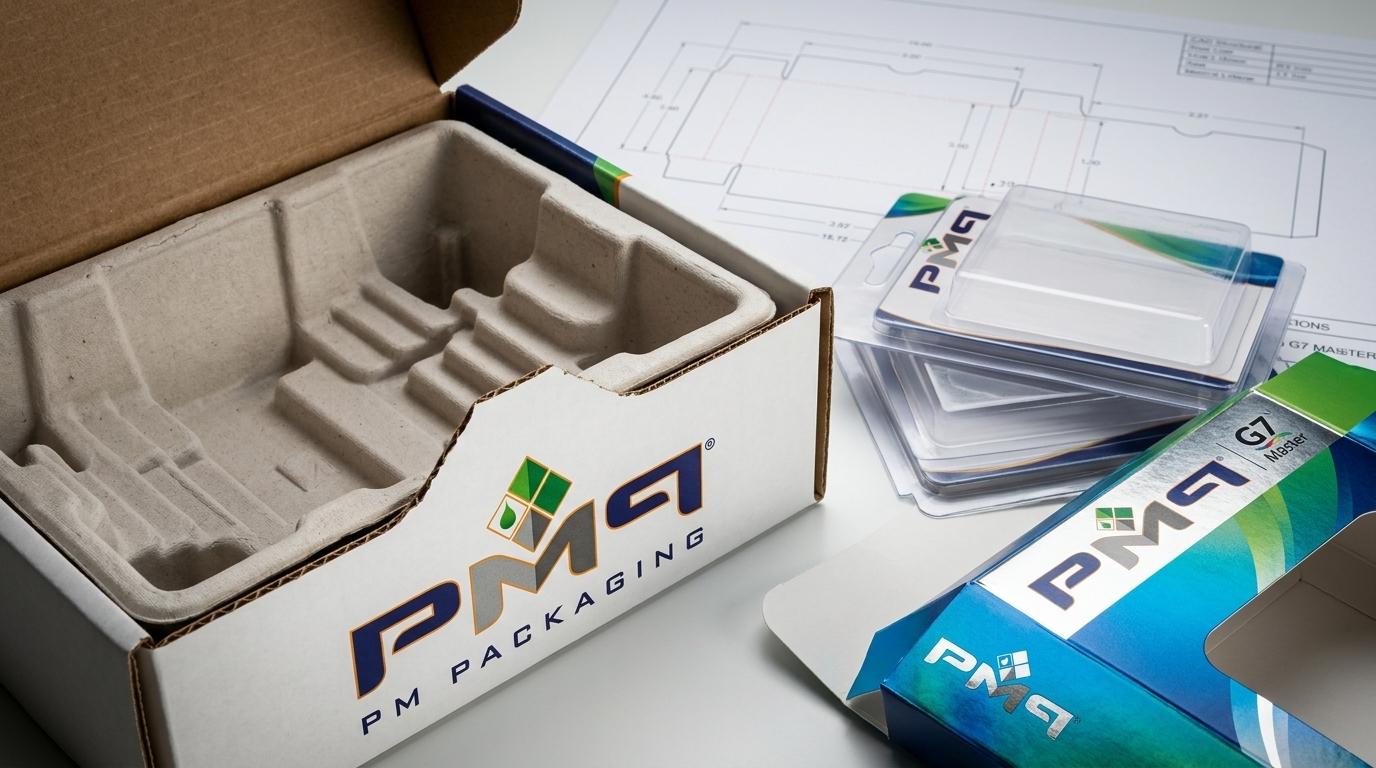
4. Dieline Architecture & High-Speed Pack-Out Efficiency
Selecting the optimal packaging dieline requires balancing structural protection, retail aesthetics, and assembly labor speed on the packaging line.
| Dieline Style | Manual Assembly Time | Cartoner Speed | Structural Rigidity & Drop | Primary Marine Application |
|---|---|---|---|---|
| Roll-End Tuck-Top (RETT) with Dust Flaps & Locks | 12 – 18 sec | Semi-Auto / Tray Former | Exceptional double-wall side & top-load strength | 7" to 16" Chartplotters, MFDs, Marine Amplifiers |
| Auto-Lock Bottom (Crash-Lock / 1-2-3) | 3 – 5 sec (Instant Pop) | 60 – 120 units/min | High base strength; moderate side drop defense | Handheld VHF Radios, GPS Pucks, Transducer Mounts |
| Straight Tuck End (STE) with Friction Fit Flaps | 6 – 9 sec | 100 – 250 units/min | Light-to-moderate; requires outer wafer seal | Cable Accessories, NMEA 2000 Kits, Fasteners |
| Two-Piece Rigid Shoulder Setup Box | 15 – 25 sec | Hand Kitting Line | Extreme crush resistance; luxury unboxing | Flagship Yacht Navigation Suites, Marine Smart Watches |
| Trapped Blister Card (qikCombo™ Heat-Seal) | 4 – 8 sec (Seal Cycle) | 30 – 60 units/min | High tamper resistance; 30+ lb hang pull | Stainless Deck Cleats, LED Lights, Battery Switches |
The Roll-End Tuck-Top (RETT) dieline in E-flute or F-flute SFL microflute remains the industry benchmark for marine electronics. Its roll-over sidewalls form rigid double-wall structures that prevent box crushing under high pallet stacking, while hinged lids present clear quick-start wiring diagrams directly on the interior flap when opened.
5. Plastic Clamshell Transition & qikCombo™ Blister Packaging for Deck Hardware
Boating accessories—such as 316 stainless steel deck cleats, bow chocks, LED navigation lights, fuel primer bulbs, marine battery switches, and waterproof circuit breakers—have traditionally been packaged in heavy thermoformed PVC clamshells that trigger consumer frustration ("wrap rage") and violate retailer plastic-reduction mandates.
PM Packaging Trapped Blister Card Program
Our trapped blister architecture sandwiches a 100% recycled rPET blister cavity between two plies of high-burst 24pt to 28pt Solid Bleached Sulfate (SBS) paperboard. High-bond water-based heat-seal varnishes lock 2 to 5 lb stainless steel cleats firmly in place, supporting 30+ lbs of hang-tab pull force while providing clean, scissor-free tear-away rear access for boat owners.
6. Graphic Fidelity, Brand Equity & Retail Shelf Impact
When investing $1,000 to $5,000+ in marine navigation electronics, consumers demand packaging that reflects cutting-edge engineering and durability.
| Embellishment Type | Technical Mechanism | Aesthetic & Tactical Effect | Target Application |
|---|---|---|---|
| Inline Cold Foil Stamping | Inline adhesive + metallic foil tower | Mirror-reflective chrome sheen; high-tech positioning | Metallic brand emblems, IPX7 waterproof badges |
| Strike-Through Spot UV Contrast | Spot matte coating + overall gloss UV | High-contrast gloss on matte; visual screen illumination | Highlighting sonar screens against deep ocean depths |
| Soft-Touch Tactile Coating | Water-based tactile aqueous finish | Velvety, non-slip matte texture; zero fingerprint haze | Flagship chartplotters, marine smart instruments |
| Anti-Scuff Matte Hardcoat | Cross-linked polymer matte finish | Eliminates transit scuffing on dark navy/black inks | Club store master packs, heavy marine audio cartons |
PM Packaging utilizes large-format 6-to-8 color offset lithographic presses running Idealliance G7 calibrated curves (175 to 200 LPI). This achieves tight spectral color consistency (Delta E < 1.5), ensuring that fiery sonar heatmaps, bathymetric contours, and dark oceanic gradients reproduce flawlessly without banding or dot gain.
7. Supply Chain Agility, Nearshore Logistics & USMCA Compliance
The recreational marine industry is defined by extreme seasonality. Marine electronics sales spike dramatically in the early spring (March through June) as boat owners prepare vessels for the season and boatbuilders ramp up production lines.
| Evaluation Metric | Transpacific Sourcing (Asia) | PM Packaging Nearshore (US / Mexico) |
|---|---|---|
| Total Lead Time | 10 – 14 Weeks (Ocean Freight) | 1 – 3 Weeks (Direct Ground Freight) |
| Transit to US Hubs | 28 – 45 Days (Ocean + Port) | 1 – 3 Days (Direct Truckload) |
| Tariff / Trade Status | Subject to 7.5% – 25%+ Tariffs | 100% Tariff-Free under USMCA / T-MEC |
| Minimum Order Quantities | 25,000 – 50,000+ Units per SKU | 5,000 – 10,000 Units (qikCombo™ Gang Runs) |
| Working Capital in Transit | 3 Months of Locked Working Capital | Less than 5 Days In-Transit Inventory |
| Border Clearance Agility | Port Demurrage & Customs Delays | C-TPAT & OEA Certified Fast-Track Border |
| Quality & Color Audits | Remote digital proofs / long delays | Same-day press checks in San Diego / Baja |
With dual-plant converting facilities in Baja California (Tijuana and Mexicali) and corporate headquarters in San Diego, California, PM Packaging delivers dedicated ground truckloads across North America in 1 to 3 days—eliminating transpacific port volatility and supporting Vendor Managed Inventory (VMI) buffer programs.
8. Enterprise Procurement Strategy & Technical Implementation Checklist
For procurement directors and packaging engineering leads onboarding a commercial packaging program for marine electronics, following a structured qualification workflow ensures zero retail launch delays.
1. Structural & Substrate Validation
- ✓Calculate total payload mass & Center of Gravity (CoG) including cast brackets & transducer cables
- ✓Ensure primary display has at least 0.75" decoupled deceleration clearance or molded fiber cradles
- ✓Specify water-resistant barrier coatings preserving 85%+ BCT under 90% relative humidity
- ✓Apply spunbond non-abrasive liners to protect optical anti-reflective glass from transit vibration
2. Regulatory & Channel Compliance
- ✓Pass ISTA 6-Amazon.com SIPP/SIOC drop, rotational impact, and random vibration certification
- ✓Integrate blind-glued EAS AM/RF acoustic-magnetic tags for merchandise with ASP > $200
- ✓Verify 30+ lbs of pull force on retail trapped blister cards for heavy stainless deck hardware
- ✓Design OEM pro-pack cartons with external scannable serial/MAC address viewing windows
3. Graphic Consistency & Nearshore Logistics
- ✓Enforce Idealliance G7 Master certified offset litho with Delta E < 1.5 color tolerance
- ✓Apply anti-scuff matte aqueous hardcoats to prevent scuffing on dark oceanic packaging backgrounds
- ✓Verify 100% USMCA / T-MEC tariff-free North American Rules of Origin compliance
- ✓Establish Vendor Managed Inventory (VMI) safety-stock buffers to absorb spring demand spikes
Scaling Marine Packaging Programs with PM Packaging
Packaging for marine electronics and boating accessories demands an uncompromising balance of heavy-duty structural engineering, high-humidity defense, pristine lithographic brand storytelling, and nearshore supply chain velocity.
With over 45 years of structural design, G7 Master certified offset lithography, Single Face Laminate (SFL) microflute manufacturing, and nearshore plants in Baja California, PM Packaging provides the technical leadership and supply chain resilience your enterprise demands.
• Headquarters & Engineering: San Diego, California
• Advanced Converting Plants: Tijuana & Mexicali, Baja California
• Certifications: G7 Master Printer, ISO 9001:2015, GMI Certified, FSC/SFI Certified, C-TPAT & OEA Certified