
For Directors of Procurement, VP/Directors of Supply Chain, Brand Managers, and Senior Packaging Engineers managing professional measuring instruments, layout tools, and optical leveling equipment, packaging a high-SKU catalog presents an intense convergence of structural physics, retail loss prevention, and supply chain agility.
Precision measuring tools—spanning digital and dial calipers, micrometers, digital angle finders, electronic protractors, magnetic torpedo levels, stud sensors, laser distance meters (LDMs), self-leveling cross-line lasers, 360° plane rotary lasers, and specialized layout accessories—are fundamentally different from ordinary consumer hardware. They represent high-value, mechanically sensitive, and optics-dependent instruments packaged in compact, high-density formats.
+-----------------------------------------------------------------------------------------------------------------------+
|                    THE MULTI-SKU PRECISION MEASURING TOOL PACKAGING & SOURCING MATRIX                                 |
+-----------------------------------------------------------------------------------------------------------------------+
|  1. CATALOG COMPLEXITY & SOURCING BOTTLENECK                                                                          |
|     [ 150+ Precision Measuring SKUs ] ──> [ Severe Pareto Velocity Skew (High-Run Tapes vs Niche Micrometers) ]       |
|                                       ──> [ Dedicated Offset Impositions Force High MOQs (25k-50k) & Cash Lockup ]   |
|                                       ──> [ High Obsolescence from Laser Compliance (FDA/CDRH) & Reese's Law Updates]  |
|                                                                                                                       |
|  2. MECHANICAL, OPTICAL & MERCHANDISING HAZARDS                                                                       |
|     [ Heavy Cast Metal & Magnetic Bases ] ──> [ High Cantilever Shear Stress on Blister Flanges & Peg Hang Holes ]   |
|     [ Sensitive Optics, Diodes & LCDs ]   ──> [ Impact Shock Transmission, Calibration Shift & Lens Scuffing ]        |
|     [ High-Value Aisle Shrink & Theft ]   ──> [ Razor Slicing of Plastic Flanges & In-Aisle Component Pilferage ]      |
|     [ Sharp Hardened Stainless Jaws ]     ──> [ Blister Cavity Puncture, Abrasive Wear & Internal Rattling ]          |
|                                                                                                                       |
|  3. THE NEARSHORE GANG-RUN SOLUTION (PM PACKAGING qikCombo™)                                                          |
|     [ Heavy-Duty 24pt-32pt Virgin SBS ]   ──> [ Trapped Blister & Sandwich Cards with 100% Fiber-Tear Adhesion ]       |
|     [ Shared qikCombo™ Impositions ]      ──> [ 5,000-Unit Economic Runs Across 8-24 Imposed SKUs per Master Sheet ]  |
|     [ Integrated EAS / RFID Inlays ]      ──> [ Concealed Loss Prevention Architecture Between Paperboard Plies ]     |
|     [ San Diego & Baja Manufacturing ]    ──> [ 10-Day Turnaround + 1-3 Day Ground Freight to Western US DCs ]         |
+-----------------------------------------------------------------------------------------------------------------------+
When merchandised across Tier-1 home improvement centers, contractor supply houses, industrial MRO distributors, and mass retail—such as The Home Depot, Lowe’s, Menards, Grainger, Fastenal, MSC Industrial Direct, Ace Hardware, True Value, Tractor Supply Co., Northern Tool, and Amazon—these tools face punishing retail merchandising realities:
1. Cantilever Shear & Heavy Mass
Heavy zinc/aluminum bodies and concentrated metal masses exert severe cantilever shear forces on retail pegboards, stressing hang holes and flange seals.
2. In-Aisle Shrink & Knife Tampering
High retail price points ($29 to $299+) attract persistent in-store theft, razor-blade flange slicing, and component pilferage in open contractor aisles.
3. Optics & Calibration Sensitivity
Sensitive optical prisms, internal leveling pendulums, calibrated glass bubble vials, and digital LCD displays cannot tolerate drop-shock transmission, clamping deformation, or moisture intrusion.
To resolve the competing pressures of structural durability, retail anti-theft compliance, and inventory carrying costs, leading tool brands are abandoning fragmented, dedicated transpacific purchasing in favor of standardized, heavy-duty blister card programs engineered with PM Packaging’s qikCombo™ gang-run manufacturing engine.
1. Catalog Dynamics: Why Multi-SKU Precision Tool Catalogs Break Traditional Procurement
Managing packaging procurement for precision measuring tools requires navigating an extreme product velocity curve. While consumer-grade 25-foot tape measures and 9-inch magnetic torpedo levels turn thousands of units weekly per retail chain, specialized layout and optical leveling instruments exhibit highly fragmented demand profiles.
                  PRECISION TOOL CATALOG VELOCITY SPECTRUM (PARETO 80/20 CURVE)

     Annual Unit Volume
       ▲
  300k ┼──────────┐  [ "A" SKUs: Top 15% of Catalog ]
       │          │  High-Velocity Mass Hardware (e.g., 25' Tape Measures, 9" Magnetic Torpedo Levels,
  120k ┼          │  Standard 6" Composite Digital Calipers, Red Beam Cross-Line Lasers)
       │          └───────────┐
   35k ┼                      │  [ "B" SKUs: 25% of Catalog ]
       │                      │  Mid-Tier Trade Instruments (Green-Beam Self-Leveling Cross Lasers,
   10k ┼                      │  Digital Angle Finders, 8" Stainless Calipers, Stud/AC Wire Detectors)
       │                      └──────────────────────┐
    3k ┼                                             │  [ "C" & "D" SKUs: 60% of Catalog ]
       │                                             │  Specialized Niche Instruments (0-1" Outside Micrometers,
    0  ┴─────────────────────────────────────────────┴──────────────────────────────────────────►
       0%                                           40%                                        100%
                                        Catalog SKU Count
The Sourcing Bottleneck of “C” and “D” Layout & Metrology SKUs
In an enterprise tool portfolio spanning 150 to 300 active SKUs, more than half the catalog consists of critical, low-to-medium-velocity instruments that professional tradesmen demand, but which move in short, episodic replenishment cycles:
- Specialized Metrology Tools: 0–1" and 1–2" mechanical outside micrometers, 8" and 12" precision IP54/IP67 stainless steel digital calipers, digital depth gauges, dial test indicators, and pitch gauges.
- Advanced Optical Leveling & Layout: 360° multi-plane green beam lasers, precision optical plumb bobs, electronic digital inclinometers, and rotary laser detector clamps.
- Specialty Surface & Inspection Gauges: Stainless steel contour profile gauges, bore gauges, precision feeler gauge leaves, and carbide-tipped layout scribers.
- Accessories & Sub-Components: Magnetic target plates, laser enhancement glasses, multi-axis micro-adjusting wall brackets, and replacement lithium-ion rechargeable battery packs.
When procurement departments attempt to source blister cards for these secondary and tertiary SKUs through conventional dedicated offset press runs, they encounter crippling structural cost penalties:
| Cost Component | Dedicated Press Run (1 Dedicated Caliper SKU) | qikCombo™ Gang Run (16 Imposed Measuring SKUs) |
|---|---|---|
| CTP Aluminum Plates | 4 to 6 plates charged 100% to 1 SKU ($500–$800) | 4 to 6 plates amortized across 16 SKUs ($40/SKU) |
| Press Makeready | 350–500 setup sheets charged to 1 SKU | 350–500 setup sheets shared across 16 SKUs |
| Ink Fountain Setup | Full washup & color staging for 1 SKU ($350) | Single washup staged for 16 SKUs ($22/SKU) |
| Die-Cutter Setup | Platen makeready & stripping for 1 SKU ($300) | Shared combo die setup across 16 SKUs ($19/SKU) |
| Minimum Economic Run | 25,000 to 50,000 units mandatory | 5,000 units per SKU fully cost-effective |
| Production Lead Time | 4 to 6 weeks (Domestic) / 12 weeks (Asia) | 10 business days (Standardized Nearshore Run) |
The Financial & Logistical Consequences of High MOQs
1. Working Capital Entrapment
To achieve a viable unit cost on a standalone press run, converters mandate minimum order quantities (MOQs) of 25,000 to 50,000 cards per SKU. For a brand managing 80 low-velocity measuring tools, purchasing 35,000 cards per part number forces the procurement team to tie up $300,000 to $600,000 in excess packaging inventory that will sit in distribution centers for 24 to 36 months.
2. Catastrophic Obsolescence & Regulatory Scrap
Precision tool packaging is uniquely exposed to frequent graphic, legal, and regulatory updates:
- Laser Safety Classification & Warnings: Updates to FDA Center for Devices and Radiological Health (CDRH 21 CFR 1040.10 / 1040.11) and international standards (IEC 60825-1:2014) regarding Class II, Class IIa, and Class IIIr power emissions (e.g., 510–530nm green diode output disclosures).
- Battery Child Safety Mandates: Enforcement of Reese’s Law (16 CFR Part 1263) requiring prominent front-panel skull-and-crossbones icons, specific warning text hierarchies, and icon placements on packaging for digital calipers and angle finders powered by button/coin cell batteries (CR2032, LR44).
- Lithium-Ion Transportation Markings: UN 3481 / UN 3091 battery transport symbols and watt-hour (Wh) rating disclosures on rechargeable laser tools.
- Retailer Branding & Merchandising Shifts: Private-label transitions, planogram peg-spacing alterations, QR code video demo integrations, and bilingual Canadian French/Spanish packaging mandates.
When regulatory or graphic updates occur, pre-printed inventories of dedicated cards must be destroyed at massive financial loss. PM Packaging’s qikCombo™ shared-run model eliminates this exposure by allowing brands to order high-frequency 5,000- to 10,000-unit batches across their entire catalog with guaranteed 10-day press turnaround.
2. Structural & Substrate Engineering for Heavy, Sensitive Hardware
Packaging a 1.5-pound cast-aluminum torpedo level or a $150 precision laser distance meter demands a substrate capable of withstanding dynamic tensile loads, edge abrasion, and transit drop impacts without tearing, warping, or delaminating.
                           STRUCTURAL LOAD & STRESS ANALYSIS: LASER LEVEL PACK

                   ┌──────────────────────────────────────────┐
                   │       Reinforced Euro/Sombrero Punch     │ <── [ Cantilever Peg Shear Force: 16-36 oz ]
                   │      (28pt-32pt SBS + Internal Gusset)   │
                   ├──────────────────────────────────────────┤
                   │                                          │
                   │       G7 Certified Master Print Face     │ <── [ High-Gloss Anti-Scuff Aqueous Coating ]
                   │      (FDA Laser Class & Reese's Warnings)│
                   │                                          │
                   │  ┌────────────────────────────────────┐  │
                   │  │ Thermoformed Heavy-Gauge RPET/GAG  │  │
                   │  │ (0.020" - 0.035" Caliper Cavity)   │  │
                   │  │                                    │  │
                   │  │   [ Laser Optics / Caliper Body ]  │  │ <── [ Point Load & Pendulum Lock Clearance ]
                   │  │   [ Concentrated Mass Center ]     │  │
                   │  │                                    │  │
                   │  │  ┌──────────────────────────────┐  │  │
                   │  │  │ Peripheral Heat-Seal Flange  │  │  │ <── [ Minimum 0.250" - 0.375" Seal Flange Width ]
                   │  │  │ (High-Solids Dispersion Bond)│  │  │     [ 100% Fiber-Tear Substrate Fusion ]
                   │  │  └──────────────────────────────┘  │  │
                   │  └────────────────────────────────────┘  │
                   │                                          │
                   │  ┌────────────────────────────────────┐  │
                   │  │   Concealed EAS / RFID Inlay Slot  │  │ <── [ Tamper-Proof Anti-Theft Protection ]
                   │  └────────────────────────────────────┘  │
                   └──────────────────────────────────────────┘
Substrate Comparison: Why Virgin SBS Is Mandatory for Precision Tools
Using recycled paperboards—such as Clay Coated Newsback (CCNB) or Coated Recycled Board (CRB)—for heavy precision tools is a primary root cause of catastrophic retail packaging failure.
| Technical Property | Solid Bleached Sulfate (SBS) | Clay Coated Newsback (CCNB) | Folding Boxboard (FBB) |
|---|---|---|---|
| Fiber Origin | 100% Virgin Bleached Chemical | Recycled Newsprint / Old Paper | Virgin Bleached Outer / Mech. |
| Caliper Range Recommended | 24pt, 28pt, 30pt, 32pt (0.032") | 26pt, 28pt, 32pt | 24pt, 28pt |
| Internal Ply Bond (Scott Bond) | 130 – 180 ft-lbs/1000 in² | 60 – 85 ft-lbs/1000 in² | 100 – 130 ft-lbs/1000 in² |
| Tear Resistance (Elmendorf - MD/CD) | 450 / 520 mN (High Fiber Inter) | 220 / 280 mN (Short Fibers) | 320 / 380 mN |
| Moisture Stability & Curl Control | Outstanding (Controlled RH) | Poor (Prone to Hygroscopic Warp) | Good |
| Heat-Seal Adhesion Reliability | 100% Fiber-Tear Failure | Premature Delamination / Flake | Clean Fiber Tear |
| Print Whiteness (GE Brightness) | 90 – 94% (Bright White Back) | 78 – 82% (Grey Newsback Rear) | 88 – 92% (Cream/White Back) |
| Primary Tool Application | Heavy Lasers, Calipers, Levels | Not Recommended for > 8 oz | Light Layout Accessories (<6oz) |
1. Internal Ply Bond Strength (Scott Bond)
When a customer pulls a 2-pound laser level forward on a retail peg hook, the load exerts severe peeling stress on the paperboard backing directly adjacent to the heat-seal flange. SBS virgin fiber possesses long, chemically bonded fibers delivering Scott Bond ratings exceeding 140 ft-lbs/1000 in². In contrast, CCNB contains recycled short fibers with low internal cohesion; under load, CCNB delaminates internally, causing the printed surface ply to tear cleanly away from the grey recycled core while leaving the blister cavity detached on the store floor.
2. Hang-Hole Tear Resistance
Heavy tools suspended on double-wire retail peg hooks generate concentrated shear forces. A 30pt SBS card provides up to 120% greater Elmendorf tear resistance than an equivalent caliper CCNB board, preventing peg-hole elongation and merchandise drops.
3. Dimensional Flatness for Automated Feeders
Recycled boards are hygroscopic and react aggressively to ambient humidity shifts, developing cross-directional (CD) curl. In high-speed automated blister sealing lines, curled cards cause vacuum pick-and-place magazine jams, shutting down production. Virgin SBS maintains precise dimensional equilibrium (5.5% to 6.5% moisture content), ensuring uninterrupted automated feeding.
3. Structural Configurations: Face Seal, Fold-Over, and Trapped Blister Architectures
Selecting the appropriate blister card architecture is a decisive engineering choice balancing tool weight, price point, theft risk, and automated assembly throughput.
+-----------------------------------------------------------------------------------------------------------------------+
|                                    BLISTER CARD ARCHITECTURAL TAXONOMY                                                |
+-----------------------------------------------------------------------------------------------------------------------+
|                                                                                                                       |
|  A. FACE SEAL BLISTER CARD (Single Card)                                                                              |
|     [ Printed 24pt-28pt SBS Card ] ◄── [ Heat-Seal Coating ] ◄── [ Thermoformed Plastic Flange (Exposed) ]            |
|     * Best For: Lightweight accessories (< 8 oz), replacement parts, marking gauges, feeler gauges.                   |
|     * Advantage: Lowest unit material cost; rapid single-station rotary sealing.                                      |
|     * Limitation: Perimeter flange vulnerable to knife slicing; moderate weight capacity.                             |
|                                                                                                                       |
|  B. FOLD-OVER / SANDWICH BLISTER CARD (1-Piece Die-Cut Card)                                                          |
|     ┌───────────────────────────────────┬───────────────────────────────────┐                                         |
|     │ Front Panel (Window Cutout)       │ Rear Backing Panel                │ ──► [ Folded along center crease ]      |
|     └───────────────────────────────────┴───────────────────────────────────┘                                         |
|     [ Front SBS Ply ] ──> [ Trapped Plastic Flange ] ──> [ Heat-Seal Matrix ] ──> [ Rear SBS Ply ]                    |
|     * Best For: Medium-weight tools (8 oz to 1.5 lbs), digital calipers, angle finders, torpedo levels.               |
|     * Advantage: Flange fully encapsulated between two plies; 2x hang-hole thickness (56pt total); high tamper resist.|
|                                                                                                                       |
|  C. TWO-PIECE TRAPPED BLISTER CARD (Front Die-Cut Card + Back Solid Card)                                             |
|     [ 20pt-24pt Front Die-Cut SBS Ply ]                                                                               |
|            ▼                                                                                                          |
|     [ Thermoformed Blister Flange (Trapped Internally) ]                                                              |
|            ▲                                                                                                          |
|     [ 20pt-24pt Rear Solid SBS Ply ]                                                                                  |
|     * Best For: Heavy pro-grade tools (1.5 lbs to 4 lbs), self-leveling laser levels, 360° plane lasers, micrometer kits.|
|     * Advantage: Maximum structural rigidity; zero plastic perimeter exposed; fully recyclable curb-side sorting.     |
+-----------------------------------------------------------------------------------------------------------------------+
| Engineering Parameter | Face Seal Card | Fold-Over (Sandwich) Card | Two-Piece Trapped Blister |
|---|---|---|---|
| Substrate Configuration | Single 24pt–30pt SBS Card | Single 24pt–28pt SBS (Scored) | Two 18pt–24pt SBS Plies |
| Total Combined Board Caliper | 24pt – 30pt | 48pt – 56pt at perimeter/hang | 36pt – 48pt laminated |
| Maximum Recommended Tool Weight | 8 oz (0.50 lbs) | 24 oz (1.50 lbs) | 64 oz (4.00 lbs) |
| In-Aisle Theft / Razor Resistance | Low (Flange exposed to cut) | High (Flange trapped in board) | Maximum (Complete encapsulation) |
| Hang-Hole Tear-Out Rating | Standard | Superior (Double-ply folded) | Superior (Full face lamination) |
| EAS / RFID Concealment | Visible rear sticker | 100% Concealed between plies | 100% Concealed between plies |
| Sealing Line Automation Speed | High (Single card feed) | High (Automated plow folder) | Medium-High (Dual card feed) |
| Tooling Cost (Heat-Seal Fixtures) | Low ($1,500 – $2,500) | Moderate ($2,500 – $4,000) | Moderate ($3,000 – $5,000) |
| Target SKUs | Replacement lenses, targets, feeler gauges, pocket rules | 6"/8" Digital Calipers, Angle Finders, Torpedo Spirit Levels | Multi-line laser levels, heavy cast levels, micrometer sets |
4. Thermoformed Blister Cavity Mating & Heat-Seal Chemistry
A blister card program is only as reliable as the molecular bond between the thermoformed plastic cavity and the aqueous heat-seal barrier coating applied over the printed paperboard.
                    MOLECULAR HEAT-SEAL INTERACTION & 100% FIBER-TEAR DYNAMICS

    Heated Sealing Platen (310°F - 340°F / 45-55 PSI / 1.5 - 2.0s Dwell)
    ═══════════════════════════════════════════════════════════════════════
    ┌─────────────────────────────────────────────────────────────────────┐  ▲
    │ Thermoformed Blister Flange (0.020" - 0.030" RPET / GAG Co-Ex)      │  │ Plastic Substrate
    ├─────────────────────────────────────────────────────────────────────┤  ▼
    │ High-Solids Aqueous Dispersion Heat-Seal Layer (3.5 - 4.5 lbs/ream) │ <── Polymer Fusion Zone
    ├─────────────────────────────────────────────────────────────────────┤  ▲
    │ Offset Litho Inks (Formulated Wax-Free for High Bond Strength)     │  │
    ├─────────────────────────────────────────────────────────────────────┤  │ SBS Virgin Paperboard
    │ Clay Coating Top Layer (G7 Master Certified Print Surface)          │  │ Z-Directional Ply Matrix
    ├─────────────────────────────────────────────────────────────────────┤  │ (Scott Bond > 140)
    │ Bleached Virgin Chemical Pulp Core (Long Interlocking Fibers)       │  │
    └─────────────────────────────────────────────────────────────────────┘  ▼
    ═══════════════════════════════════════════════════════════════════════
    Lower CNC Aluminum Sealing Nest (Silicone Gasket Pressure Relieved over Optics)
Blister Material Selection: RPET vs. GAG vs. PVC
| Material Parameter | RPET (Recycled Polyethylene) | GAG (PETG / APET / PETG Co-Ex) | PVC (Polyvinyl Chloride) |
|---|---|---|---|
| Resin Composition | 100% Post-Consumer APET | APET core with PETG outer skins | 100% Rigid Virgin PVC |
| Caliper Range | 0.015" – 0.035" (15 to 35 mil) | 0.015" – 0.035" (15 to 35 mil) | 0.015" – 0.030" (15 to 30 mil) |
| Impact & Low-Temp Brittleness | High stiffness; can crack < -5°C | Exceptional impact shock damp. | Good impact; toxic lifecycle |
| Optical Clarity (Haze Rating) | High (< 3.0% Haze) | Ultra-High Optical Clarity | High Clarity (Yellows over UV) |
| Heat-Seal Activation Window | Narrow (320°F – 350°F ±10°F) | Wide (290°F – 340°F ±20°F) | Wide (280°F – 330°F) |
| Flange Webbing & Tear Resistance | Moderate | Superior (Resists sharp jaws) | Moderate |
| Retail ESG & Recyclability Status | Class 1 RIC (Widely Recycled) | Class 1 RIC Compatible | Prohibited by Major Retailers |
| Recommended Tool Application | Standard Torpedo Levels, Studs | Heavy Lasers, Pointed Calipers | OBSOLETE / NON-COMPLIANT |
1. Why GAG Co-Extrusion Outperforms Standard RPET for Precision Tools
GAG is a three-layer co-extruded sheet featuring a central core of Amorphous PET (APET) flanked by outer cap layers of Glycol-modified PET (PETG). Standard RPET has a high melting temperature and a narrow sealing window; if sealing platens overheat slightly, RPET crystallizes, becoming brittle and turning milky white. The PETG outer skins of GAG melt at lower temperatures (290°F), fusing instantly with the water-based heat-seal coating on the SBS card without inducing thermal distortion, cavity warping, or plastic embrittlement.
2. Preventing Puncture from Hardened Tool Jaws
Calipers and scribers feature precision-ground, hardened stainless steel jaws and carbide tips. During drop testing or transit vibration, these sharp metal edges act as localized chisels against the thermoformed cavity. GAG’s high tensile elongation at break prevents corner puncturing and cracking during ISTA 3A transit simulation.
The Mechanics of 100% Fiber-Tear Adhesion
In quality assurance auditing, a blister card seal must achieve 100% Fiber Tear. When a sealed package is manually peeled apart during destruct testing:
Pass (100% Fiber Tear)
The adhesive bond between the blister flange and the coating is stronger than the internal cohesive strength of the paperboard. As the blister is pulled away, it rips long cellulose fibers directly out of the SBS core across the entire sealing perimeter.
Fail (Adhesive Failure / Peeling)
The blister separates cleanly from the board without pulling paper fibers, exposing bare ink or unbonded coating. This indicates insufficient sealing temperature, low platen pressure, inadequate coating coat weight (< 3.0 lbs/ream), or contamination from wax-containing printing inks.
PM Packaging utilizes proprietary, high-solids water-based heat-seal dispersion formulations applied inline on large-format coating towers. Our coatings are 100% solvent-free, comply with FDA 21 CFR 175.105, and are specifically matched to wax-free lithographic ink sets to guarantee deep fiber-tearing seals across dynamic production conditions.
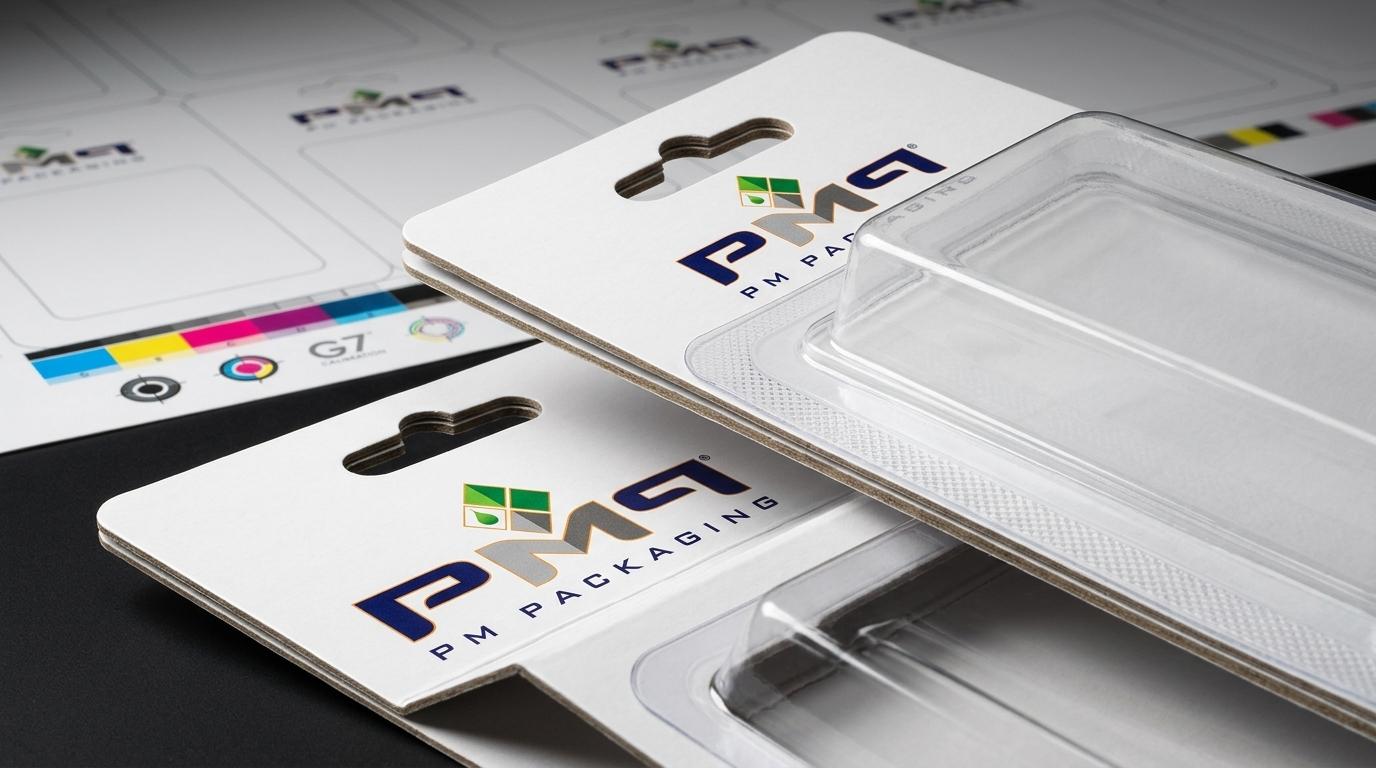
5. Retail Merchandising, Loss Prevention & Regulatory Mandates
Precision measuring tools and laser levels command high retail dollar density. Merchandising these products in open-aisle contractor environments requires balancing high-impact graphics with theft deterrence and complex statutory labeling.
+-----------------------------------------------------------------------------------------------------------------------+
|                                  RETAIL COMPLIANCE & THEFT-DETERRENCE ECOSYSTEM                                       |
+-----------------------------------------------------------------------------------------------------------------------+
|                                                                                                                       |
|  1. THEFT DETERRENCE & LOSS PREVENTION (LP)                                                                           |
|     * Trapped Blister Perimeter: Flange locked between board plies; impossible to pull apart without shears.         |
|     * Concealed EAS / RFID Cavity: 58 kHz Acousto-Magnetic (AM) or RF tags embedded invisibly between plies.          |
|     * Anti-Slice Board Coating: Toughened polymer coatings resist razor scoring on high-shrink $100+ laser SKUs.      |
|                                                                                                                       |
|  2. STATUTORY REGULATORY DISCLOSURES (FRONT & REAR PANELS)                                                            |
|     * Reese's Law (16 CFR Part 1263): Mandatory icon + text warning on button-cell powered calipers and gauges.      |
|     * FDA / CDRH 21 CFR 1040.10: Laser Class II / Class IIIr warning box, max power (<1mW / <5mW), wavelength (nm).  |
|     * UN 38.3 Lithium Battery Markings: Standardized handling labels for integrated Li-Ion rechargeable levels.       |
|                                                                                                                       |
|  3. PLANOGRAM & MERCHANDISING OPTIMIZATION                                                                            |
|     * Standardized Card Dimensions: Standardized footprints (e.g., 4.5"x8", 6"x10", 7"x12") optimize peg density.     |
|     * True-Scale Graphic Rulers: Metric and Imperial scales printed on card borders allow in-aisle part measurement.  |
|     * High-Clarity Inspection Windows: Distortion-free blister cavities allow optical inspection of glass vials.      |
+-----------------------------------------------------------------------------------------------------------------------+
Statutory Compliance Mandates for Packaging Engineers
| Regulatory Standard | Governing Body | Affected Product Categories | Required Packaging Feature |
|---|---|---|---|
| Reese’s Law (16 CFR Part 1263) | US CPSC | Calipers, Angle Finders, Dial Gauges using Coin Cells (CR2032) | Front-panel safety warning icon (skull/crossbones) + text box |
| FDA CDRH 21 CFR 1040.10 / 1040.11 | US FDA / CDRH | Line Lasers, Dot Lasers, Rotary Lasers, Laser Distance Meters | Laser safety class badge, diode output (mW), wavelength (nm) |
| IEC 60825-1:2014 | International Electrotechnical Commission (IEC) | International Export Lasers | Yellow/Black equilateral laser warning triangle + Class rating |
| UN 38.3 / UN 3481 Transport | US DOT / IATA / IMO | Rechargeable Li-Ion Lasers and Digital Measuring Wheels | Lithium battery handling mark + UN ID number + phone contact |
| NIST Traceability Disclosures | National Institute of Standards and Technology (NIST) | Pro-Grade Machining Calipers, Micrometers, Master Squares | Certificate of inspection mark and calibration tolerance box |
Engineering for In-Aisle Verification
Contractors and machinists frequently evaluate precision measuring tools inside retail aisles before purchasing. Leading tool brands leverage the structural layout of the blister card to enhance conversion:
1. Integrated Imperial & Metric Scale Margins
By printing high-precision 1/16-inch and 1-millimeter graduated rules along the outer edge of the blister card (calibrated and verified to ±0.005" on press), buyers can use the package itself to measure fasteners or fittings in the store aisle.
2. True-Sight Vial & Optics Exposure
Blister tooling must be engineered with zero-draft, optical-grade polished cavities over bubble spirit vials, 360° laser prisms, and digital back-lit LCD screens. Distorted thermoformed plastic causes optical refraction, making laser diodes and spirit levels appear poorly calibrated on retail display shelves.
6. High-Speed Sealing Line Automation & Pack-Out Throughput
For packaging operations running thousands of tools daily across automated rotary or linear shuttle heat-sealing machinery (such as Alloyd, Starview, Visual Packaging, or Sonoco systems), blister card dimensional precision dictates operational uptime.
+-----------------------------------------------------------------------------------------------------------------------+
|                                AUTOMATED ROTARY HEAT-SEAL CAROUSEL LINE                                               |
+-----------------------------------------------------------------------------------------------------------------------+
|                                                                                                                       |
|    [ Station 1: Auto Card Feed ] ──> Vacuum pick-and-place drops blister card into precision CNC nest.                |
|                                      * Requires zero card curl (< 0.040" deflection) & clean die-cut edges.           |
|                                                                                                                       |
|    [ Station 2: Auto Blister Drop ] ──> Robotic arm destacks thermoformed RPET/GAG cavities into nests.               |
|                                         * Anti-nesting silicone-treated flanges prevent multi-feed jams.              |
|                                                                                                                       |
|    [ Station 3: Tool Loading ] ──> Manual or pick-and-place robotic insertion of laser level / caliper.              |
|                                    * Laser optics aligned to relieved nest pockets to prevent diode pressure.         |
|                                                                                                                       |
|    [ Station 4: Secondary Card / Fold ] ──> Automated plow arm closes sandwich card or feeds second trapped card ply. |
|                                                                                                                       |
|    [ Station 5: Heat-Seal Platen ] ──> Pneumatic/hydraulic heated platen descends:                                    |
|                                        * Temperature: 315°F – 335°F (157°C – 168°C)                                   |
|                                        * Sealing Pressure: 45 – 55 PSI (3.1 – 3.8 bar)                                |
|                                        * Dwell Time: 1.5 – 2.2 seconds                                                |
|                                                                                                                       |
|    [ Station 6: Auto Eject & Inspection ] ──> Vision system inspects seal perimeter; robotic vacuum pack-out to case. |
|                                                                                                                       |
+-----------------------------------------------------------------------------------------------------------------------+
Sealing Parameter Process Window for 28pt-32pt SBS Trapped Blister Cards
Operating an automated blister sealing line requires maintaining a precise thermodynamic equilibrium between temperature, pressure, and dwell time. Deviations outside this window result in either weak seals or thermal plastic degradation:
| Process Variable | Under-Sealed (Defect Mode) | Optimal Operating Window | Over-Sealed (Defect Mode) |
|---|---|---|---|
| Platen Temperature (Pyrometer Verified at Flange) | < 290°F (143°C) Adhesive fails to melt; 0% fiber tear; cold peel. | 315°F – 335°F (157°C – 168°C) Instant polymer chain fusion with 100% board fiber tear. | > 365°F (185°C) Substrate scorches; GAG/RPET crystallizes & turns brittle. |
| Sealing Dwell Time (Cycle Speed vs Heat Transfer) | < 1.0 second Insufficient heat penetration through heavy 28pt-32pt SBS. | 1.5 – 2.2 seconds Complete thermal saturation across internal ply matrix. | > 3.5 seconds Blister cavity warps; board blisters; coating boils. |
| Pneumatic Platen Pressure (Uniform Hydraulic Distribution) | < 35 PSI (2.4 bar) Micro-gaps along flange border; localized edge delamination. | 45 – 55 PSI (3.1 – 3.8 bar) Uniform adhesive displacement without flange thinning. | > 75 PSI (5.2 bar) Blister flange crushes; card fibers crush; board thins out. |
| Sealing Tooling Nest Design (CNC Fixture Geometry) | Flat un-relieved aluminum plate Crushes delicate laser diodes, pendulum locks, and LCDs. | Relieved pocketing over optics Maximum perimeter pressure on structural seal flanges. | Inadequate support at flange Platen bends unsupported board causing localized unsealed gaps. |
Engineering Sealing Nests for Optical & Delicate Measuring Devices
Unlike durable brass fittings or steel sockets, precision measuring tools contain delicate internal sub-assemblies that will be destroyed if subjected to direct mechanical clamping pressure during heat-sealing:
Self-Leveling Pendulum Mechanisms
Laser levels utilize magnetically dampened pendulums mounted on micro-ball bearings with tolerances measured in microns. Sealing fixtures must incorporate custom-milled relief cavities that fully isolate the pendulum housing from vibration and compression while the perimeter flange is sealed.
Glass Bubble Spirit Vials
Cast-aluminum torpedo levels feature acrylic or glass vials calibrated to 0.0005 in/in accuracy. Sealing platens must utilize CNC-relieved silicone rubber gaskets that apply zero downward pressure over vial windows to prevent fracturing or fluid displacement.
Optical Laser Apertures
Sealing fixtures must clear laser output lenses to prevent scuffing or microscopic coating transfer from heated tooling.
7. Nearshore Manufacturing Agility: USMCA Sourcing vs. Transpacific Supply Chains
For North American tool brands, sourcing packaging from transpacific converters in China or Southeast Asia creates severe vulnerability to lead time delays, inventory bullwhips, and shipping disruption.
+-----------------------------------------------------------------------------------------------------------------------+
|                             SUPPLY CHAIN TIMELINE: TRANSPACIFIC VS. PM PACKAGING NEARSHORE                            |
+-----------------------------------------------------------------------------------------------------------------------+
|                                                                                                                       |
|  TRANSPACIFIC SOURCING PIPELINE (China / East Asia) ──► Total Lead Time: 10 to 14 Weeks                               |
|  ┌───────────────────┬───────────────────┬───────────────────┬───────────────────┬───────────────────┐                |
|  │ Press Scheduling  │ Ocean Transit     │ Port Congestion   │ Customs & Drayage │ Inland US Freight │                |
|  │ & Print (3-4 Wks) │ (3-4 Weeks)       │ & Demurrage (1 Wk)│ Clearance (1 Wk)  │ to DC (1-2 Wks)   │                |
|  └───────────────────┴───────────────────┴───────────────────┴───────────────────┴───────────────────┘                |
|  * High minimum order quantities (25k-50k cards per SKU required).                                                    |
|  * Massive cash lockup ($400k+) in stagnant safety stock to buffer shipping volatility.                              |
|  * Severe obsolescence risk during mid-year laser compliance or retailer graphic revisions.                           |
|                                                                                                                       |
|  PM PACKAGING NEARSHORE ENGINE (San Diego HQ & Baja California Facilities) ──► Total Lead Time: 10 to 14 Days         |
|  ┌───────────────────────────────────────┬───────────────────────────────────────┐                                    |
|  │ qikCombo™ Gang-Run Print & Convert    │ Direct Ground Freight to West Coast / │                                    |
|  │ (10 Business Days Guaranteed)         │ Southwest DCs (1-3 Days Door-to-Door) │                                    |
|  └───────────────────────────────────────┴───────────────────────────────────────┘                                    |
|  * Low dynamic run quantities (5k-10k cards per SKU) fully cost-effective on shared forms.                            |
|  * 100% USMCA / T-MEC Tariff-Free Rules of Origin compliance.                                                        |
|  * Rapid Kanban / VMI replenishment eliminates safety stock bloat and warehouse clutter.                             |
|                                                                                                                       |
+-----------------------------------------------------------------------------------------------------------------------+
Strategic Supply Chain Advantages of Nearshoring with PM Packaging
| Commercial / Logistical Factor | Asian Transpacific Sourcing | PM Packaging Nearshore Engine |
|---|---|---|
| Production Lead Time | 4 to 6 Weeks | 10 Business Days (qikCombo™) |
| Transit Time to US Distribution | 30 to 45 Days (Ocean Freight) | 1 to 3 Days (Direct Ground) |
| Total Procurement Cycle | 10 to 14 Weeks | 2 to 3 Weeks Total Turnaround |
| Minimum Order Quantity (Per SKU) | 25,000 to 50,000 Cards | 5,000 to 10,000 Cards |
| Tariff & Customs Exposure | Section 301 Tariffs (7.5%–25%) | 0% Tariffs (USMCA / T-MEC Duty) |
| Border Clearance Security | Standard Commercial Port Queue | C-TPAT & OEA Fast-Track Customs |
| Tooling & Engineering Turnaround | 4 to 6 Weeks for Die Revisions | 3 to 5 Days (In-House Tooling) |
| Color Consistency Verification | Remote PDF Proofs / Late Mail | In-Person Press Checks / G7 GMI |
| Working Capital Requirements | Massive Buffer Stock Required | Agile Just-In-Time Replenish |
1. USMCA / T-MEC 100% Tariff-Free Compliance
All folding cartons, blister cards, and paperboard substrates converted at PM Packaging’s Baja California facilities are 100% compliant with USMCA Rules of Origin, completely exempt from Section 301 tariffs, customs surcharges, and transpacific port demurrage.
2. IMMEX Virtual Transfers for Cross-Border Contract Packagers
For brands operating contract assembly and tool kitting facilities in Tijuana, Mexicali, Juarez, or Monterrey, PM Packaging executes seamless IMMEX virtual transfers (Pedimento V1), delivering secondary packaging directly to assembly lines without incurring Mexican import VAT.
3. C-TPAT and OEA Certified Rapid Border Clearance
Shipments across the Otay Mesa and Calexico commercial border crossings clear customs via dedicated FAST lanes, arriving at Southern California and Southwestern US distribution hubs within hours of leaving the converting facility.
8. Print Quality, Brand Consistency & Technical Embellishments
For professional tradesmen and industrial buyers, packaging aesthetics communicate the underlying mechanical precision of the tool inside. A blister card with misregistered printing, dull color reproduction, or scuffed varnish projects low quality, repelling tradesmen who demand absolute precision.
+-----------------------------------------------------------------------------------------------------------------------+
|                               PM PACKAGING ADVANCED PRINT & EMBELLISHMENT CAPABILITIES                                |
+-----------------------------------------------------------------------------------------------------------------------+
|                                                                                                                       |
|  1. CERTIFIED G7 MASTER PRINTER & GMI CERTIFICATION                                                                   |
|     * Spectrophotometric Delta E < 1.5 across signature tool brand colors (DeWalt Yellow, Milwaukee Red,             |
|       Bosch Blue, Klein Orange, Starrett Red, Stabila Yellow, Johnson Orange, Hilti Red).                             |
|     * Large-format 6-to-8 color offset litho presses with inline closed-loop color scanning.                          |
|                                                                                                                       |
|  2. ADVANCED TACTILE & VISUAL EMBELLISHMENTS                                                                          |
|     * Strike-Through Matte / Gloss Contrast: Matte anti-scuff background with high-gloss spot UV over tool imagery.    |
|     * Inline Cold Foil Stamping: Metallic silver/gold accents highlighting IP67 water-resistance & laser specs.      |
|     * Micro-Embossing & Debossing: Precision tactile brand logos and calibration icon badges.                         |
|     * High-Rub Anti-Scuff Aqueous Topcoats: Resists peg-hook abrasion, carton vibration, and jobsite handling.       |
|                                                                                                                       |
|  3. QUALITY CERTIFICATIONS & ENVIRONMENTAL COMPLIANCE                                                                 |
|     * ISO 9001:2015 Quality Management Systems across all manufacturing plants.                                       |
|     * GMI Certified (Walmart, Target, Home Depot, Lowe's print compliance).                                           |
|     * FSC (Forest Stewardship Council) & SFI (Sustainable Forestry Initiative) Chain-of-Custody Certified.           |
|                                                                                                                       |
+-----------------------------------------------------------------------------------------------------------------------+
9. Comprehensive Procurement Audit Checklist for Precision Tool Packaging
When evaluating your current precision tool packaging program or auditing prospective packaging converters, use this 10-point technical checklist to identify structural vulnerabilities and cost-reduction opportunities:
+-----------------------------------------------------------------------------------------------------------------------+
|                                  ENTERPRISE PRECISION TOOL PACKAGING AUDIT CHECKLIST                                  |
+-----------------------------------------------------------------------------------------------------------------------+
|  [ ] 1. SUBSTRATE CALIPER & PLY INTEGRITY                                                                             |
|         Is the card manufactured from heavy-duty virgin SBS (24pt-32pt) with a Scott Bond rating > 130 ft-lbs/1000 in²  |
|         to eliminate internal delamination under heavy cantilever peg-hook loads?                                     |
|                                                                                                                       |
|  [ ] 2. BLISTER CAVITY MATING & MATERIAL COMPATIBILITY                                                                |
|         Is the thermoformed cavity formed from impact-modified GAG or RPET (0.020"-0.035") with zero-draft optical     |
|         clarity over spirit vials, optical lenses, and LCD screens?                                                   |
|                                                                                                                       |
|  [ ] 3. 100% FIBER-TEAR HEAT-SEAL ADHESION                                                                            |
|         Does the heat-seal coating formulate wax-free, high-solids aqueous dispersion achieving instant fiber tear    |
|         at 315°F–335°F without scorching coatings or inducing blister flange embrittlement?                          |
|                                                                                                                       |
|  [ ] 4. REESE'S LAW & BATTERY SAFETY COMPLIANCE                                                                       |
|         Do all cards for button-cell powered tools (calipers, angle finders) carry mandatory 16 CFR Part 1263         |
|         prominent front-panel warnings and tamper-resistant blister enclosures?                                       |
|                                                                                                                       |
|  [ ] 5. LASER RADIATION STATUTORY DISCLOSURES                                                                         |
|         Are laser level cards fully compliant with FDA CDRH 21 CFR 1040.10 and IEC 60825-1 Class II / IIIr warning    |
|         markings, wavelength (nm), and maximum power (mW) disclosures?                                                |
|                                                                                                                       |
|  [ ] 6. THEFT DETERRENCE & LOSS PREVENTION ARCHITECTURE                                                                |
|         Are high-value instruments ($49-$299+) packaged in trapped blister or sandwich card architectures with         |
|         concealed internal EAS (AM/RFID) security inlays between plies?                                               |
|                                                                                                                       |
|  [ ] 7. GANG-RUN SOURCING ECONOMICS (qikCombo™)                                                                       |
|         Can your converter gang-run 8 to 24 secondary SKUs on shared master sheets, enabling 5,000-unit minimum runs   |
|         without charging standalone CTP plate, press makeready, or washup surcharges?                                 |
|                                                                                                                       |
|  [ ] 8. AUTOMATED LINE DIMENSIONAL STABILITY                                                                          |
|         Are cards guaranteed flat (controlled 5.5%-6.5% moisture content) with precision die-cut edge burr suppression|
|         to eliminate magazine jams on automated rotary pick-and-place sealing carousels?                              |
|                                                                                                                       |
|  [ ] 9. NEARSHORE LOGISTICAL AGILITY                                                                                  |
|         Is production situated nearshore (US-Mexico border footprint) delivering 10-day guaranteed production and     |
|         1-3 day ground transit to avoid 12-week ocean transit, container demurrage, and port bottlenecks?             |
|                                                                                                                       |
|  [ ] 10. G7 MASTER COLOR CONTROL & GMI CERTIFICATION                                                                  |
|          Does the converter maintain certified G7 Master Printer status with closed-loop spectrophotometric Delta E   |
|          < 1.5 color consistency across your entire multi-SKU tool portfolio?                                         |
+-----------------------------------------------------------------------------------------------------------------------+
10. Partner with PM Packaging for Multi-SKU Hardware & Metrology Packaging
For more than 45 years, PM Packaging has engineered high-performance retail packaging solutions for the world’s leading tool brands, industrial manufacturers, and mass retailers.
Our dual-region manufacturing footprint—combining engineering and account headquarters in San Diego, California with advanced high-capacity converting facilities in Baja California (Tijuana and Mexicali)—delivers the optimal blend of technical sophistication, rapid 10-day turnaround, and substantial total landed cost reductions.
Why Enterprise Tool Brands Choose PM Packaging:
qikCombo™ Gang-Run Cost Efficiency
Eliminate minimum order penalties on low-volume measuring tools. Run 5,000 to 10,000 units per SKU with shared tooling, cutting inventory carrying costs by up to 60%.
Heavy-Duty Structural Engineering
In-house CAD structural designers develop custom 28pt–32pt virgin SBS trapped blister cards, fold-over sandwich cards, and reinforced hang tabs engineered specifically for heavy metal hardware.
Certified G7 Master Print Consistency
Flawlessly match signature tool brand colors across 150+ SKUs with GMI-certified offset lithographic print technology.
100% USMCA Nearshore Advantage
10-day production cycles and 1–3 day ground shipping to West Coast and Southwest distribution centers eliminate transpacific supply chain vulnerability.
Schedule a Technical Program Review
To evaluate your multi-SKU precision measuring tool packaging, request structural samples, or calculate your cost savings under the qikCombo™ gang-run program, contact PM Packaging’s technical sales engineering team:
PM Packaging
45+ Years of Structural Packaging Excellence & Nearshore Manufacturing Leadership
Headquarters: San Diego, California
Manufacturing Centers: Tijuana & Mexicali, Baja California
Core Specializations: Heavy-Duty Blister Cards, Litho-Laminated Single Face Corrugate (SFL), Folding Cartons, Counter PDQ Displays, Full-Pallet Club Displays, and Luxury Rigid Setup Boxes.
Website: pmpackaging.com