
A product-launch packaging program can fail even when the package itself is structurally flawless.
A commercial launch depends on an expansive network of converging physical elements: printed Single Face Lamination (SFL) outer cartons, precision cavity inserts, primary products, accessories, charging cords, trial samples, literature, quick-start guides, serialized labels, master shipping shippers, and retail point-of-purchase displays. Every single item must arrive at the kitting facility in the exact right quantity and correct version before assembly can begin.
While replenishment programs absorb minor schedule shifts, a commercial product launch operates against an immovable set date. If outer mailers are converted but the inserts are delayed, if a retailer-specific promotional card is missing, or if regional electrical plugs are misallocated, the entire program stalls.
Launch execution succeeds on a strict operational rule: The right component + the right version + the right quantity + the right destination + the right date.
Clarification on scope: In supply chain planning, an individual launch kit refers to the single physical package delivered to a recipient. In contrast, a launch program represents the complete operational campaign that manufactures, versions, kits, and distributes hundreds or thousands of packages to diverse sales channels. The physical kit should already have an approved structure and component layout before high-volume assembly planning begins. If your primary challenge is designing the physical launch kit—its structure, insert layout, and opening sequence—see our guide to designing SFL packaging for custom product launch kits.
Planning packaging converting and contract fulfillment as a single synchronized workflow eliminates hand-off friction and guarantees on-time rollout.
Work Backward From the Launch Date
Operational launch management begins with the firmest calendar date: the moment packages must be in the hands of recipients or on retail sales floors.
Launch timelines must be built backward using dependency-based milestone gating rather than arbitrary lead-time estimates:
- Mandatory Inbound Receiving Windows: Retail distribution center delivery appointments, influencer embargo mailings, and PR drop dates.
- Outbound Freight Transit Times: Dedicated truckload, LTL carrier schedules, or multi-zone express parcel delivery windows.
- Assembly, Kitting & QC Throughput: Dedicated line-assembly shifts, barcode verification gates, and master carton palletization.
- Component Staging & Quarantine Buffers: Receiving, counting, inspecting, and staging primary merchandise, secondary accessories, and literature.
- SFL Converting & Finishing: Litho press printing, fluting lamination, die-cutting, folder-gluing, and quality inspection.
- Final Pre-Flight Sign-Offs: Structural dieline approvals, color proofs, and production pilot pack-outs.
Establishing hard milestone gates ensures downstream kitting lines never sit idle waiting for packaging or components.
Build a Complete Launch Bill of Materials
A product launch program requires an exhaustive, multi-tier Bill of Materials (BOM). In launch kitting, a missing five-cent quick-start booklet halts an entire $200 launch kit run just as decisively as a missing electronic device.
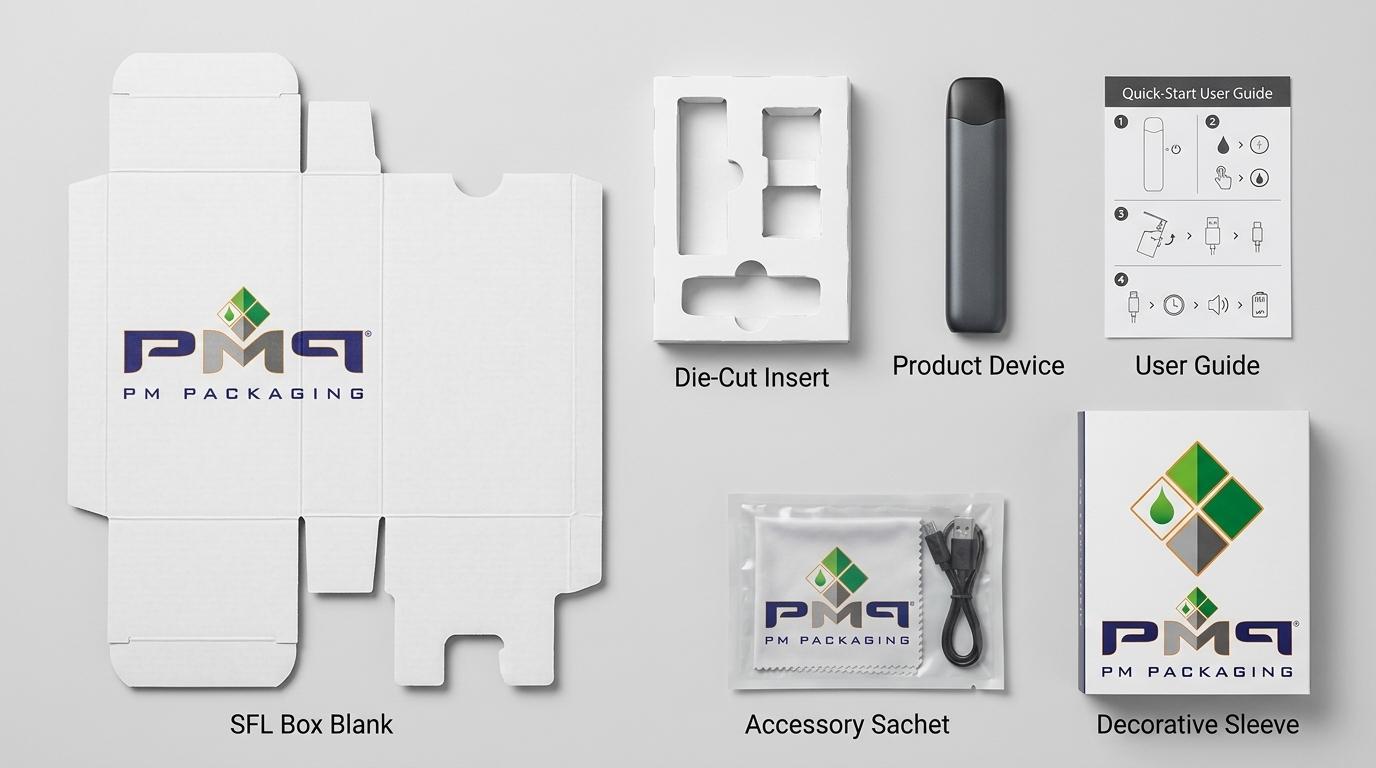
A comprehensive launch program BOM categorizes items across physical layers:
| BOM Layer | Component Description | Component Type | Version Controlled? |
|---|---|---|---|
| Primary Packaging | E-Flute or F-Flute SFL Outer Mailer | Standard Platform | No (Common across versions) |
| Internal Support | Die-cut paperboard cavity insert tray | Standard Platform | No (Common layout) |
| Hero Merchandise | Primary product unit (e.g. device, cosmetic, tool) | Core Product | Yes (SKU colorway / model) |
| Accessories | Cables, adapters, hardware, charging base | Ancillary Merchandise | Yes (Regional plug / spec) |
| Trial Samples | Consumable refills, cosmetic minis, accessory packs | Promotional Item | Yes (Audience-specific) |
| Collateral | Quick-start guide, warranty, VIP welcome card | Printed Literature | Yes (Language / Channel) |
| Exterior Finishes | Paperboard belly band, decorative sleeve, wafer seals | Customization Element | Yes (Channel barcode) |
| Secondary Logistics | Corrugated master shipper carton & UCC-128 labels | Distribution Packaging | Yes (Destination DC routing) |
Mapping every child component against its parent SKU prevents assembly shutdowns caused by unacknowledged accessories.
Coordinate Packaging Inventory With Product Availability
In multi-piece launch campaigns, packaging and consumer products are rarely produced by the same supplier or on identical lead times. Packaging converters, contract packagers, and component factories operate on separate schedules.
Unsynchronized arrivals create severe operational bottlenecks:
- Warehouse Floor Gridlock: If 5,000 converted SFL outer boxes arrive at a fulfillment facility four weeks before the primary product clears customs, valuable staging square footage is consumed by empty packaging.
- Incomplete Kit Staging: Starting kitting before all components arrive results in half-packed boxes sitting on assembly lines, multiplying the risk of dust exposure, product loss, and duplicate handling.
- Obsolete Printed Materials: If marketing revises a product specification while packaging is already printed and waiting, the entire finished packaging inventory faces scrap.
Synchronizing packaging manufacturing with product dock arrival minimizes warehouse dwell time and safeguards cash flow.
Separate Standard Components From Launch-Specific Components
The most efficient launch programs decouple structural packaging from campaign-specific marketing materials. Treating every component as unique forces small, expensive printing runs and creates high obsolescence risk if launch numbers change.
Dividing your packaging into standard versus variable tiers provides operational agility:
Standard Common Platform
- High-volume SFL outer mailer box with master brand graphics
- Universal die-cut interior cavity insert
- Standard master corrugated shipping boxes and pallet configurations
- Can be converted in volume at lower unit cost and held safely as common stock
Variable Launch-Specific Elements
- Interchangeable printed paperboard sleeves with channel barcodes
- Audience-specific literature (influencer card vs. retail sell sheet)
- Channel-specific accessory packs or sample configurations
- Serialized destination labels and promotional seals applied during kitting
Postponing final customization to fulfillment allows operations teams to adjust channel allocations right up to final pack-out.
Use Late-Stage Versioning to Manage Multiple Audiences
A major national launch campaign rarely addresses a single audience. Brands must deliver tailored experiences across retail buyers, PR influencers, sales teams, and direct consumer pre-orders.
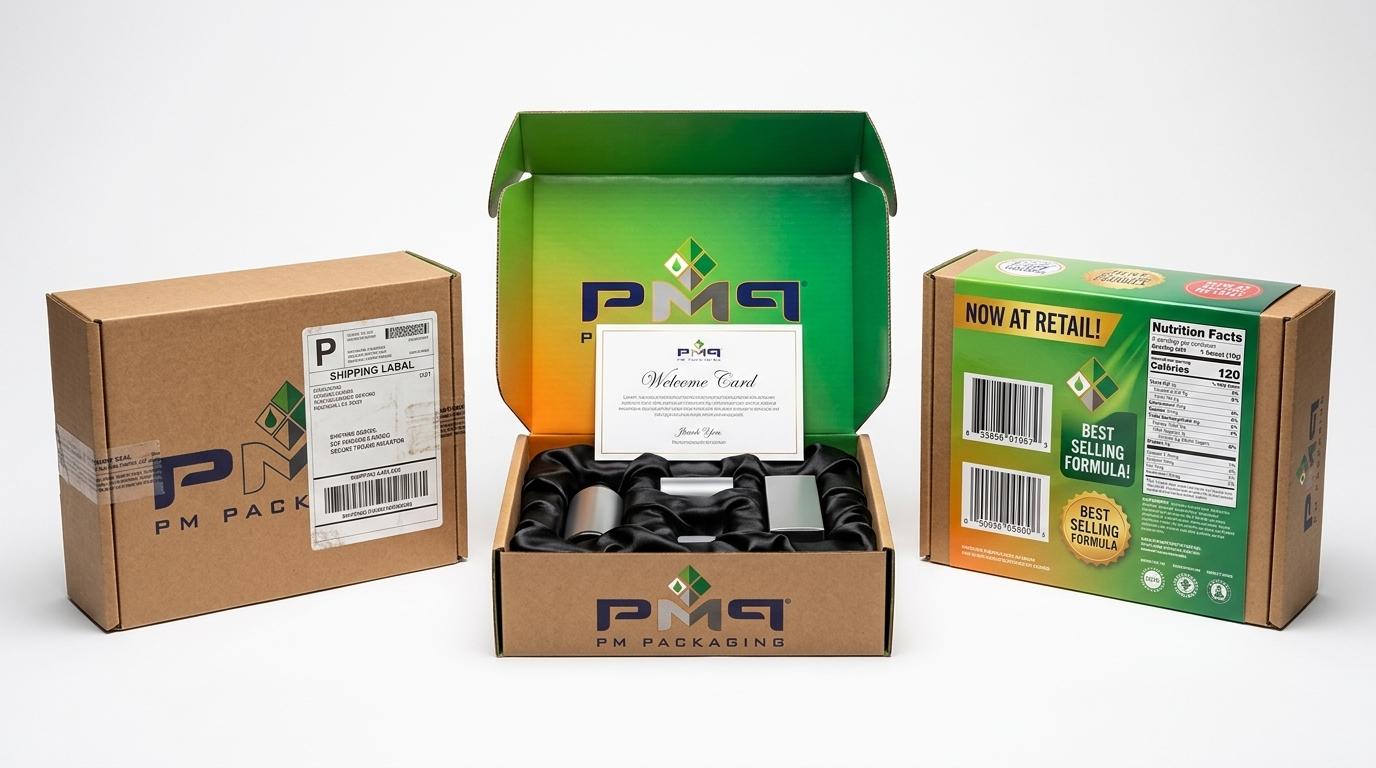
Consider this operational program model for a 5,000-kit commercial launch:
Standard SFL box + retail sell-sheet + GS1 master carton labeling for retail DC cross-docking.
Standard SFL box + VIP personalized welcome card + full sample assortment + individual parcel shipping label.
Standard SFL box + demonstration product guides + field rep sales collateral + durable carrying sleeve.
Standard SFL box + editorial press release booklet + high-resolution digital asset card.
By sharing 5,000 identical SFL base boxes and introducing channel differentiation during kitting, operations achieves volume scale while marketing achieves targeted personalization.
Build a Repeatable Kit Assembly Workflow
Assembly lines cannot run on guesswork. Assembling multi-piece launch kits requires a rigorous, linear station sequence with visual work instructions and defined cycle times at every step.
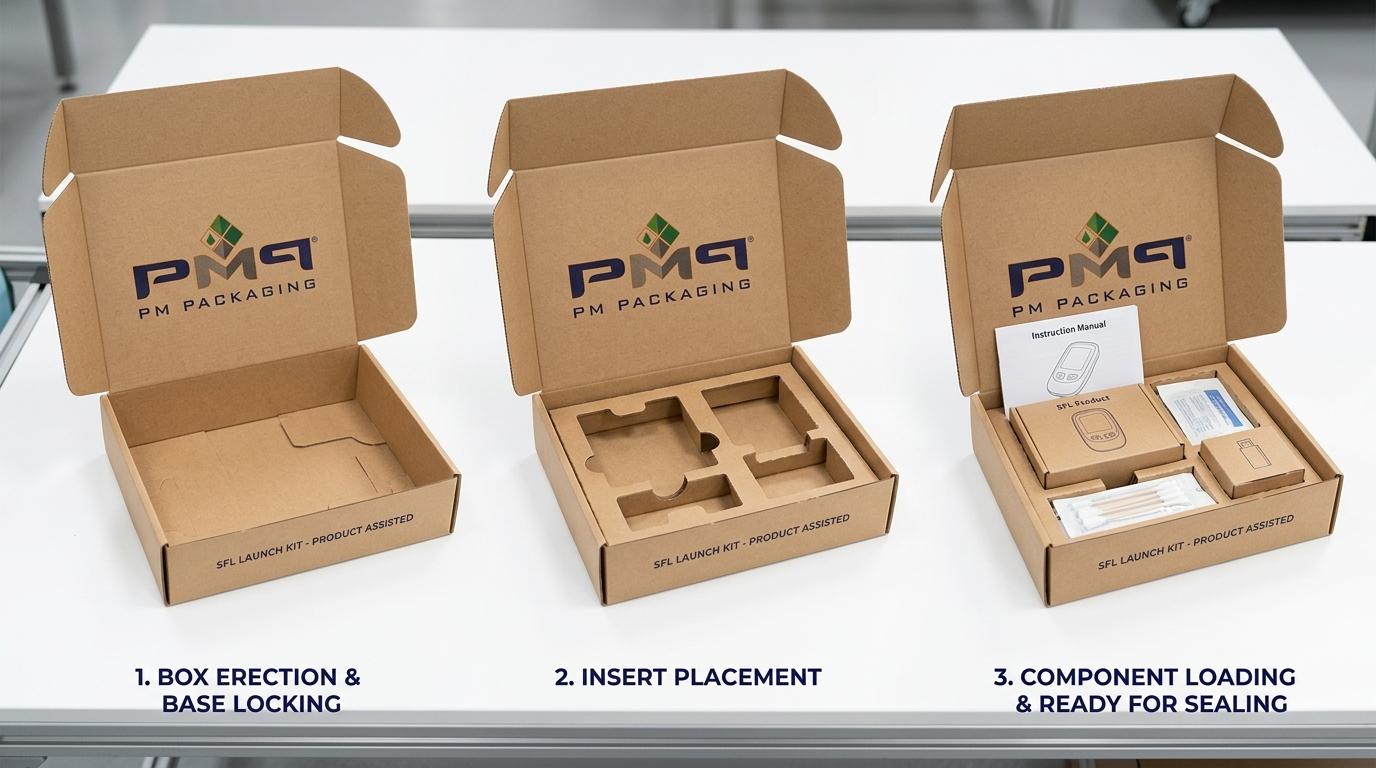
A standard 7-station launch kit assembly line operates in disciplined sequence:
- Station 1: Erect Outer SFL Box: Fold flat SFL blank into 3D structure, locking side roll-over flaps into pre-broken base slots.
- Station 2: Seat Cavity Insert: Drop pre-folded paperboard or microflute insert flush into the base tray without sidewall binding.
- Station 3: Nest Primary Product: Seat the core merchandise into its designated focal cavity with logos and branding facing upward.
- Station 4: Load Secondary Accessories: Place cords, adapters, trial samples, or hardware into secondary recessed compartments.
- Station 5: Insert Marketing Literature: Place welcome cards, quick-start guides, or product brochures flat across designated retaining tabs.
- Station 6: Verification & Closure: Inspect visual planogram compliance, scan product barcode, close lid, and engage closure locks.
- Station 7: Labeling & Master Packing: Apply channel sleeve or shipping label, pack into master corrugated cartons, and palletize.
Breaking kit assembly into repeatable, timed steps maximizes pack-out throughput and eliminates operator fatigue.
Prevent SKU and Version Errors During Kitting
The greatest hazard in multi-channel launch programs is component cross-contamination. Shipping an influencer kit with a retail pricing sell-sheet, or packing an American power cord into a European retail box, causes immediate brand embarrassment and customer returns.
Proven fulfillment operations enforce systematic error prevention protocols:
- Strict Physical Line Clearances: When shifting assembly from one version to another (e.g. from Retail Kits to Influencer Kits), all remaining collateral, components, and labels from the previous run must be physically removed from the kitting line before new materials are introduced.
- Barcode Verification at Pick Points: Operators scan individual product and accessory barcodes against the digital tier BOM before loading them into the package.
- Color-Coded Station Staging: Use color-coded tote bins and staging tags (e.g. Green for Retail, Blue for Influencer) to prevent component mix-ups on the warehouse floor.
- Pre-Flight Golden Sample Approval: QA leads and shift supervisors must sign off on a physical master sample at the head of each line before volume kitting begins.
Structured line clearances and optical barcode checks ensure every recipient receives the exact version intended for their channel.
Manage Multiple Launch Versions Without Creating Excess Inventory
Demand forecasting for a new product launch is notoriously difficult. If a brand converts 2,000 kits fully dedicated to Retailer A and 1,000 for Retailer B, but Retailer B suddenly triples their order while Retailer A delays, the brand faces inventory stock-outs alongside obsolete printed packaging.
Managing version inventory requires building buffer strategies into your fulfillment plan:
- Maintaining common SFL boxes unassigned to any single channel until final assembly
- Ordering printed collateral in matched batches with slight overrun buffers on lower-cost paper items
- Staging assembly in waves: releasing 60% of volume for day-one launch, holding 40% in buffer staging
- Re-allocating un-sleeved common base boxes between retail, PR, and ecommerce based on early demand signals
- Preventing obsolete packaging write-downs by avoiding pre-printed dates on primary outer boxes
- Establishing rapid re-order protocols with your packaging converter for quick replenishment runs
Decoupling outer packaging from variable promotional inserts protects your program against expensive scrap and stock-outs.
Coordinate Master Packing and Outbound Distribution
Once individual kits are assembled, verified, and sealed, outbound distribution takes over. A launch program typically feeds multiple simultaneous freight channels, each with strict receiving rules.
Logistics parameters must be planned alongside packaging converting:
- Master Shipper Carton Density: SFL kit dimensions should be engineered to pack snugly into master corrugated shippers (e.g. 6, 8, or 12 kits per carton) without internal void space or weight overhang.
- Palletization & Retail DC Compliance: Retail orders must be palletized on 48" × 40" GMA pallets with corner boards, stretch-wrap tension, and serialized UCC-128 barcode labels aligned with electronic ASNs.
- Staggered Parcel Dispatch: Influencer and media kits traveling via parcel carriers must be dispatched according to carrier transit days so that recipients nationwide receive their kits on the designated embargo date.
Coordinating master case packing and carrier appointments ensures kits arrive at their destination intact and compliant.
Build Quality Control Into the Fulfillment Process
In high-stakes launch execution, quality control cannot be an afterthought at the end of the shift. QA checkpoints must be embedded directly across the workflow:
- Inbound receiving count and defect audit on all arriving components and merchandise
- First-piece inspection and 'Golden Sample' sign-off prior to authorizing volume kitting
- Inline check-weighing on calibrated scales to instantly detect missing cables or booklets
- Surface inspection for scuffs, glue smears, or fold wrinkles before sealing cartons
- Barcode verifier scans ensuring 100% readability of outer shipping and UPC codes
- Pallet audit verifying load stability, stretch wrap tension, and correct destination placards
Continuous inline quality control catches errors at the assembly station before packages are sealed into master shipping containers.
Plan for Launch Changes and Exceptions
In commercial manufacturing, real-world disruptions are inevitable: a shipment of accessory cords arrives three days late, a retailer revises their store count two weeks before delivery, or a printing error requires re-running a promotional card.
Resilient launch programs manage exceptions through systematic operational planning:
- Modular Assembly Flexibility: If a secondary promotional item is delayed, lines can erect outer boxes, seat inserts, and load primary products, staging kits to receive the final insert in a rapid closing pass.
- Separating Standard From Variable Stock: Because outer SFL boxes are standardized, late retailer quantity adjustments simply mean shifting sleeve prints rather than scrapping master cartons.
- Dedicated Escalation Protocols: Daily cross-functional syncs connecting packaging engineers, production planners, and brand launch managers ensure issues are resolved within hours.
Designing operational flexibility into the workflow ensures unexpected delays do not compromise your launch deadline.
When Packaging and Fulfillment Should Be Planned Together
Sourcing packaging converting from one vendor and contracting a separate 3PL for kitting introduces hand-off friction, freight legs, and split accountability. When an insert doesn't fit or a scoreline tears, the packager blames the converter, while the converter blames assembly handling.
Integrating packaging manufacturing and fulfillment under a single roof is particularly advantageous when:
- Kits contain multiple components with tight structural insert tolerances
- The launch involves multiple versioned channels (retail, influencer, DTC, sales)
- Launch timelines are compressed, leaving no room for inter-facility shipping delays
- Assembly requires specialized manual dexterity, visual inspection, or delicate handling
- Brand teams need real-time visibility and rapid pilot pack-out adjustments
- Outbound distribution spans both palletized retail cross-docking and individual parcel drops
For an in-depth analysis of single-source advantages, explore our article on when packaging and fulfillment under one roof makes commercial sense.
Coordinating Product-Launch Programs With PM Packaging
PM Packaging pairs industrial Single Face Lamination manufacturing with turnkey contract kitting and fulfillment operations. By synchronizing dieline converting, multi-piece assembly, barcode verification, and outbound freight scheduling under one roof, we eliminate operational hand-offs and guarantee on-time launch delivery.
When planning a coordinated launch program with our operations team, please provide:
- Firm target launch date and earliest retail DC receiving windows
- Total kit quantity and planned breakdown across audience channels
- Comprehensive Bill of Materials listing all merchandise, accessories, and collateral
- Expected arrival dates for incoming merchandise and trial components
- Version requirements (retail vs. influencer vs. sales demo kits)
- Assembly guidelines and insert nesting specifications
- Serialized labeling, GS1 barcode, and ASN requirements
- Outbound freight distribution plan (palletized freight vs. express parcel drops)
Our operations and structural engineering teams will collaborate with you to build an integrated production schedule and assembly workflow tailored to your deadline.
Execute Your Launch With Operational Certainty
Executing a high-volume product launch program requires treating packaging converting, component inventory, kit assembly, and freight logistics as a single unified system.
Lock in your critical path, separate standard platforms from variable campaign materials, and enforce inline quality controls to guarantee your launch rolls out smoothly on deadline.
Contact PM Packaging today to review your launch program timeline and Bill of Materials. Our production planners and fulfillment specialists will design a turnkey manufacturing and kitting schedule engineered for launch day success.