
Choose foil stamping when a beauty package needs a highly visible metallic or specialty accent for logos, product names, borders, or prestige cues. Choose spot UV when the goal is subtler contrast, especially over matte or soft-touch surfaces, where gloss can highlight patterns, typography, or imagery without introducing metallic color. The better choice depends on brand positioning, artwork detail, substrate, background finish, tooling, registration requirements, and production volume.
In prestige cosmetics, skincare, and fragrance retail, secondary packaging establishes perceived formula value before a customer opens the box. On competitive retail shelves, folding cartons rely on decorative embellishments to capture shopper attention and reinforce brand equity. While both finishes elevate printed paperboard into an upscale presentation, they serve distinct visual, tactile, and commercial roles.
10-Factor Comparison: Foil Stamping vs. Spot UV
Choosing between metallic foil stamping and clear gloss spot UV requires balancing sensory appeal, artwork tolerances, substrate interactions, and production economics:
| Specification | Hot Foil Stamping | Spot UV Coating |
|---|---|---|
| Primary Effect | Highly reflective metallic, pigment, or specialty film accent | Clear specular gloss and optical depth over selected artwork |
| Visual Appearance | Mirror flash under retail spotlights; visible from distance and angles | Refractive sheen visible at tilted angles; tone-on-tone highlights |
| Tactile Feel | Smooth metallic film; pairs with embossing for 3D raised relief | Silky-smooth to pronounced high-build 3D dimensional ridge |
| Best Background / Substrate | Coated SBS, uncoated paperboard, or dyed vat stocks | Soft-touch film laminate or dead-matte dispersion coating |
| Tooling Required | CNC brass or etched magnesium stamping die | Screen stencil, flexo plate, or digital inkjet file |
| Min. Stroke / Knockout | 0.5pt positive; 1.0pt reverse clearance | 0.5pt positive; 0.75pt reverse clearance; 0.25–0.5mm trap |
| Score Relief | Hold back ≥ 1/16" (1.5mm) from creases to avoid flaking | Hold back ≥ 1/16" (1.5mm) from creases to avoid cracking |
| Short-Run Economics (<2,500) | Higher unit cost due to upfront stamping die tooling | Economical via digital inkjet UV without physical tooling |
| Volume Economics (>25,000) | Highly economical once die tooling amortizes across run | Fast inline application with low incremental coating cost |
| Brand Impression | Prestige-oriented, classic luxury, high-visibility reflective cues | Modern, restrained, dimensional gloss-on-matte contrast |
Quick Decision Framework: Foil Stamping vs. Spot UV
Foil Stamping Is Typically a Stronger Fit When:
- Metallic or reflective contrast is central to the brand identity.
- The finish needs to remain clearly visible from a distance under retail lighting.
- Logos, product names, border trims, or prestige cues require strong focal emphasis.
- A metallic, pearlescent, or specialty-film effect is intentional.
Spot UV Is Typically a Stronger Fit When:
- The design depends on subtle, refined contrast and light play.
- The package uses matte dispersion coatings or velvety soft-touch film backgrounds.
- Existing artwork, typography, or photography should be highlighted without adding metallic color.
- Tone-on-tone patterns, textures, or dimensional gloss are more important than mirror reflectivity.
How Foil Stamping Works on Beauty Folding Cartons
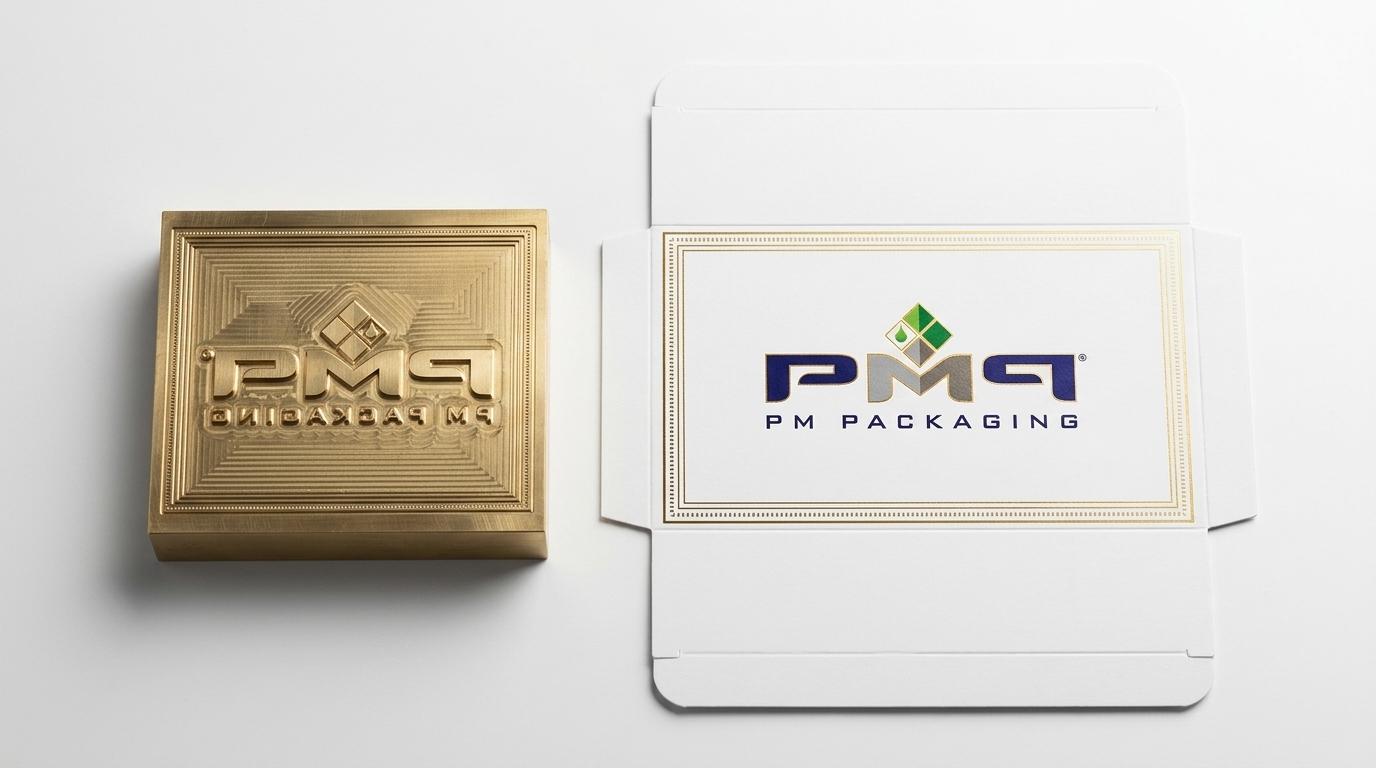
Hot foil stamping uses CNC-engraved brass or etched magnesium dies heated to 200°F–300°F (95°C–150°C) to thermally fuse metallic, holographic, pigmented, or specialty polyester films onto paperboard under calibrated mechanical pressure. While metallic printing inks scatter ambient light diffusely through suspended flakes, hot stamping foil forms an opaque, continuous reflective plane that catches overhead lighting. Available in traditional gold, silver, rose gold, copper, satin matte foils, and prismatic holographic films, foil provides distinct visual contrast.
In cosmetics, skincare, and fragrance packaging, foil stamping is commonly applied to brand logos, product names, border trims, decorative accents, and prestige tier callouts. To add dimension, foil can be combined with an embossing counter-die (combination stamping) to lift the foiled typography above the carton surface, introducing tactile 3D relief.
How Spot UV Creates Modern, Tactile Contrast
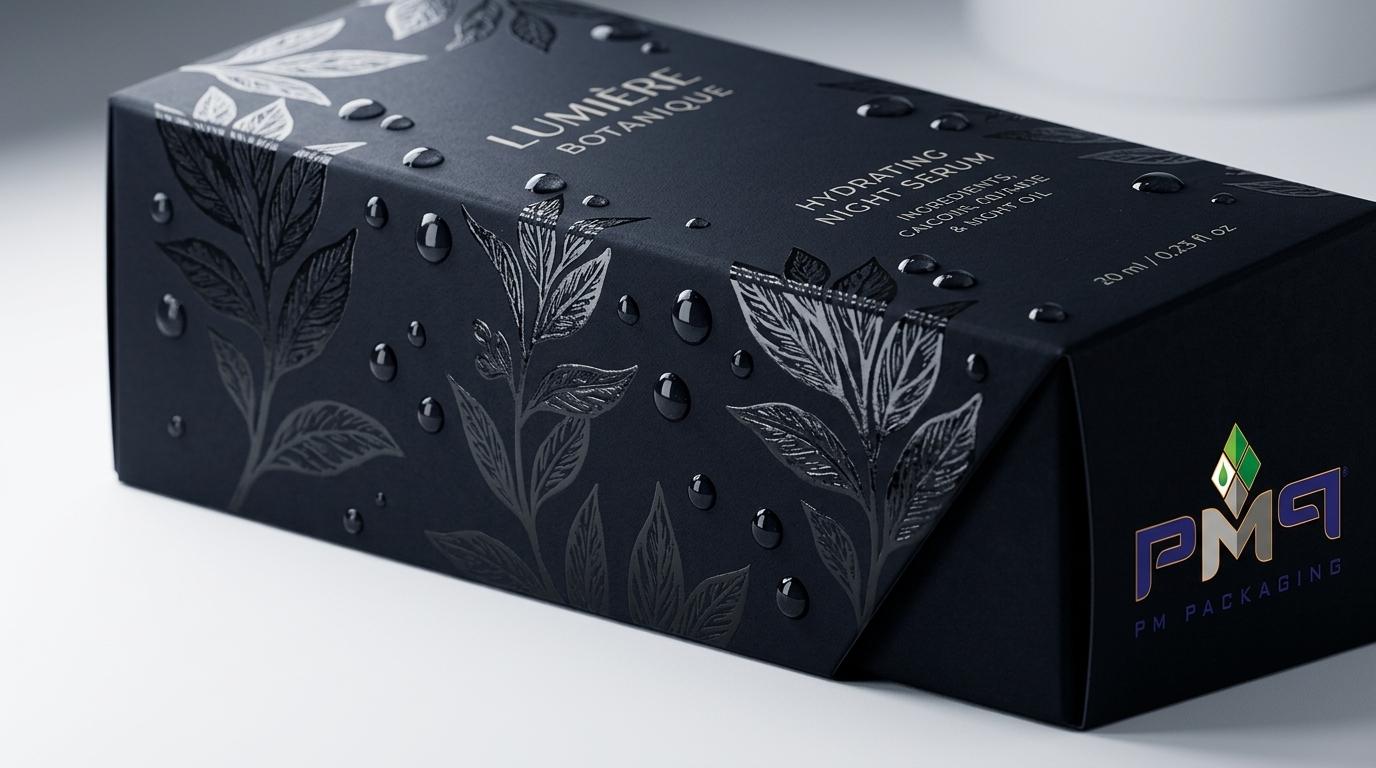
Spot UV applies a clear polymer gloss coating selectively over targeted artwork, illustrations, or typography rather than flooding the full sheet. Cured instantaneously under ultraviolet lamps, the liquid resin cross-links into a clear, hardened layer that ranges from a smooth satin sheen to a raised, high-build tactile ridge. By locking high specular gloss over selected zones against a matte backdrop, spot UV creates optical depth and invites tactile interaction.
In beauty packaging, spot UV is a strong option for modern, restrained aesthetics. Common applications include simulated water droplets on hydrating skincare cartons, gloss botanical illustrations, repeating geometric monograms, and subtle pattern accents that emphasize packaging graphics without introducing metallic color.
When to Choose Foil Stamping for Your Beauty Line
Foil stamping is typically the stronger choice when a beauty brand requires reflective emphasis, distinct shelf hierarchy, and metallic ornamentation:
- •Prestige Brand Positioning: For high-potency serums, fine fragrance, and luxury gift sets, reflective foil signals product tier distinction and premium shelf presence.
- •Distance Visibility under Retail Lighting: Under directional retail spotlights, metallic foil reflects specular highlights that draw shoppers' eyes from down the aisle.
- •Signature Metallic Brand Identity: When logos, family wordmarks, or crests call for a consistent metallic hue (such as custom rose gold or warm champagne), foil delivers uniform opacity.
- •Combination Foil Embossing: Pairing foil with an embossing counter-die raises typography above the board, adding tactile relief and light catching angles.
When to Choose Spot UV for Your Beauty Line
Spot UV is widely chosen for modern, restrained, and tactile packaging presentations across clean beauty, active skincare, and contemporary cosmetic lines:
- •Clean & Dermatological Aesthetics: In clinical skincare and clean cosmetics, spot UV projects ingredient transparency and purity without ornate metallic trim.
- •Hydration & Texture Metaphors: Dimensional high-build spot UV simulates tactile water droplets or botanical textures over matte backgrounds, visually communicating barrier hydration.
- •Tone-on-Tone Patterns: Repeating geometric monograms, botanical illustrations, or ingredient watermarks span carton panels smoothly without visual clutter.
- •Unisex & Modern Grooming Lines: For gender-neutral skincare, hair care, and daily SPF, spot UV on slate, charcoal, or neutral paperboard provides understated distinction.
Substrates and Background Compatibility: Why Surface Systems Matter
Applying spot UV over standard semi-gloss paperboard yields an optical delta of only about 20 gloss units—making the clear varnish barely perceptible under store lighting. To unlock dramatic contrast, spot UV performs best over a soft-touch laminate film or dead-matte dispersion coating (2–5 gloss units), creating an 80+ unit specular delta where clear varnish pops like wet liquid glass. Hot foil stamping, conversely, is completely opaque, creating brilliant reflective contrast across coated SBS, uncoated kraft, or heavily dyed paperboard.
Finish performance depends on the complete surface system, including the paperboard substrate, printing inks, film lamination, coating varnishes, surface dyne levels (adhesion), and carton scoring requirements. Foil stamping adheres well over raw paperboard or specialized foil-receptive varnishes, while spot UV requires adequate surface energy on the underlying ink or laminate to prevent pinholing, crawling, or flaking. Because paperboard sizing, ink chemistries, and coating formulations vary across mills and converters, universal compatibility cannot be assumed without proper testing.
Artwork Rules, Tooling, and Score-Line Geometry
Precision finishing on cosmetics and skincare folding cartons requires observing prepress dieline tolerances and folding geometry before ordering tooling:
Score Lines and Folding Considerations: Specialty finishes must always be engineered in coordination with carton folding mechanics. Foil artwork placed too close to or across score lines can shear, crack, or flake when carton panels fold 90° or 180° during automated gluing and pack-out. Heavy spot UV coatings across score areas present a similar risk: the brittle, cross-linked polymer resin can fracture, craze, or whiten along the crease. Best practice is to hold both foil stamping and spot UV boundaries at least 1/16 inch (1.5mm) away from all fold scores, creases, and die-cut edges.
Foil Stamping Specifications
- Positive Stroke: Maintain ≥ 0.5pt (0.18mm) stroke thickness to ensure continuous foil transfer without voids.
- Knockout Type: Maintain ≥ 1.0pt to 1.5pt reverse clearance to prevent thermal heat bridging in fine text.
- Score Clearance: Hold foil edges ≥ 1/16" (1.5mm) away from folding creases to prevent film shearing along folds.
Spot UV Specifications
- Layer Separation: Place artwork on a dedicated spot separation layer named
Spot_UVset to overprint. - Registration Trap: Allow 0.25mm to 0.5mm registration tolerance relative to underlying CMYK artwork.
- Score Clearance: Stop heavy UV coatings ≥ 1/16" (1.5mm) before carton scores to avoid resin fractures.
Finishing Economics: Tooling, Make-Ready, and Volume Drivers
When budgeting decorative embellishments, brand owners and procurement teams should evaluate the total cost system rather than unit finishing quotes in isolation. Total finishing investment depends on:
- Artwork Coverage: Total surface area of foil or coating.
- Finish Locations: Single-panel accent vs. multi-panel wraps.
- Tooling Requirements: Metal stamping dies vs. coating plates or digital files.
- Setup & Make-Ready: Thermal balancing and pressure makeready vs. plate mounting.
- Registration Complexity: Tight-trap multi-pass tolerances.
- Run Quantity: Total production volume amortizing setup.
- Number of SKUs: Common tooling shared across variants vs. unique dies.
- Number of Finish Passes: Inline single-pass application vs. offline multi-pass converting.
Tooling Differences: Foil stamping typically requires a dedicated metal die—such as CNC-engraved brass for micro-detail and long runs, or etched magnesium for shorter batches—along with counter-dies if embossed. These upfront tooling and setup costs amortize across volume, making hot foil very cost-effective on larger production runs. Spot UV, by contrast, can be applied via photopolymer flexo plates, silkscreen mesh stencils, or digital inkjet embellishment. For short boutique runs or multi-shade collections, digital spot UV eliminates plate costs entirely, while flexographic or screen spot UV provides high-speed throughput for large retail volumes.
Proofing, Physical Sampling, and SKU Repeatability
Because foil release, varnish gloss, and coating adhesion interact directly with underlying paperboard fibers, ink absorption, and lamination chemistry, finishing choices should be validated through physical cutting-table samples, press drawdowns, or contract proofs before ordering production tooling.
Testing on your production stock confirms foil edge crispness, spot UV gloss retention, rub resistance, and fold integrity. For beauty lines spanning multiple colorways or shade extensions, verifying prepress dielines and finish separations ensures repeatable visual quality across every SKU and future re-order.
Ecommerce, Photography, and Social Media Unboxing
Modern beauty cartons must photograph well on digital storefronts and social feeds. Foil stamping creates specular flash in unboxing videos under ring lights, but in static 2D product photography it requires diffused lighting to prevent white glare hotspots. For lighting angle strategies, review our guide on how to design packaging that photographs well for ecommerce.
Spot UV provides directional tonal contrast that studio softboxes capture cleanly without washing out adjacent typography, creating an intimate sensory dynamic in unboxing clips.
The Dual-Finish Strategy: When and How to Combine Both
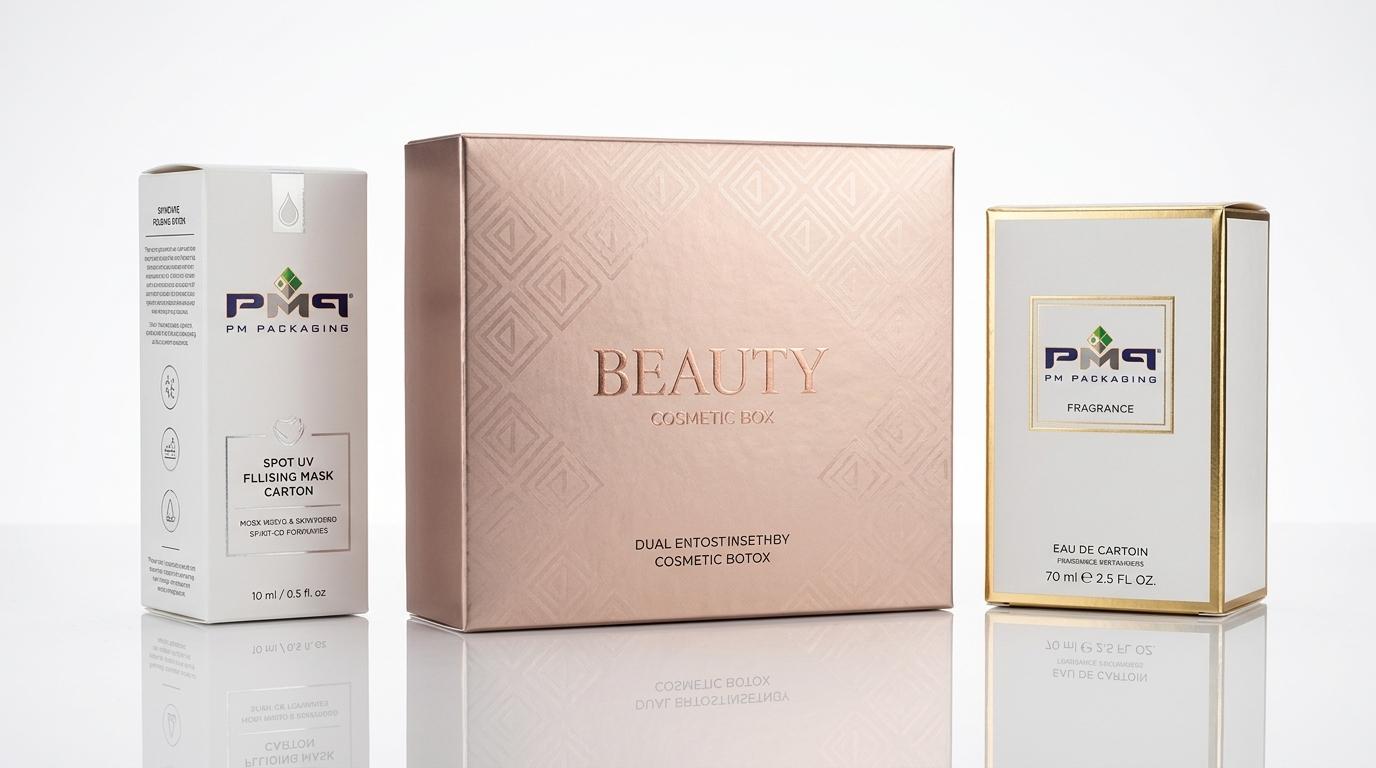
For flagship skincare regimens and perfumes, pairing foil stamping and spot UV creates compelling depth. Use hot foil as the primary anchor for the brand wordmark or active ingredient concentration, and deploy spot UV as the atmospheric layer for tone-on-tone botanical patterns across matte panels.
Tooling and Registration Considerations: Combining both finishes adds setup complexity, tighter registration requirements, additional production passes, and cost, but can produce a layered premium effect when justified by the brand design. Furthermore, coating spot UV directly over foil is not recommended because slick polyester foil provides low surface dyne energy, risking flaking. Keep foil and spot UV boundaries physically separated. For methods to balance finishes without sensory clutter, review our guide on how to create strong shelf presence without overdesigning the package.
When a Beauty Carton Needs Neither Finish
In many beauty programs, omitting both finishes creates a stronger brand statement. For zero-waste or 100% post-consumer recycled (PCR) skincare lines, unvarnished kraft or textured paperboards signal environmental commitment better than synthetic coatings. Crisp soy ink typography, sculpted blind embossing, and natural fiber textures convey organic authenticity.
Frequently Asked Questions: Beauty Carton Finishes
What is the difference between hot foil stamping and cold foil printing?
Hot foil stamping uses heated metal dies under pressure to fuse foil directly onto paperboard, delivering intense mirror reflection and sharp edges. Cold foil applies UV adhesive inline and cures instantly, enabling CMYK overprinting with slightly softer edge crispness.
Can both finishes be used on the same beauty carton?
Yes. Combining foil stamping and spot UV on the same carton creates a multi-layered premium effect—such as a reflective metallic brandmark paired with subtle spot UV patterns over a soft-touch background. However, combining them adds tooling, setup, and registration complexity, so both finishes should be kept in physically separate design zones to avoid adhesion issues.
Can you apply spot UV over foil stamping, or will it peel?
Directly coating spot UV over foil is not recommended. The slick polyester foil surface has low dyne energy, risking flaking. Best practice keeps foil and spot UV in separate, non-overlapping design zones.
How does soft-touch coating affect the visual impact of spot UV?
Soft-touch finishes create an ultra-diffuse matte background (2–5 gloss units). Gloss spot UV (85+ gloss units) creates an 80-unit specular delta, making clear varnish pop like wet liquid glass.
Will foil stamping or spot UV crack along carton score lines?
Yes, both can crack if applied over creasing scores. Foil shears as board fibers bend, while cured UV resin is brittle. Hold finish boundaries at least 1/16 inch (1.5mm) away from fold lines.
Does foil stamping make a cosmetic carton non-recyclable?
Hot stamped foil is under 0.0001 inches thick. At typical coverage under 15–20% of carton surface, foil particles separate cleanly in repulping screens, preserving paperboard recyclability.
How do tooling and order volumes affect the cost of foil stamping versus spot UV?
Foil stamping requires physical metal dies and press make-ready, which increases upfront tooling costs but becomes highly cost-effective per carton across larger production runs. Spot UV can be applied via coating plates, screen stencils, or tooling-free digital inkjet for smaller batches. Overall finishing economics depend on total coverage, number of finish locations, tooling, registration tolerance, SKU count, and whether multiple press passes are required.
Engineer Your Beauty Cartons with PM Packaging
PM Packaging can help beauty brands evaluate foil stamping, spot UV, soft-touch surfaces, embossing, and other finishing combinations based on the carton structure, artwork, production volume, and desired retail effect.
Ready to review packaging substrates and finish samples?
Our structural team will evaluate your CAD dielines and artwork files.