
Agricultural packaging has to do more than simply contain a product. It needs to protect produce and packaged goods during handling, support stacking and transportation, fit supply chain requirements, and in many cases help present the product more effectively in the market. For growers, packers, exporters, distributors, and retail-focused agricultural brands, packaging is a working part of the product strategy.
That is why customization matters.
When agricultural packaging is built using Single Face Lamination (SFL), businesses gain more than just a corrugated structure. They gain flexibility. SFL-based packaging can be customized in ways that support both performance and presentation, helping businesses align packaging with their product type, shipping demands, branding goals, and retail needs.
At PM Packaging, SFL is used to produce corrugated and microcorrugated materials with a 3-layer structure consisting of a Liner as the inner layer, a Medium as the fluted layer, and a Top Sheet as the outer layer. The process begins with the Medium being fluted and laminated to the Liner, followed by the application of the Top Sheet. This creates a packaging material that offers strength, efficiency, and strong print potential. Because PM Packaging uses offset printing rather than flexographic printing, the final result can also deliver a much higher level of graphic quality.
So what exactly can be customized in agricultural packaging made with SFL? The answer is quite a lot. From structure and flute profile to size, shape, print design, branding, and application, SFL-based packaging gives agricultural businesses a wide range of options.
Why Customization Matters in Agricultural Packaging
Agricultural products are not all packaged the same way because agricultural products do not all behave the same way. Fresh produce, specialty crops, export shipments, display-ready goods, and packaged farm products all have different packaging requirements.
One business may need a box optimized for stacking strength and long-distance transport. Another may need retail-ready packaging that presents produce attractively at shelf level. Another may want export packaging that protects the product while reinforcing its brand identity in a competitive market.
Customization matters because it allows packaging to be built around the actual application instead of forcing every product into a generic format.
With custom agricultural packaging, businesses can better align packaging with:
- Product dimensions and weight
- Handling and logistics requirements
- Storage conditions
- Display or retail goals
- Brand presentation needs
- Shipping efficiency
- Market-specific packaging expectations
SFL-based packaging is especially useful here because it combines structural flexibility with high-quality print potential.
What Is SFL in Agricultural Packaging?
Before looking at customization options, it helps to understand the structure itself.
SFL, or Single Face Lamination, is part of the process used to create corrugated and microcorrugated materials. In PM Packaging’s process, the board is built with three layers:
- Liner as the inner layer
- Medium as the fluted layer
- Top Sheet as the outer layer
The process starts by fluting the Medium and laminating it to the Liner. Once that structure is created, the Top Sheet is applied. The result is a finished board that combines strength, cushioning, and a high-quality outer printable surface.
This makes SFL especially valuable for agricultural packaging because it allows packaging to serve both structural and visual purposes. It can perform in the supply chain and still look polished in customer-facing environments.
Structural Format Can Be Customized
One of the biggest areas of customization is the overall packaging structure.
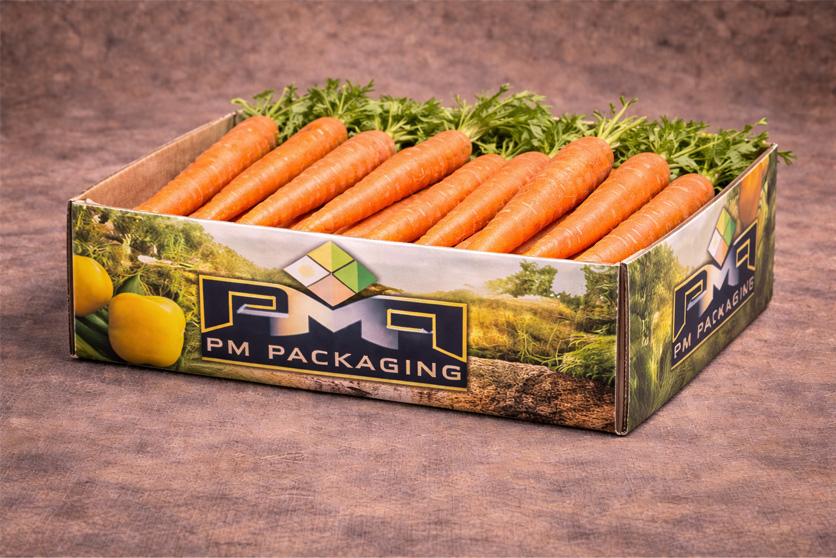
Different agricultural products need different packaging formats. A package used for bulk produce transport may require a very different structure than a package designed for retail-ready produce display. SFL-based corrugated and microcorrugated materials can be adapted into packaging structures that match the application more precisely.
Structural customization may include:
- Shipping cartons
- Produce boxes
- Display-ready cartons
- Retail-ready agricultural packaging
- Trays
- Shelf-ready packaging formats
- Specialty agricultural product packaging
The right structure depends on how the product moves through the supply chain and where the package needs to perform. For example, a package intended for palletized transport may prioritize stacking and handling efficiency, while a package meant for retail presentation may need a structure that improves visibility and accessibility.
Size Can Be Customized
Agricultural packaging should match the product and packing system as closely as possible. Oversized packaging can lead to wasted space, inefficient shipping, and poor product support. Packaging that is too small can create product stress, bruising, or packing inefficiency.
That is why size customization is so important.
With custom SFL packaging, dimensions can be developed around:
- Product size
- Product count or pack pattern
- Packing line requirements
- Pallet configuration
- Retail shelf or display fit
- Export handling needs
For agricultural businesses, right-sizing the package can improve both protection and logistics. It can reduce movement inside the package, help improve stacking performance, and support more efficient transport and warehousing.
Flute and Board Profile Can Be Customized
Because SFL is used to create both corrugated and microcorrugated materials, another key area of customization is the board profile itself.
This matters because different flute profiles can support different packaging goals.
For some applications, a more traditional corrugated structure may be the best choice because it offers stronger performance for handling, transport, and stacking. For other applications, microcorrugated packaging may offer a better balance between structural support and a more refined final appearance.
This allows businesses to choose a packaging material that fits the needs of the product, such as:
- Greater transport durability
- More refined retail presentation
- Better balance of strength and appearance
- Packaging suited to display-ready applications
- A lighter-profile structure with improved print presentation
Choosing the right board profile helps ensure the packaging performs where it needs to without adding unnecessary material or compromising the visual result.
Print Design and Graphics Can Be Customized
One of the clearest advantages of PM Packaging’s SFL-based agricultural packaging is that it can be paired with offset printing packaging instead of standard flexographic printing.
That makes graphic customization one of the most important benefits.
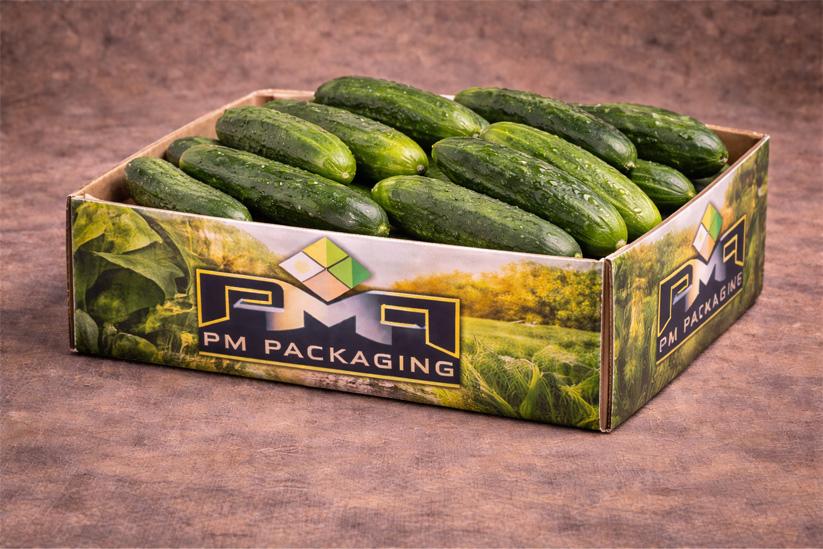
In many agricultural markets, packaging is now part of the sales presentation. Buyers, distributors, retailers, and end customers all see the package. Clean branding and strong print design can help the product look more organized, more professional, and more market-ready.
Custom print design can include:
- Brand logos
- Product names
- Color-coded product lines
- Farm or grower identity
- Product photography or illustrations
- Handling instructions
- Product information
- Promotional messaging
- Retail-oriented graphics
- Export branding elements
Because offset printing offers sharper detail, cleaner text, and stronger color consistency than flexographic printing, the package can achieve a much higher-quality visual presentation.
This is especially valuable for agricultural businesses that want packaging to do more than simply identify the product.
Branding Can Be Customized
Branding is often a major reason businesses move toward custom agricultural packaging.
A plain package may perform structurally, but a branded package can help reinforce consistency, increase recognition, and present the product more professionally across markets. This is particularly important for businesses selling into retail environments, export channels, specialty agricultural programs, or customer-facing produce markets.
Branding customization may include:
- Company logo and visual identity
- Branded color systems
- Product family differentiation
- Private label packaging
- Seasonal or campaign-based graphics
- Market-specific branding versions
For some agricultural businesses, branding is about shelf impact. For others, it is about presenting a more reliable and professional image to buyers and partners. In either case, SFL packaging with offset printing gives more room to build a cleaner and stronger brand presence.
Surface Appearance Can Be Customized
Not all agricultural packaging needs to look the same. Some packaging is purely functional. Some needs to appear more polished, display-ready, or premium. The Top Sheet and overall print presentation help influence the final visual appearance of the package.
This allows customization in how the package feels and appears in the market.
Depending on the application, businesses may want packaging that looks:
- More retail-ready
- More premium
- More natural and product-focused
- More export-professional
- More promotional
- More consistent with broader brand packaging
Because PM Packaging uses offset printing rather than flexographic printing, the surface appearance can be much cleaner and more refined. That makes it easier to customize the package toward the intended market impression.
Product Communication Can Be Customized
Agricultural packaging often needs to communicate more than just a product name. Depending on the market, the package may need to include a variety of product and handling information.
Custom communication elements may include:
- Product variety or grade
- Packing details
- Handling notes
- Destination or channel identification
- Brand story elements
- Retail-facing product messages
- Category differentiation
- Seasonal identifiers
A custom printed package makes this information easier to organize and present clearly. That can improve both operational clarity and market presentation.
For retail-ready and export packaging, this type of communication can be especially valuable because the package often serves as both a transport unit and a presentation surface.
Application Use Can Be Customized
Custom agricultural packaging is not only about what the package looks like. It is also about where and how it will be used.
SFL-based packaging can be customized around different agricultural applications, such as:
- Fresh produce packaging
- Fruit and vegetable cartons
- Export packaging
- Branded agricultural boxes
- Retail-ready packaging
- Shelf display packaging
- Specialty crop packaging
- Customer-facing agricultural product packs
Each of these uses places different demands on the package. Fresh produce may need a strong balance of protection and handling efficiency. Export packaging may require more emphasis on stacking and presentation. Retail-ready packaging may need stronger branding and cleaner visual quality.
Customization allows the packaging to fit the application instead of relying on a one-size-fits-all solution.
Logistics and Handling Needs Can Be Customized
Agricultural packaging does not only need to work in the market. It also needs to work through the supply chain. That means logistics and handling should be part of the customization process.
Custom agricultural packaging with SFL can be developed to support:
- Efficient palletization
- Better product containment
- Stronger handling performance
- More consistent stacking
- Improved warehouse or transport efficiency
- Better alignment with packing processes
For agricultural businesses, these factors matter because packaging decisions affect cost, damage rates, and operational flow. Customization helps reduce mismatch between the packaging and the actual movement of the product.
Why Offset Printing Changes the Value of Customization
Customization becomes even more meaningful when the print quality is strong enough to take advantage of it.
With flexographic printing, packaging may be functionally customized, but graphic precision can be more limited. With offset printing, customization can extend much further into branding and presentation because the finished result supports:
- Sharper imagery
- Better logo detail
- More readable text
- Cleaner color execution
- Stronger shelf appeal
- More polished design overall
For PM Packaging, this is one of the biggest differentiators in custom agricultural packaging with SFL. The packaging is not only customizable in structure. It is also customizable in a way that looks better when finished.
Why This Matters for Agricultural Businesses
For growers, exporters, distributors, and packaging decision-makers, custom agricultural packaging can have a direct business impact.
The right customization can help:
- Improve product protection
- Reduce handling damage
- Support better shipping efficiency
- Strengthen brand presentation
- Make products look more market-ready
- Improve consistency across packaging lines
- Differentiate products in retail or export channels
When packaging is better aligned with the product and the market, it does more work for the business. It becomes part of product quality, logistics performance, and customer perception.
Final Thoughts
Custom agricultural packaging with SFL offers a wide range of customization possibilities because the packaging itself is built to support both structure and presentation. At PM Packaging, Single Face Lamination is used to create corrugated and microcorrugated materials with a 3-layer structure made up of a Liner, a fluted Medium, and a Top Sheet. This creates a packaging material that can be adapted to different agricultural applications while also supporting high-quality offset printing.
So what can be customized? The answer includes structure, size, board profile, graphics, branding, communication elements, visual appearance, and application-specific performance. That flexibility allows agricultural packaging to be developed around real product and market needs instead of relying on generic solutions.
"For agricultural businesses that want packaging to protect better, present better, and work more effectively across the supply chain, custom SFL packaging offers a strong and practical advantage."
At PMPackaging.com, that means packaging can be designed not just to carry the product, but to support it more completely from pack line to market.